Yet their eventual fates were very different. While Germany was split into communist East Germany and capitalist West Germany in 1949, Austria remained a single country and regained its full independence in 1955.
This was not inevitable. For much of the decade following the war, there was a genuine possibility that Austria could suffer the same fate as Germany.
Ultimately, a combination of Austria’s political circumstances, its strategic location, Allied diplomacy and a carefully negotiated agreement on neutrality prevented its permanent division.
Austria’s defeat and occupation in 1945
Austria had been annexed by Nazi Germany in March 1938, an event known as the Anschluss. For the next seven years, Austria ceased to exist as an independent country, becoming part of Hitler’s Third Reich.
In October 1943, the United States, Britain and the Soviet Union issued the Moscow Declaration, which described Austria as the first country to fall victim to Nazi Germany’s expansionism.
The Allies committed themselves to restoring an independent Austrian state after the war.
However, the declaration also acknowledged Austria’s responsibility for participating in the Nazi war effort. This distinction is important because many Austrians had actively supported Hitler, served in German armed forces or participated in Nazi crimes.
Nevertheless, the Allied commitment to restoring Austria’s independence gave the country an important advantage over Germany, whose political future remained far more uncertain.
As the war drew to a close in April 1945, Soviet troops entered Austria from the east, capturing Vienna after heavy fighting. American, British and French forces subsequently occupied other parts of the country.
Germany surrendered in May 1945, and the Allies formalised Austria’s division into four occupation zones that summer.
How Austria was divided into four occupation zones
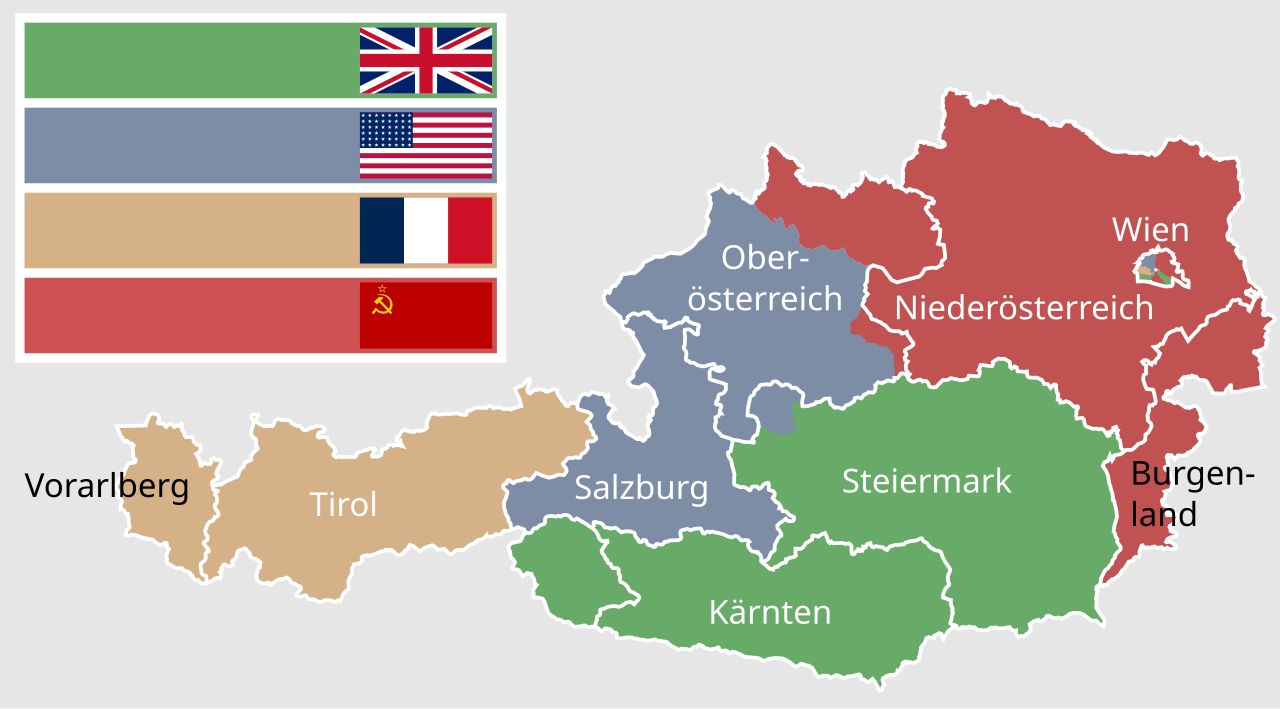
The Map at the top shows the four Allied occupation zones of Austria between 1945 and 1955.
Austria was divided between the Soviet Union, United States, United Kingdom and France, with each country administering a particular region.
- Soviet Union: Lower Austria, Burgenland and the northern part of Upper Austria
- United States: Salzburg and most of Upper Austria
- United Kingdom: Styria, Carinthia and East Tyrol
- France: North Tyrol and Vorarlberg
Vienna, although surrounded by Soviet-controlled territory, was also divided among all four powers.
The Soviet zone was particularly significant because it included much of eastern Austria, its agricultural hinterland, important industrial assets and the territory surrounding the capital.
However, unlike Germany, Austria was not divided into separate eastern and western governments. The occupation zones were administrative and military divisions, rather than independent countries.
The occupation of Vienna: A city divided in four
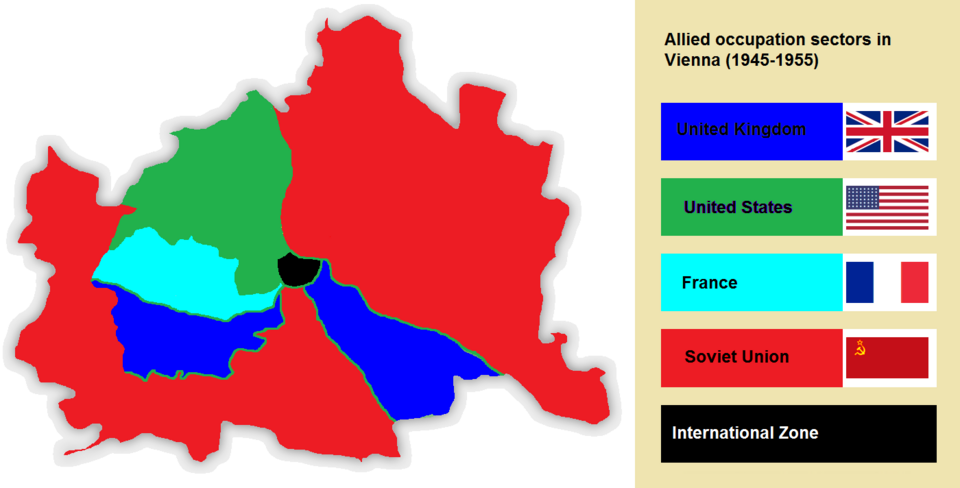
Vienna was an especially unusual case. Like Berlin, it was divided between the four Allied powers despite being geographically surrounded by Soviet-occupied territory.
The Red Army had captured the city in April 1945 and initially controlled it entirely. However, agreements reached that summer required the Soviet Union to allow American, British and French troops to enter and establish their own sectors.
The historic districts of Vienna were allocated as follows:
- Soviet sector: Districts 2, 4, 10, 20 and 21.
- American sector: Districts 7, 8, 9, 17, 18 and 19.
- British sector: Districts 3, 5, 11, 12 and 13.
- French sector: Districts 6, 14, 15 and 16.
- International sector: District 1, the historic city centre, was administered jointly by all four powers.
The most distinctive arrangement concerned Vienna’s historic centre, the Innere Stadt, which included many important government buildings. Rather than giving exclusive control to one country, the Allies agreed to administer it collectively.
Responsibility for chairing its administration rotated monthly between the four powers.
This arrangement became famous for the so-called “Four in a Jeep” patrols, consisting of one military policeman from each occupying power travelling together through Vienna.
Unlike Berlin, Vienna never developed a permanent physical barrier separating its Soviet and Western sectors. There were restrictions and occupation authorities, but the city remained connected.
What was life like in occupied Vienna?
The immediate postwar years were extremely difficult.
According to the City of Vienna, more than 20% of the city’s housing stock was partly or completely destroyed, leaving approximately 87,000 flats uninhabitable.
Food shortages, damaged infrastructure, homelessness and the disruption of basic services were widespread.
The behaviour of occupying troops also varied, but Soviet forces in particular became associated with widespread looting, sexual violence and property seizures during the initial occupation.
Over time, reconstruction gathered pace. Vienna’s population gradually resumed normal life, and Austrian political institutions were re-established. The city held democratic elections in November 1945, in which the Socialists won a majority of seats.
Importantly, Vienna continued functioning as the capital of a single Austrian republic, rather than becoming the competing capital of two separate Austrian states.
Austria’s political system remained united
One of the most important differences between Austria and Germany was what happened to their governments after the war.
In Austria, a provisional national government was established in April 1945 under Karl Renner, a veteran Social Democratic politician.
Although the Soviet Union initially played an important role in establishing and recognising Renner’s government, the Western Allies eventually accepted it as well.
National elections were held in November 1945, with the Austrian People’s Party and the Socialist Party emerging as the country’s dominant political forces.
The Austrian Communist Party won less than 6% of the national vote.
This result was particularly significant because the Soviet Union had hoped that Austrian communists could establish a much stronger political position.
Instead, Austria developed a democratic political system dominated by the centre-right and centre-left, which cooperated in coalition governments.
Although the occupying powers retained substantial authority, Austria had a functioning national government that administered the country across occupation boundaries.
A second Allied control agreement in June 1946 further expanded the Austrian government’s powers.
This made it much harder to justify establishing a separate communist government in eastern Austria.
Why wasn’t Austria split into East and West Austria?
This is the central question, and there were several interconnected reasons.
Austria was treated differently from Germany from the beginning
The 1943 Moscow Declaration had already established the principle that Austria should be restored as an independent country.
Germany, by contrast, was seen as the principal aggressor responsible for starting the war in Europe.
The Allied occupation of Germany therefore involved a more fundamental attempt to restructure the German state and prevent it from becoming a military threat again.
Austria’s situation was different. The Allies were formally committed to separating Austria from Germany and reconstructing an independent Austrian government.
Although Cold War tensions threatened this objective, it remained the official basis for the occupation.
Austria had one government; Germany developed two
The political divergence between Austria and Germany became increasingly obvious during the late 1940s.
In Germany, the Western Allies gradually integrated their occupation zones economically and politically.
In May 1949, their three zones became the Federal Republic of Germany, commonly known as West Germany.
In October 1949, the Soviet occupation zone became the German Democratic Republic, or East Germany, governed by a communist regime.
Austria never followed this path.
Even though different Allied powers controlled different parts of the country, the Austrian national government remained intact and the Soviet Union continued to recognise it.
The country had occupation boundaries but no separate eastern and western Austrian states.
Austria’s Communist Party was too weak to dominate national politics
In eastern Germany, Soviet authorities helped establish a communist-dominated political system.
In Austria, attempts to expand communist influence proved much less successful.
The Communist Party’s poor performance in the 1945 elections demonstrated that it lacked widespread popular support, including in Soviet-occupied regions.
Furthermore, non-communist parties were permitted to operate in the Soviet zone.
The Soviet Union certainly retained the military ability to interfere with Austrian politics, but turning eastern Austria into a communist satellite would have required a much more forceful break with the existing arrangements.
This political reality helped Austria avoid the institutional separation that developed in Germany.
Austria was strategically less important than Germany
Germany was the central prize in the emerging Cold War.
It was Europe’s largest industrial power, occupied a critical geographical position, and was essential to the military and economic security of both the Western and Soviet blocs.
Austria was strategically important too, particularly because of its position between Germany, Italy, Yugoslavia and Soviet-controlled Eastern Europe.
However, its smaller population, economy and military significance made a negotiated settlement more manageable.
For the Soviet Union, an independent but neutral Austria could offer something valuable: a buffer separating Western-aligned countries from parts of the communist bloc.
Rather than retaining eastern Austria indefinitely, Moscow could potentially achieve its security objectives by ensuring that the whole of Austria remained outside NATO.
Neutrality provided a compromise both sides could accept
Ultimately, this was the decisive breakthrough.
Austria’s political leaders wanted the occupying armies to leave and were willing to make concessions to secure independence.
The Western powers wanted to prevent Austria from falling under Soviet domination.
The Soviet Union wanted to prevent Austria from becoming another NATO member on its borders.
A permanently neutral Austria provided a compromise: the Soviet Union would withdraw its troops, but Austria would promise not to join a military alliance with the West.
A neutral, independent country was preferable to permanent division for Austrian leaders, while Moscow could accept losing its occupation zone without seeing the territory incorporated into NATO.
The compromise also enabled Soviet leaders to demonstrate a willingness to negotiate during a period of intense Cold War rivalry.
The Austrian State Treaty of 1955
The breakthrough came following the death of Joseph Stalin in March 1953 and a gradual change in Soviet diplomatic policy.
Negotiations had been taking place for years, but disagreements over security, Soviet-controlled assets and Austria’s future international position repeatedly prevented an agreement.
In April 1955, Austrian Chancellor Julius Raab travelled to Moscow with an Austrian delegation.
On 15 April, the Austrian and Soviet representatives reached an understanding that Austria would become permanently neutral in return for Soviet agreement to end the occupation.
Just one month later, on 15 May 1955, Austria and the four occupying powers signed the Austrian State Treaty at the Belvedere Palace in Vienna.
The treaty restored Austria’s full sovereignty and provided for the withdrawal of foreign troops. It also prohibited another union between Austria and Germany.
The agreement involved economic concessions as well. Austria agreed to compensate the Soviet Union for former German-owned assets, including a payment of $150 million, alongside arrangements involving oil and other assets.
A particularly important detail is that Austria’s neutrality was not actually written into the State Treaty itself. Instead, it was a separate political commitment made during negotiations.
The principal milestones were:
- 15 April 1955: Austrian-Soviet agreement reached in Moscow
- 15 May 1955: Austrian State Treaty signed in Vienna
- 27 July 1955: Treaty entered into force
- October 1955: Allied occupation troops completed their withdrawal
- 26 October 1955:Austrian Parliament adopted permanent neutrality
- 14 December 1955: Austria joined the United Nations
Austria’s neutrality meant that it would not join military alliances or permit foreign military bases on its territory.
The date of its neutrality law, 26 October, subsequently became Austria’s National Day.
Why couldn’t Germany simply follow Austria’s example?
The Austrian settlement inevitably raised the question of whether Germany could be reunited under a similar arrangement.
In principle, a neutral and reunified Germany was discussed during the Cold War.
However, there were major obstacles.
By 1955, East Germany and West Germany had already developed into separate states, with different political systems, economies, military arrangements and international allegiances.
West Germany joined NATO in May 1955, making it an important part of the Western military alliance.
East Germany, meanwhile, had become deeply integrated into the Soviet sphere of influence.
Unlike Austria, where an existing national government could simply regain full sovereignty, German reunification would have required dismantling two competing political systems and agreeing on the international status of a much larger and more powerful country.
For Western governments, there were also concerns that a neutral Germany might become vulnerable to Soviet political influence.
For Moscow, a unified Germany closely aligned with the West was unacceptable.
Consequently, the Austrian solution did not translate easily to Germany. German reunification would have to wait until 1990, 35 years after Austria regained its independence.
Conclusion: Why Austria avoided Germany’s fate
Austria avoided a permanent East-West division because its circumstances were fundamentally different from Germany’s, despite their superficially similar occupations.
The Allies had committed themselves to restoring an independent Austrian state before the war ended. Austria also managed to preserve a single democratic government across all four occupation zones, while the country’s communist movement failed to establish the political dominance seen in eastern Germany.
Most importantly, the Soviet Union eventually accepted that a neutral Austria could satisfy its security interests without requiring the continued occupation of the country’s eastern half.
The result was an unusual Cold War compromise: a country occupied and divided between the Soviet Union and the Western powers that regained its independence without becoming two separate states.
Austria’s experience demonstrates that the division of Europe after 1945 was not entirely predetermined.
Germany remained divided for another 35 years, but Austria showed that, under the right political and diplomatic circumstances, even the Soviet Union could agree to withdraw from territory it had occupied at the end of the Second World War.
Sources and further reading
- The Soviet Occupation of Austria: The National WWII Museum. An overview of the Soviet occupation, wartime background, postwar conditions and the political situation.
- The Years of the Allied Forces in Vienna (1945–1955): City of Vienna. Details on Vienna’s occupation, reconstruction, administration and return to democracy.
- Occupation of Austria 1945–1955: Austria-Forum. An account of the occupation zones, Vienna’s district divisions and Allied administration.
- 1955 – Staatsvertrag und Neutralität: Austrian Parliament (German). Explains the State Treaty, Austria’s responsibility for the Nazi period and the neutrality settlement.
- Austrian State Treaty, 1955: US Department of State. An official historical account of the negotiations, treaty and Austria’s neutral status.
- A Cold War over Austria: The Struggle for the State Treaty, Neutrality, and the End of the East-West Occupation, 1945–1955: Cold War Studies at Harvard University. A summary of the scholarly history by Gerald Stourzh and Wolfgang Mueller, particularly useful for understanding why the occupation lasted ten years and how it ended.
- US Diplomatic Records on Soviet Policy in Austria: US Department of State, Foreign Relations of the United States. A contemporary diplomatic assessment of Soviet objectives and how Austria’s occupation differed from Germany’s.
- The Army and the Occupation of Germany: National Army Museum. Useful for comparing Austria’s postwar experience with the emergence of East and West Germany in 1949.
- Austrian State Treaty – Official Legal Text: Republic of Austria’s Legal Information System (German). The treaty itself, including its provisions on Austrian sovereignty and the prohibition of another Anschluss.
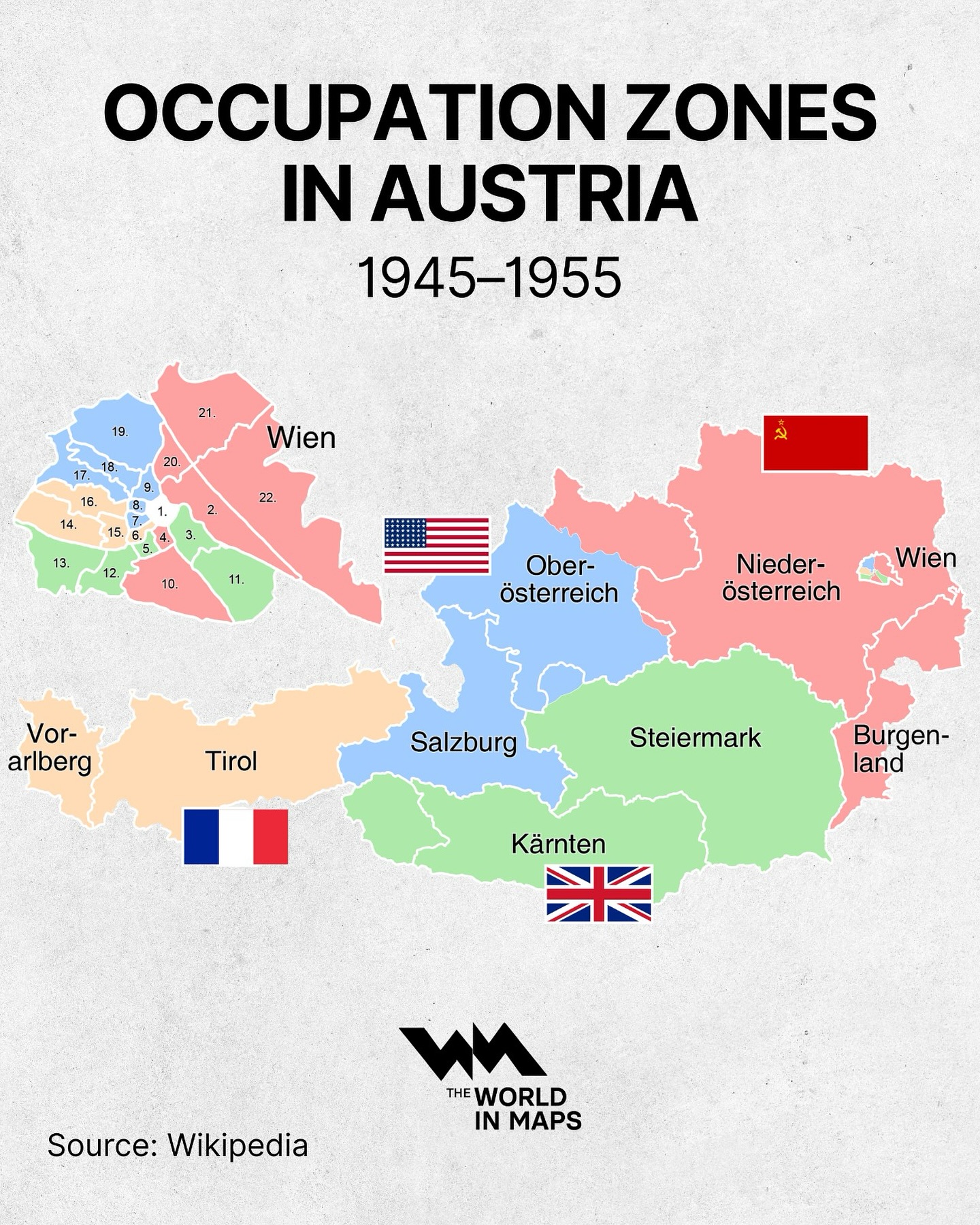
Another version of the map from the top:




Leave a Reply