
The map above shows an interesting fact. While the majority of Sikhs live in India and Sikhism itself comes from there, the country with the highest share of Sikhs is not India but Canada.
The map below shows that only 3 countries have a Sikh population above 1%:
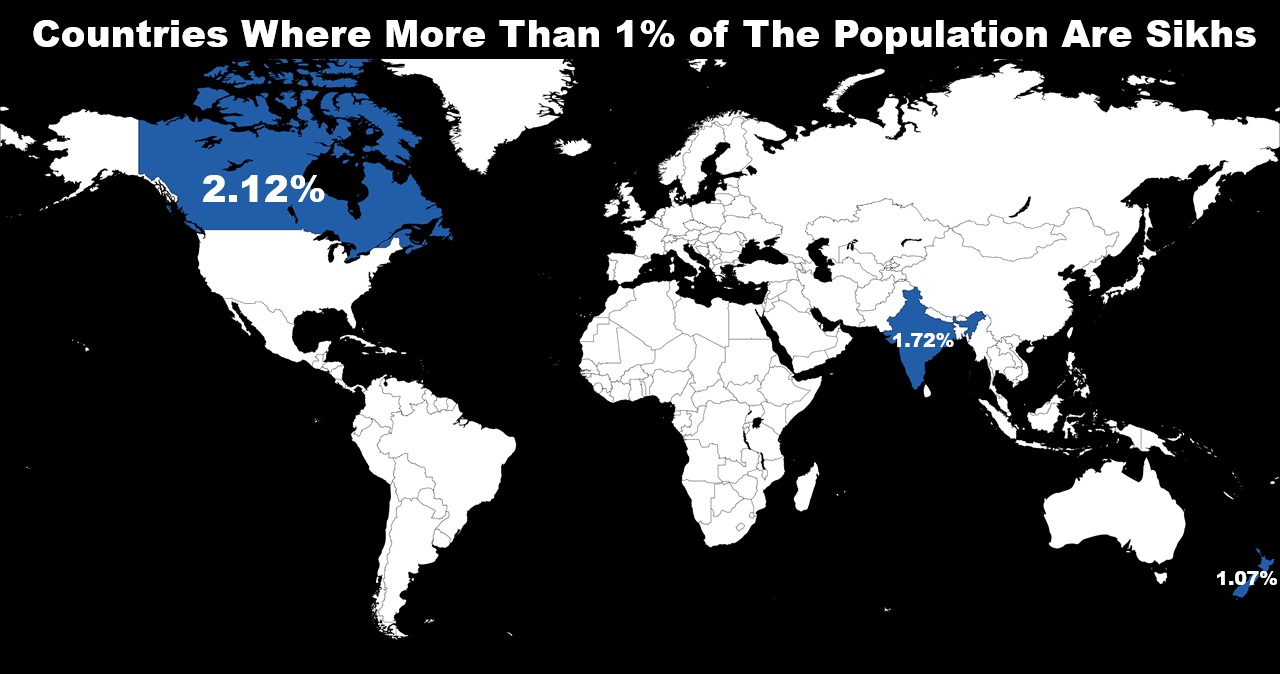
The numbers for the maps come from Wikipedia which gives:
| Country | No. of Sikhs | Sikh % | % of all Sikhs |
|---|---|---|---|
| India | 20,833,116 | 1.72% | 88.72% |
| Canada | 771,790 | 2.12% | 3.29% |
| United Kingdom | 524,529 | 0.85% | 2.23% |
| United States | 280,000 | 0.08% | 1.19% |
| Italy | 220,000 | 0.37% | 0.94% |
| Australia | 210,400 | 0.83% | 0.90% |
| Malaysia | 100,000 | 0.30% | 0.43% |
| Thailand | 70,000 | 0.10% | 0.30% |
| New Zealand | 53,406 | 1.07% | 0.23% |
| United Arab Emirates | 52,000 | 0.56% | 0.22% |
| Portugal | 35,000 | 0.34% | 0.15% |
| Oman | 33,704 | 0.75% | 0.14% |
| France | 30,000 | 0.04% | 0.13% |
| Philippines | 28,436 | 0.03% | 0.12% |
| Spain | 26,000 | 0.05% | 0.11% |
| Greece | 20,000 | 0.19% | 0.09% |
| Germany | 18,000 | 0.02% | 0.08% |
| Pakistan | 15,998 | 0.01% | 0.07% |
| Kuwait | 15,000 | 0.35% | 0.06% |
| Netherlands | 15,000 | 0.08% | 0.06% |
| Indonesia | 15,000 | 0.01% | 0.06% |
| South Africa | 13,000 | 0.02% | 0.06% |
| Singapore | 12,051 | 0.35% | 0.05% |
| Hong Kong | 12,000 | 0.16% | 0.05% |
| Belgium | 10,000 | 0.09% | 0.04% |
| Austria | 9,000 | 0.04% | 0.04% |
| Saudi Arabia | 6,700 | 0.02% | 0.03% |
| Kenya Kenya | 6,000 | 0.01% | 0.03% |
| Norway | 4,080 | 0.08% | 0.02% |
| Denmark | 4,000 | 0.07% | 0.02% |
| Sweden | 4,000 | 0.04% | 0.02% |
| Fiji | 2,577 | 0.31% | 0.01% |
| Uganda | 2,400 | 0.01% | 0.01% |
| Ireland | 2,183 | 0.04% | 0.01% |
| Nepal | 609 | 0.00% | 0.00% |
| Panama | 302 | 0.01% | 0.00% |
| Argentina | 300 | 0.00% | 0.00% |
| Brazil | 300 | 0.00% | 0.00% |
| Georgia | 200 | 0.01% | 0.00% |
| Trinidad and Tobago | 150 | 0.01% | 0.00% |
| Afghanistan | 140 | 0.00% | 0.00% |
| Iceland | 100 | 0.03% | 0.00% |
| Iran | 100 | 0.00% | 0.00% |
| Bangladesh | 23,000 | 0.01% | 0.10% |
| Cyprus | 2,260 | 0.24% | 0.01% |
| Total | 23,482,831 | 0.29% | 100.00% |
More about Sikhs:
Who are Sikhs?
Sikhs are followers of Sikhism, a monotheistic religion that began in the Punjab region of South Asia in the late 15th century. Sikh identity is both religious and cultural, centred on equality, service, and devotion to one God.
The word “Sikh” means “learner” or “disciple”.
Core Beliefs of Sikhism
Sikhism emphasizes a simple but powerful set of principles:
One God
- Belief in one formless, eternal God
- God is universal—beyond religion, gender, or ethnicity
Equality of All People
- Rejects caste, class, and gender inequality
- Everyone is equal before God
Honest Living & Service
- Earn a living honestly (kirat karo)
- Share with others (vand chhako)
- Remember God (naam japo)
Community & Service (Langar)
- Free communal meals served to all in Sikh temples (gurdwaras)
- Symbolizes equality and service
The Five Ks (for initiated Sikhs, the Khalsa)
- Kesh (uncut hair)
- Kara (steel bracelet)
- Kanga (comb)
- Kachera (special shorts)
- Kirpan (ceremonial sword)
Founding & History
Guru Nanak (1469–1539)
- Founder of Sikhism
- Taught unity of God, rejection of ritualism, and equality
- His teachings are recorded in the Guru Granth Sahib
The Ten Gurus
- Sikhism was developed by a line of 10 human Gurus
- The last Guru, Guru Gobind Singh, founded the Khalsa in 1699:
- A community of initiated Sikhs committed to justice and discipline
- Formalized Sikh identity (including the Five Ks)
Guru Granth Sahib
- After Guru Gobind Singh, the scripture became the eternal Guru
- Central to Sikh worship and life
Sikh History: Conflict & Empire
- Sikhs faced persecution under the Mughal Empire
- Became militarized to defend their faith and communities
- Established the Sikh Empire (1799–1849) under Maharaja Ranjit Singh
- Based in Punjab
- Known for religious tolerance and strong governance
- Later annexed by the British after the Anglo-Sikh Wars
Sikhism in the Modern Era
Partition of India (1947)
- Punjab was split between India and Pakistan
- Many Sikhs migrated to India
- Caused major displacement and violence
Post-independence
- Sikh population concentrated in Indian Punjab
- Diaspora expanded globally
Why Do So Many Sikhs Live in Canada?
Canada has one of the largest Sikh populations outside India (~800,000+).
Here’s why:
Early Migration (Late 1800s–Early 1900s)
- Sikhs (mostly Punjabi men) arrived in British Columbia
- Worked in logging, railways, and farming
British Empire Connection
- India and Canada were both part of the British Empire
- Easier migration pathways initially
Immigration Policy Changes (1960s onward)
- Canada removed race-based immigration restrictions
- Opened doors for skilled migrants and families
Family Sponsorship
- Early migrants brought relatives → strong chain migration
Economic Opportunities
- Jobs, education, and stability attracted more migrants
Multicultural Policy
- Canada officially embraces multiculturalism
- Sikhs can maintain identity (e.g., turbans allowed in police, military)
Community Networks
- Strong Sikh institutions (gurdwaras, cultural groups)
- Cities like Surrey, Brampton, and Vancouver became hubs
Sikh Identity Today
Sikhs are known for:
-
- Visible identity (turbans, uncut hair)
- Strong emphasis on charity and service
- Active political and social engagement in diaspora countries
Sikh communities are highly influential in Canada:
-
- Sikh politicians, ministers, and community leaders
- One of the fastest-growing religious groups in the country




Leave a Reply