
It also revels a very interesting fact. None of them has ever crossed the equator. But why?
Tropical cyclones, known as hurricanes in the Atlantic and Northeast Pacific, typhoons in the Northwest Pacific, and simply cyclones in the South Pacific and Indian Ocean (see map here), have never been observed to cross the equator.
This phenomenon is primarily due to the Earth’s rotation and the resulting Coriolis effect, which is essential for the formation and maintenance of these storms.
Reasons Why Tropical Cyclones Don’t Cross the Equator:
Coriolis Effect is Zero at the Equator:
- The Coriolis effect arises from the Earth’s rotation and causes moving air to deflect to the right in the Northern Hemisphere and to the left in the Southern Hemisphere.
- At the equator, the Coriolis force is essentially zero. This means there is no force to initiate or maintain the rotation of a cyclone.
- Reference: National Oceanic and Atmospheric Administration (NOAA) states, “Because of the lack of Coriolis force at the equator, tropical cyclones rarely form within 5 degrees of the equator.”
Opposite Rotation in Different Hemispheres:
- Cyclones rotate counterclockwise in the Northern Hemisphere and clockwise in the Southern Hemisphere due to the Coriolis effect.
- Crossing the equator would require a cyclone to reverse its rotation, which is dynamically unfavorable and practically impossible.
- Reference: The American Meteorological Society explains, “The reversal of the Coriolis parameter at the equator inhibits tropical cyclones from crossing it.”
Lack of Supporting Wind Patterns:
- The Intertropical Convergence Zone (ITCZ) near the equator has prevailing winds that do not favor the movement of cyclones across the equator.
- The atmospheric conditions are not conducive to supporting the structure of a cyclone in this region.
- Reference: World Meteorological Organization notes, “The general circulation near the equator does not support the development or movement of tropical cyclones across it.”
Additional Information:
- Formation Latitude: Tropical cyclones typically form between 5 and 20 degrees latitude north or south of the equator.
- Rare Near-Equator Storms: While extremely rare, there have been instances of cyclones forming close to the equator but none have been documented to cross it.
- Dynamic Constraints: The physical laws governing atmospheric motion make it highly unlikely for a cyclone to survive the crossing even if it somehow reached the equator.
The absence of the Coriolis effect at the equator, the requirement for cyclones to reverse rotation when crossing hemispheres, and unfavorable wind patterns all contribute to why hurricanes and typhoons do not cross the equator.
These dynamic atmospheric conditions make it practically impossible for such storms to maintain their structure and energy while crossing.
Why are there so few hurricanes/cyclones in South America and the West Coast of Africa?
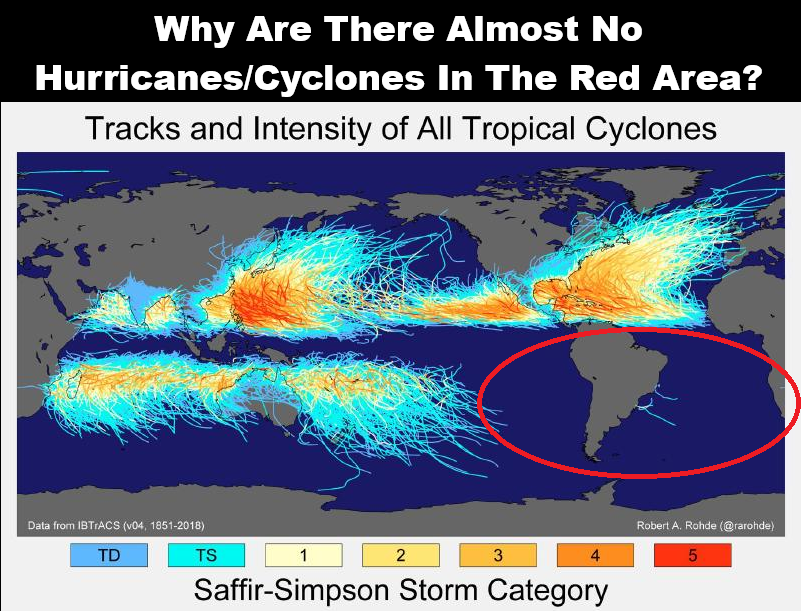
It mostly comes down to ocean temperature, prevailing winds, wind shear, and the Coriolis effect (see above). South America and the west coast of Africa happen to sit in parts of the tropics that are generally hostile to tropical cyclones.
On the west coast of Africa, there is an interesting twist: a huge number of Atlantic hurricanes actually begin there. Disturbances called African easterly waves move off countries such as Senegal, Guinea and Cape Verde and can develop into hurricanes.
But once offshore, the trade winds normally carry them westward, away from Africa and toward the Caribbean or North America.
The coastal waters themselves are also often relatively cool. The Canary Current cools the northwest African coast, while the Benguela Current brings very cold water northward along Namibia and Angola.
Hurricanes normally need sea-surface temperatures of roughly 26–27°C or warmer over a substantial depth, so these currents greatly reduce the area where storms can intensify.
South America has an even bigger disadvantage. The tropical South Atlantic is one of the least favourable cyclone basins on Earth. Several factors combine:
- Strong vertical wind shear often tears developing storms apart.
- The South Atlantic generally has fewer favourable tropical disturbances to act as cyclone “seeds.”
- Much of the water off Brazil is less favourable than equivalent latitudes in the Caribbean or western Pacific.
- Near the equator, the Coriolis effect is too weak to give storms enough rotation. Tropical cyclones rarely form within about 5° latitude of the equator.
- South Atlantic atmospheric circulation tends not to produce the same combination of moist air, low pressure and weak shear found in major hurricane regions.
That’s why the east coast of South America almost never gets hurricanes, although it isn’t impossible. The famous exception was Hurricane Catarina, which struck southern Brazil in March 2004, the first hurricane-strength tropical cyclone known to make landfall in the South Atlantic.
There’s also a neat geographical contrast:
- West coast of Africa → storms tend to travel away from the continent.
- East coast of North America → those same storms can eventually travel toward the continent.
- And on the Pacific coast of South America, hurricanes are essentially absent because the Humboldt (Peru) Current makes the ocean extremely cold.
Even places near the equator, such as coastal Peru, can have sea temperatures far below what a hurricane requires.
You can also watch a video of every storm below:


Y.D. Robinson says
If one notices carefully, these tropical super-storms are quite rare in South America, certainly off the west coast where the cold Humboldt Current flows almost to the equator, but even off the east coast where the currents through the tropics anyway are warmer. It’s the eastward bulge of South America that steals most of the potential cyclone-forming warm currents away from South America and instead towards North America.
Also, due to the cold Benguela Current, there aren’t any cyclones forming off the west coast of southern Africa.
André Mulder says
Not passing the equator is due to the effect of corriolis as you state, but is there an additional factor in the form of the season. Hurricanes need warm water and when the northern hemispheer is warmest in fall, the southern waters have than lost a lot of their energy. Making the formation of tropical storms difficult.