
Also see: Map Showing The Devastation Of The Great Fire Of London Over Modern London.
As for the image above:
Drawing commissioned by the Sunday times Colour Magazine to celebrate the 350th anniversary of Sir Christopher Wren’s birth. It attempts to illustrate how the City of London might have looked had Wren’s plan for the rebuilding after the Great Fire of 1666 been adopted. The drawing moves buildings that were built to their nearest location on his plan.
The map below shows what his plan was:
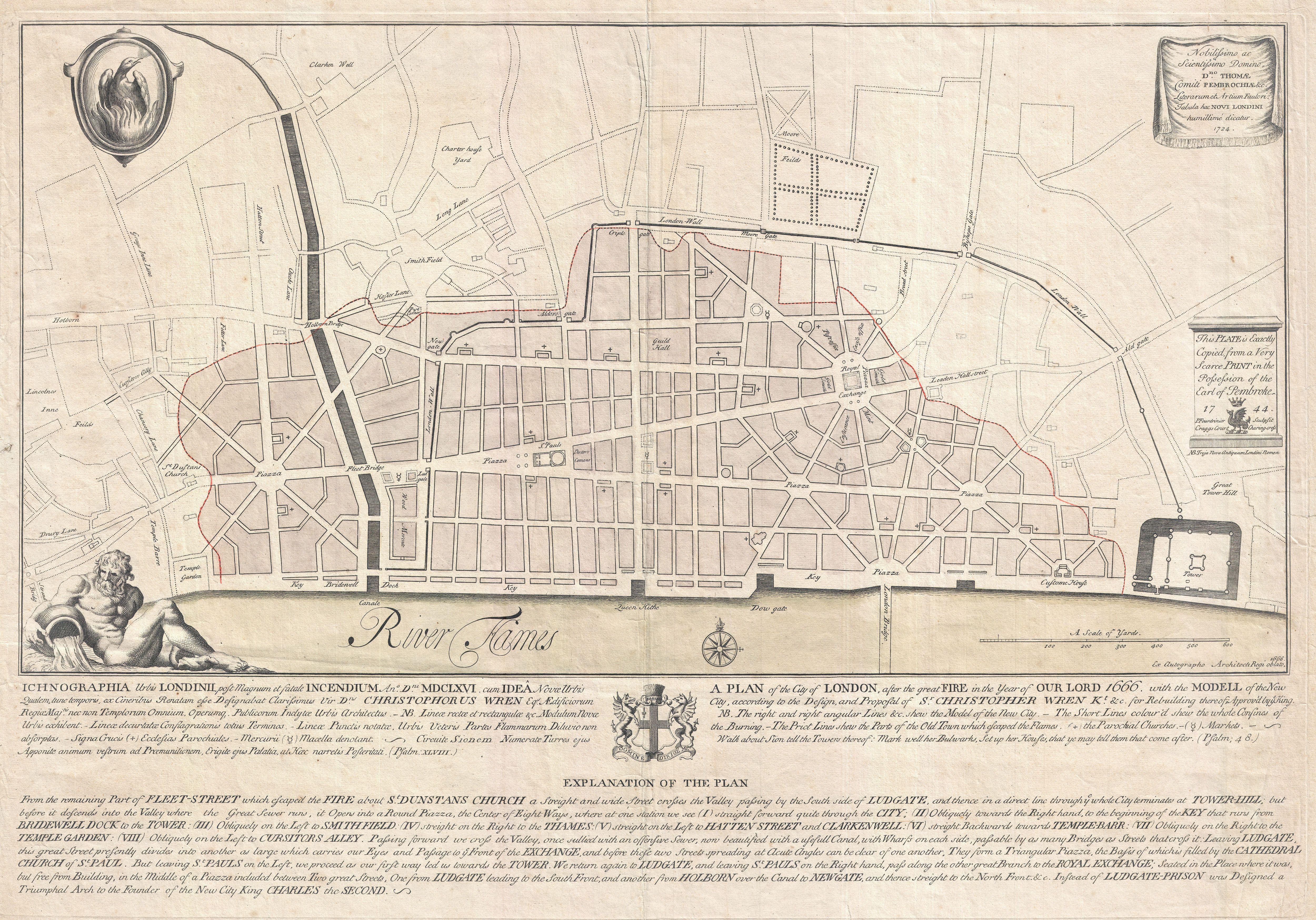
An extremely scarce 1744 map of London showing Sir Christopher Wren’s plan for reconstructing the city following the 1666 Great Fire of London. In 1666 the Great Fire swept through the old Roman portions of London, laying waste to most of the original walled city.
Christopher Wren, a well known architect of the period was quick to respond to the disaster as a opportunity to dramatically redesign and modernize London’s center.
Wren having been schooled in Paris envisioned an elaborate classically influenced reconstruction of the city with broad avenues meeting in a series of Piazzas. Despite, or perhaps because of, Wren’s promptitude in producing a plan for a major post-fire reconstruction, his plan exhibits a number of dramatic errors.
Wren did not take the city’s topography into account and consequently much of the this plan is unfeasible. Despite claims to the contrary in the document itself, Wren’s plan was never seriously considered by either the King or the Parliament.
Today Wren’s original 1666 plan is lost. This version was drawn in 1744 by the once fashionable engrave P. Fourdrinier, who claims to have replicated exactly a scarce 1724 original owned by the Earl of Pembroke.
This map covers London along the north side of the Thames River from Strand Bridge to Great Tower Hill. Shows Wren’s detailed reconstruction plan, along with the regions originally destroyed by the Great Fire.
Identifies the proposed locations of parochial churches, markets, piazzas, bridges and warehouses. A vignette in the lower left quadrant depicts Thamesis, the river god for which the Thames River is named.
The upper left quadrant bears the image of a phoenix, suggesting that, like the mythical bird, London too would rise from its own ashes and be reborn in fire.
The lower quadrants of this plate include the map’s title in both English and Latin as well as a detailed Explanation of the Plan. This plan is highly uncommon and rarely appears outside of institutional collections.
However, Wren wasn’t the only one with a plan. Sir John Evelyn also produced this plan:
Sir John Evelyn’s plan for rebuilding the city of London after the Great Fire in 1666

Rebuilding The City of London After The Great Fire
Several architects and thinkers proposed plans to rebuild London in ways that would prevent such a disaster from happening again, with a cleaner, more organized, and more visually impressive layout.
Among the most notable proposals were those from Sir Christopher Wren and Sir John Evelyn.
Sir Christopher Wren’s Plan
Wren, who would later design St. Paul’s Cathedral and become a major architect of London, envisioned a grand, modernized city.
His plan proposed wide, straight streets in a grid layout, a central square, and an organized, logical layout inspired by the Renaissance urban ideals, similar to cities like Paris and Rome.
Wren aimed to reduce congestion, create open spaces, and incorporate the Thames as a central feature, creating a more organized and aesthetically appealing capital city.
Sir John Evelyn’s Plan
Evelyn, a contemporary of Wren and a notable writer and gardener, also developed a plan for rebuilding the city.
Like Wren’s, Evelyn’s plan focused on a neater, grid-like street structure to prevent the narrow, winding streets that had helped the fire spread.
Evelyn’s design included broader streets, with special attention to sanitation, fire prevention, and orderly layouts.
Why These Plans Weren’t Implemented
Although both plans were visionary, practical challenges prevented their adoption:
- Land Ownership and Property Rights: Both Wren and Evelyn’s plans required a total reorganization of property lines, which meant seizing and redistributing land on a massive scale. However, land ownership in London was complex, and the government faced resistance from landowners unwilling to give up or significantly alter their property.
- Financial Constraints: Rebuilding London from scratch as Wren and Evelyn suggested would have been incredibly expensive. The fire had already devastated London financially, and without centralized funding or the ability to raise sufficient funds from property owners, the government could not support such ambitious plans.
- Urgency for Rebuilding: The need for swift reconstruction led people to rebuild as quickly as possible, often without waiting for a larger, organized effort. People wanted to return to their homes and businesses, so the city began to rebuild along old property lines and familiar street patterns out of necessity.
How Londoners Rebuilt Instead
In the absence of a comprehensive plan, Londoners rebuilt on their existing plots, following the old medieval street patterns.
Although the government enacted new building regulations to prevent future fires—such as requiring buildings to be constructed from brick or stone instead of wood and establishing a street-widening code—the city retained much of its pre-fire layout.
This pragmatic, piecemeal rebuilding resulted in a city that still had narrow, winding streets but was less vulnerable to fire due to improved building materials and some enhanced infrastructure.






Leave a Reply