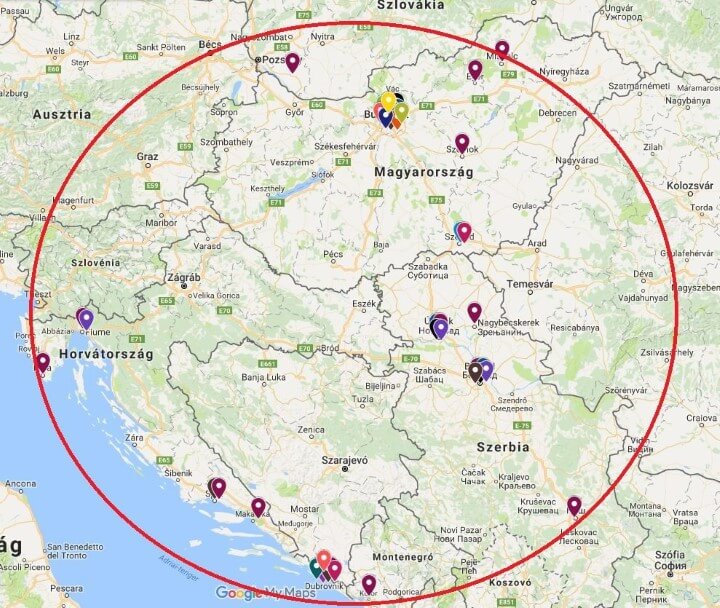
As the map above shows, since 2000, every single Men’s Water Polo Olympic Gold Medallist was born within the marked area of the circle.
The map was made after the 2016 Olympics so may no longer be 100% correct. However, given Serbia has won the gold medals in 2020 and 2024 it’s still likely to be mostly correct.
Winning counties have been:
- 2000 – Hungary
- 2004 – Hungary
- 2008 – Hungary
- 2012 – Croatia
- 2016 – Serbia
- 2020 – Serbia
- 2024 – Serbia
And in terms of birth places up to 2016, here are the numbers from each city and town:
- 15 from Budapest
- 8 from Dubrovnik
- 5 from Belgrade
- 4 from Novi Sad
- 2 each from Szeged, Rijeka, and Split
- 1 each from Miskolc, Dunajská Streda, Eger, Szolnok, Nis, Zrenjanin, Makarska, Pula, and Kotor
Why are Hungary, Croatia and Serbia so good at Water Polo?
The remarkable success of Hungary, Croatia, and Serbia in water polo isn’t accidental—it’s the result of a rich blend of history, culture, infrastructure, and systemic support for the sport.
Here are some key factors:
- Deep-Rooted Tradition and National Identity
- Hungary: Water polo is almost a national sport in Hungary. With a legacy that spans over a century, Hungarian water polo has produced numerous Olympic medals and world championships. This tradition permeates every level of the sport, from grassroots to elite competitions.
- Croatia and Serbia: Both countries have inherited a strong water polo tradition from the former Yugoslavia, which was itself a powerhouse in the sport. Today, water polo remains a major part of national pride and identity, fueling consistent support and participation.
- Robust Youth Development and Training Systems
- All three countries invest heavily in developing young talent. Local clubs and national programs scout and nurture players from an early age, ensuring that the sport’s high standards are maintained across generations.
- The emphasis on technical skills, tactical awareness, and physical conditioning in training regimens creates a solid foundation that prepares athletes for the international stage.
- Strong Domestic Leagues and Competitive Environment
- The competitive domestic leagues in Hungary, Croatia, and Serbia provide players with regular, high-level competition. This consistent exposure to intense matches not only sharpens skills but also builds mental toughness.
- Fierce rivalries, both domestically and regionally, drive continuous improvement and innovation in playing styles and strategies.
- World-Class Coaching and Tactical Innovation
- Experienced coaches in these nations have developed specialized training methodologies that emphasize teamwork, strategy, and technical precision.
- Continuous tactical innovation—refining offensive and defensive systems—has helped these countries remain at the forefront of the sport.
- Cultural and Environmental Factors
- A strong swimming culture and ample access to aquatic facilities create a natural environment for water sports to flourish.
- Community support, media coverage, and public interest in water polo help sustain its popularity, ensuring that both the sport and its athletes receive the recognition and resources they deserve.
If you’d like to learn more about Water Polo, you may enjoy the following books:
- Secrets Of A Serbian Water Polo Coach
- Swimming Through Life: Terry Schroeder and the USA Olympic Men’s Water Polo Team
- The Water Polo Psychology Workbook: How to Use Advanced Sports Psychology to Succeed in the Water Polo Pool
- More Water Polo related products on Amazon
Enjoy this post? Please help us by sharing it:




Peter Adamkovics says
“While Eastern Europe may not dominate the overall medal table at the Summer Olympics, they do pretty well at Water Polo.”
except that’s not “Eastern Europe”
the eastern edge of Europe is roughly 1000 miles east of the center of that circle, and the west coast of France is also about 1000mi from there.
you’d think a site called “brilliantmaps.com” would realize this.
Sven F. says
Yes, that is still true, after the 2024 Olympics.
(Sources: English Wikipedia “team rosters” for those tournaments, and the respective players’ articles.)
Brilliant Maps says
Amazing, thanks for looking it up!