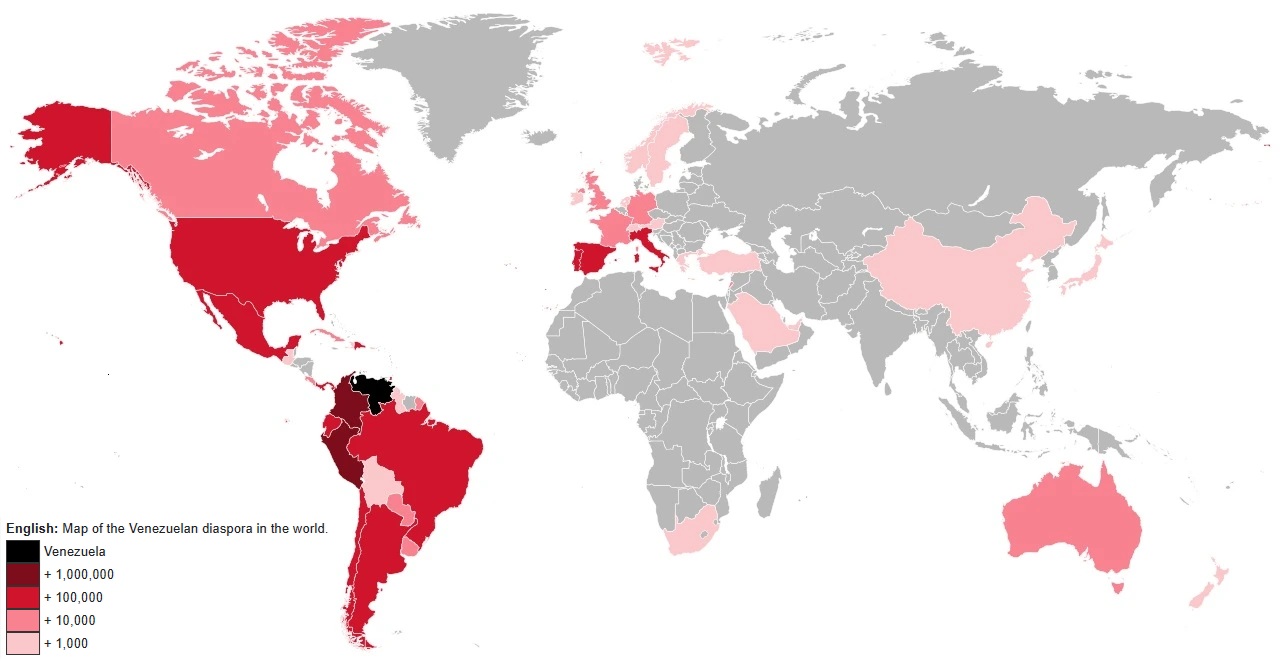
The map above shows the estimated number of Venezuelan’s living in other countries around the world. The table below gives an estimate by country:
| Colombia | 2,820,000 |
|---|---|
| Peru | 1,662,889 |
| United States | 1,168,271 |
| Chile | 728,586 |
| Brazil | 626,885 |
| Spain | 518,918 |
| Ecuador | 500,000 |
| Argentina | 162,495 |
| Dominican Republic | 124,100 |
| Portugal | 100,000 |
| Panama | 94,400 |
| Trinidad and Tobago | 78,849 |
| Syria | 60,000 - 200,000 |
| Italy | 59,000 - 150,000 |
| Mexico | 53,000 |
| Uruguay | 33,000 |
| France | 30,000 |
| Canada | 28,395 |
| Germany | 20,000 |
| French Guiana | 19,000 |
| Bolivia | 18,940 |
| Aruba | 17,000 |
| Curaçao | 17,000 |
| United Kingdom | 15,000 |
| Cuba | 15,000 |
| Lebanon | 12,000 |
| Australia | 10,000 |
| Ireland | 5,000 |
| Paraguay | 4,000 |
| Puerto Rico | 3,108 |
| Costa Rica | 3,000 |
| Guyana | 3,000 |
| United Arab Emirates | 2,500 |
| Sweden | 2,274 |
| New Zealand | 2,000 |
| Denmark | 1,325 |
| China | 1,000 |
| Netherlands | 1,000 |
| Saudi Arabia | 1,000 |
| South Africa | 1,000 |
| Bonaire | 713 |
| Sint Maarten | 600 |
Venezuela’s population is around 30 million people and the total diaspora population is around 8 million which means around 21% of Venezuelan’s don’t live in Venezuela.
Below is another map from The.World.In.Maps which uses slightly different numbers to show the top 10 countries:

From the author:
The Venezuelan diaspora has now surpassed 8 million people worldwide, making it one of the largest displacement crises on the planet.
This map shows the top 10 countries hosting Venezuelan communities, based on recent data compiled by GeoPolaris.
While migration flows have slowed since the peak years (2017–2023), the overall numbers continue to rise in countries like Chile, Peru, the U.S., Brazil, and Spain. In contrast, places like Colombia, Ecuador, and Argentina have seen a slight decline or stabilization.
The data comes from a mix of official sources, including national statistics offices and international platforms such as R4V, UNDESA, and INEGI.
It’s important to note that many countries have not yet updated their figures for 2024–2025, so the full picture is still evolving.
Despite data gaps, the trend is clear: Venezuelan migration continues to reshape communities across Latin America and beyond.





Leave a Reply