
From the map authors:
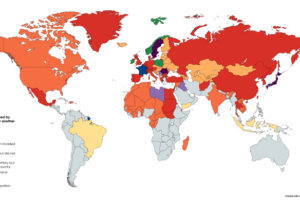
The map highlights locations that could be considered the safest in the event of a global conflict like World War III.
It focuses on places that are mostly geographically isolated, have low strategic importance in military terms, and benefit from neutral international policies. The marked locations include remote islands scattered across the oceans, parts of the Southern Hemisphere such as New Zealand and southern Argentina, and a few other isolated regions.
The emphasis is on areas that are far from major geopolitical tensions and potential warzones, making them less likely to be targeted or drawn into large-scale conflicts.
What 10 Countries Would Most Likely Be The Least Affected by World War 3?
It’s important to emphasize upfront that any discussion about the impacts of a hypothetical World War III is highly speculative.
In today’s interconnected world, nearly every nation would feel some form of global disruption—whether economic, environmental, or humanitarian—even if not directly involved in military action.
In other words, “least affected or safest” is a relative term, and no country would be entirely insulated from the reverberations of a global conflict.
That said, some analysts and commentators have suggested that certain factors might make some countries less likely to be primary targets or direct battlegrounds. Such factors include:
- Geographic Isolation: Being far from traditional conflict zones or major power centers.
- Political Neutrality: A longstanding policy of neutrality (or low-profile alliances) that might reduce a country’s likelihood of being drawn into a conflict.
- Low Strategic Value: A perceived lack of military or economic strategic value that might make a country a less attractive target.
- Stable Domestic Conditions: Strong internal governance and low internal conflict can help a nation better weather external shocks.
Based on these broad—and very speculative—criteria, here is one list of 10 countries that some analysts might argue could be among those “least affected or sfatest” (at least in terms of direct military conflict) in a hypothetical global crisis:
- New Zealand
Often cited for its remote location and low profile in global military affairs, New Zealand’s isolation might help it avoid being a primary target. - Iceland
Situated in the North Atlantic with a small population and little strategic military significance, Iceland is frequently viewed as relatively removed from the centers of global conflict. - Switzerland
Known for its long-standing neutrality and strong defensive preparations, Switzerland has historically avoided direct involvement in large-scale wars—even though its central European location means it could still experience indirect effects. - Australia
As a large, island-continent with vast distances between population centers and a strategic focus on regional security, Australia might be less likely to be targeted in a global conflict. - Ireland
Ireland’s commitment to neutrality and its geographical position on the western edge of Europe have contributed to its reputation as a country that tends to avoid direct entanglement in major conflicts. - Costa Rica
Without a standing military and with a strong focus on diplomacy and peace, Costa Rica is often mentioned as a nation that might be spared the direct impacts of global warfare. - Chile
Chile’s long, narrow geography and remote location in South America might mean that it would see fewer direct military engagements, even though it could still be affected by global economic and environmental fallout. - Uruguay
Similar to Costa Rica in its reputation for stability and neutrality—and with a relatively low profile on the international military stage—Uruguay might be among the countries less directly impacted by hostilities. - Mauritius
This small island nation in the Indian Ocean benefits from geographic isolation, which might shield it from the primary theaters of a global conflict, even though island states can be vulnerable to other kinds of disruptions (like economic or climate impacts). - Botswana
Known for its political stability and relative isolation from global power struggles, Botswana in Southern Africa might avoid becoming a direct focus in a large-scale military conflict.
A Few Caveats
- Indirect Impacts: Even if a country is spared from direct military engagement, it could still face severe economic, environmental, or humanitarian challenges (for example, disruptions to global trade, refugee flows, or environmental fallout).
- Changing Dynamics: Global politics are complex and fluid. A nation that appears “safe” by today’s standards might find its situation altered by shifting alliances, emerging threats, or unforeseen circumstances.
- Not a Guarantee: This list is based on a range of factors that are open to debate, and no country can be considered entirely safe in the event of a full-scale global conflict.
So while the above countries are sometimes cited in discussions of “relative safety” due to their isolation, neutrality, or stability, any prediction about the outcomes of such a catastrophic event remains deeply uncertain.
This discussion is speculative and should be treated as one of many possible viewpoints rather than a definitive forecast.
What do you think?





Claudia says
Chile & Uruguay, but not Argentina? Why?
Lasfritas says
They are more implicated in global politics.
Christopher says
Greenland? That map didn’t age well …
Leara says
Australia has Pine Gap US military intelligence (haha) base, according to Grech. J (2025), “… the most important US communications base outside of the US”…. Without Pine Gap, the US cannot control the satellite operations that are now essential to the execution of war”. Therefore, it’s presence on Australian soil would make Australia a major target in any global conflict.
https://nautilus.org/briefing-books/australian-defence-facilities/pine-gap/the-pine-gap-project/
https://redflag.org.au/article/what-you-need-to-know-about-pine-gap
Musa McCall says
Paraguay would be a solid bet no? Politically Neutral, no issues with it’s neighbours, has a hydropower dam and fully self sufficient in agriculture.
Bolivia too probably.
Anna says
Glad to live in Switzerland, despite someone at the WEF just said we have too much immigration, which could be discussed about. But I don’t feel so.