
The map above shows a hypothetical post-WWII occupation plan for Japan based on how the allies divided Germany.
In our timeline, the atomic bombings of Hiroshima on 6 August 1945 and Nagasaki on 9 August 1945, likely forced a quicker end to the war than would have happened without them.
If Japan had not surrendered after the atomic bombings in August 1945 (or the bombs had not been ready), an invasion of the Japanese home islands would have likely led to the partition of Japan and a more complex post-war occupation.
The Soviet Union, United Kingdom, and China would have played significant roles in the occupation, with plans resembling the division of Germany into zones of control by Allied powers.
Here’s a more detailed look at how the occupation might have unfolded, with a focus on these international actors.
1. Soviet Involvement: A Key Player in a Divided Japan
The Soviet Union declared war on Japan on August 8, 1945, after the United States dropped the first atomic bomb on Hiroshima.
Stalin had committed to this action at the Yalta Conference in February 1945, as part of an agreement with the Western Allies.
Soviet forces quickly moved into Manchuria, northern Korea, Sakhalin Island, and the Kuril Islands, easily defeating the Japanese forces there.
- Soviet Control of Northern Japan: Had Japan continued to resist, Soviet forces would likely have tried to invad the northern Japanese island of Hokkaido, as well as other parts of northern Japan. The Soviets aimed to expand their influence in East Asia and were prepared to take advantage of a post-war power vacuum in Japan. Some historians believe Stalin intended to partition Japan much like Germany, with a Soviet-controlled zone in the north.
- Cold War Consequences: If Soviet forces had occupied parts of Japan, the country would likely have been divided between communist and non-communist zones, similar to the post-war division of Germany into East and West. A Soviet-controlled northern Japan could have been transformed into a communist state, adding Japan to the growing list of Cold War battlegrounds between the Soviet Union and the Western Allies.
- Impact on Korea: The Soviet invasion of Manchuria and northern Korea led directly to the division of Korea into North and South, which remains to this day. Had Japan been partitioned similarly, Hokkaido with or without northern Honshu could have become a Soviet satellite state, possibly mirroring the situation in East Germany or North Korea.
- Similarly, Tokyo might also have been divided like Berlin was into different zones.
2. British Role: A Secondary but Influential Power
While the United Kingdom’s direct involvement in the Pacific theater was not as extensive as the United States or Soviet Union, the British had significant stakes in the post-war settlement, particularly in curbing Soviet expansion and maintaining their colonial holdings in Asia.
- British Occupation Zones: The UK was expected to take control of some areas in Japan, particularly in cooperation with the United States. They may have been assigned sectors in Western Japan, possibly around Kyushu or Shikoku. However, British forces were stretched thin by the war, and any occupation role would have been smaller compared to the U.S. or the Soviet Union.
- Imperial Interests: The British were deeply concerned about the balance of power in Asia. A Soviet-dominated Japan would have threatened British colonial holdings in places like Hong Kong, Malaya, and Burma. As a result, British officials likely would have worked closely with the United States to ensure Japan did not fall entirely under Soviet influence, contributing to the political and military framework of a divided Japan.
3. Chinese Involvement: A Complicated Stakeholder
China, under Chiang Kai-shek’s Nationalist government, was also an important Allied power.
China had suffered greatly from Japanese occupation since 1937, and Chiang had a strong interest in Japan’s post-war fate.
However, China’s role in any occupation would have been complex due to the internal situation in China, where the Chinese Civil War between the Nationalists and the Communists was reigniting.
- Limited Role in Direct Occupation: While Chiang’s government had a legitimate claim to a role in Japan’s occupation, it was less clear how much influence China would have had in Japan itself. China was more likely to focus on reclaiming territories like Taiwan and dealing with Japanese influence in Manchuria. That said, China may have sought a small sector in southern Japan or a symbolic role in the occupation, though the logistical challenges of participating in a Japanese occupation likely limited its involvement.
- Manchuria and Taiwan: China’s main focus post-war was on reclaiming Manchuria and Taiwan from Japanese control. The Soviet Union’s invasion of Manchuria complicated the situation, as the Soviets initially controlled the region and provided aid to the Chinese Communists, leading to tension with the Nationalist government. In Taiwan, China was eager to reclaim the island from Japan, which it successfully did, but its role in Japan’s occupation would have been secondary to this territorial reclamation effort.
- In the map above, Shikoku would be occupied by China. If that were the case, two interesting further developments could have happened. Either it forms some sort of Union with the eventual Republic of China (aka Taiwan) or the People’s Republic of China takes over administering it and it becomes more closely aligned with the Soviet Sector (at least until the Sino-Soviet split).
4. U.S. Role: The Dominant Force in the Occupation
Even in the scenario of a divided Japan, the United States would have been the dominant occupying force, much like it was in Germany.
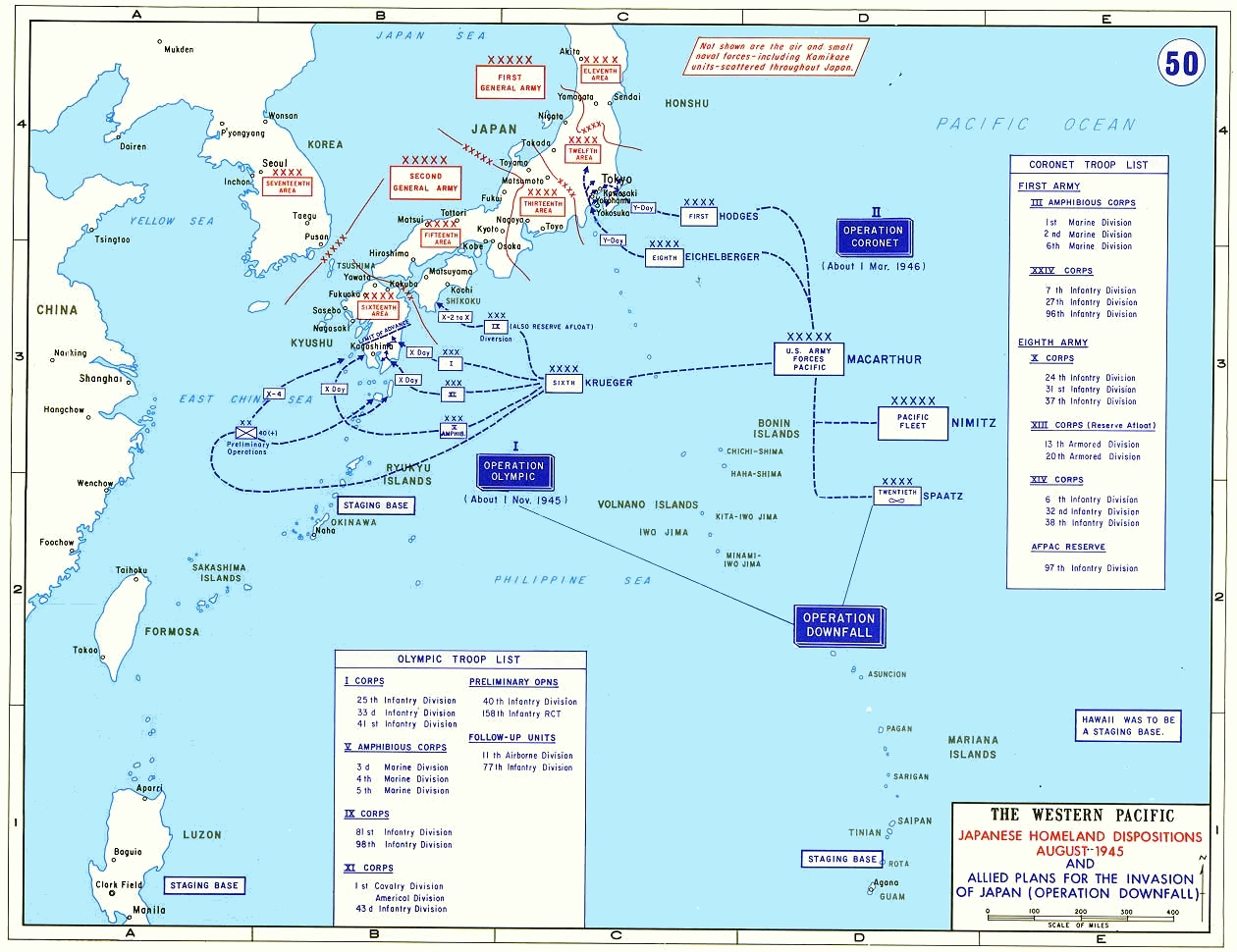
The U.S. military was already planning an invasion and occupation through Operation Downfall, and American forces were expected to bear the brunt of the fighting and administration of Japan.
Map of Operation Downfall:
Alterative version:
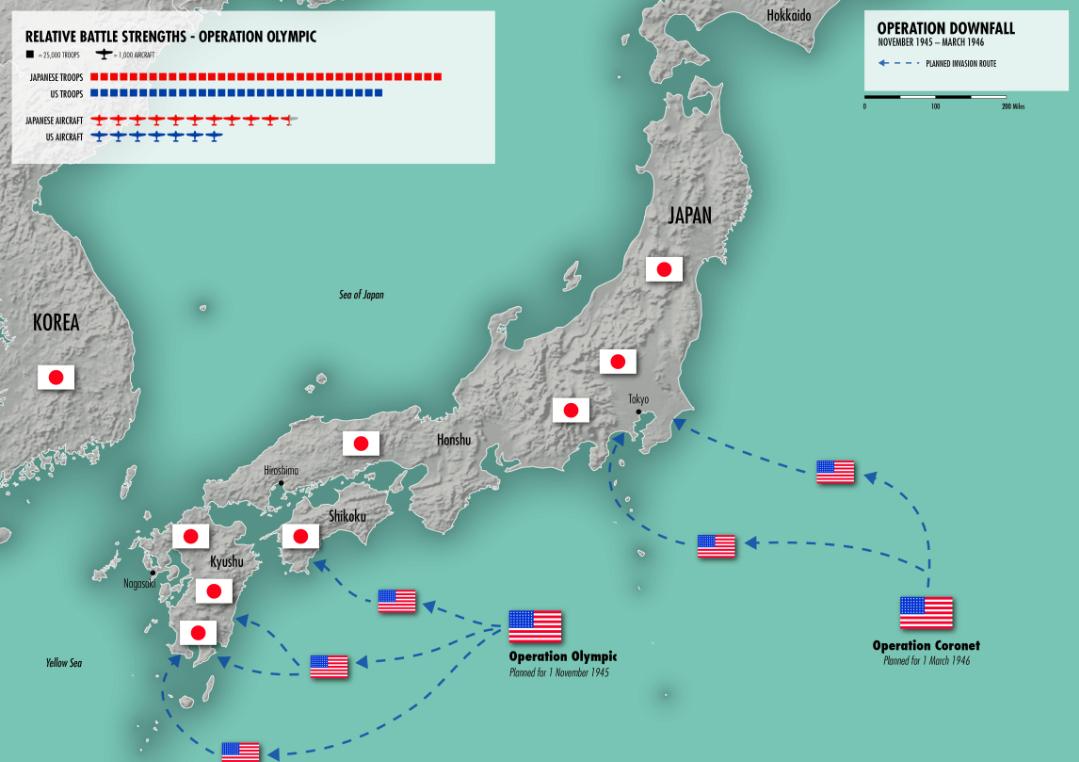
- U.S. Control of Central Japan: The U.S. likely would have occupied Honshu (the main island), including Tokyo and key industrial areas like Osaka and Nagoya. The U.S. had already developed detailed plans for a military government in Japan, modeled on the occupation of Germany. General Douglas MacArthur, who led the actual occupation of Japan, would have been the figurehead of this effort, tasked with dismantling Japan’s military and overseeing democratization and economic reforms.
- Geopolitical Balance: The U.S. would have been deeply concerned with preventing Soviet expansion into Japan. Even if Japan were partitioned, the United States would have ensured that it maintained a strong presence in the more economically and politically important parts of Japan, particularly Tokyo and the southern industrial regions.
5. Outcome of a Partitioned Japan
If Japan had been partitioned along similar lines to Germany, the country would have likely faced decades of political division and Cold War tensions.
The northern part of Japan, under Soviet control, could have developed into a communist state, while the U.S.-British-controlled south would have followed a democratic and capitalist path, similar to West Germany.
- Japanese Communism: The Soviet Union may have tried to support communist movements within Japan, especially if a Soviet occupation zone was established. While Japan had no strong communist presence during the war, prolonged conflict and occupation might have allowed communist factions to gain traction in the Soviet zone.
- Cold War Flashpoint: A divided Japan would have become a major flashpoint in the Cold War. Much like East and West Germany, the two halves of Japan would have been militarized and ideologically opposed, with the United States and its allies maintaining bases in the south to contain Soviet influence.
Another version of the map:

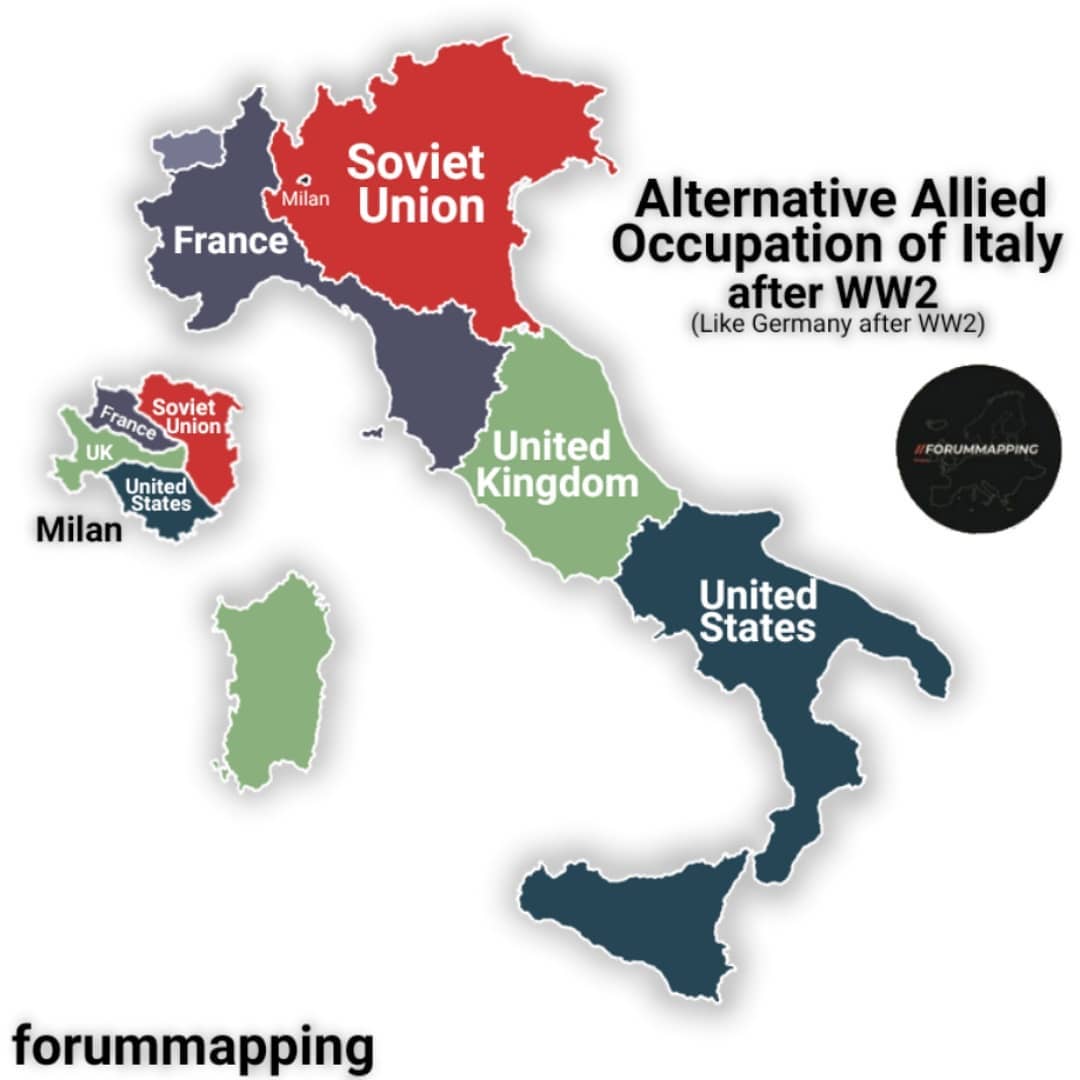
And finally, here’s a version for Italy:
What do you think?





Samo says
Some of the territory (eastern part) of Italy, which, according to the author would supposedly be occupied by the Soviet Union… would surely be occupied by Yugostavia, which after all marched in Trieste early May 1945 and claimed the territory from Trieste, Gorizia and to the north, at least.
This would surely make one interesting situation in 1948 and later, when Yugoslavia and the Soviet Union almost started the war between themselves…