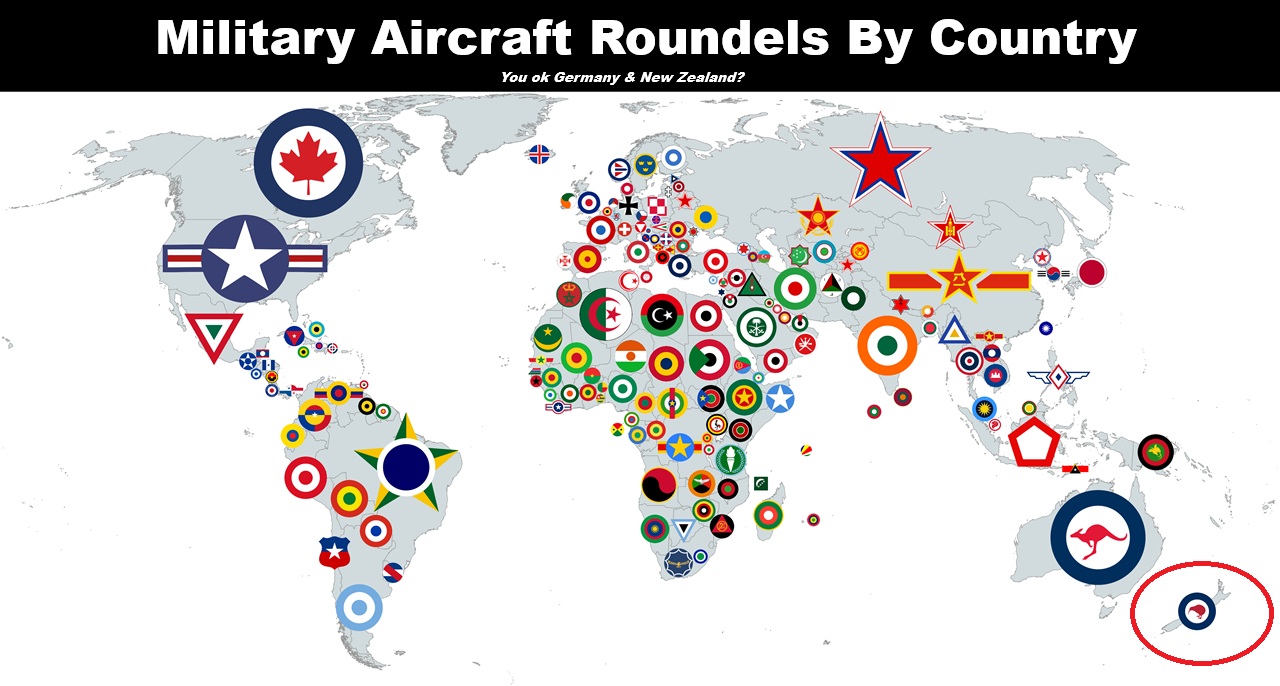
Here’s a bit more about them:
Although most countries use fairly conventional circles in their national colours, others have chosen everything from kangaroos and flightless birds to crosses, stars and checkerboards.
What makes them particularly interesting is that some designs are more than a century old, while others were deliberately changed to distinguish one country’s aircraft from another’s.
What is the point of military aircraft roundels?
The main purpose of a military aircraft roundel is to identify which country an aircraft belongs to, particularly during combat.
The tradition dates back to the early years of military aviation, particularly the First World War, when pilots and soldiers struggled to distinguish friendly aircraft from enemy ones.
Roundels serve several purposes:
- Preventing friendly fire: Helping pilots and ground forces distinguish friendly aircraft from hostile ones.
- Showing nationality: Identifying which country’s military operates the aircraft.
- Establishing military identity: Distinguishing military aircraft from civilian ones, including for purposes of international law.
- Preserving tradition: Many designs have become powerful symbols of national military history.
Interestingly, the British originally painted the Union Jack on their aircraft during the First World War. However, at a distance it could be confused with Germany’s black cross.
Britain therefore adopted a circular red, white and blue marking in late 1914, reversing the order of the colours used by France, whose roundel had been introduced in 1912.
Today, radar, identification-friend-or-foe systems and other technology are far more important for identifying aircraft during combat. Indeed, many modern military aircraft use subdued grey or black insignia to avoid compromising their camouflage.
Why does Germany still use a cross on its military aircraft?
Germany is unusual because its modern military aircraft still feature a black cross outlined in white, rather than the circular roundels used by most other countries.
The reason is that the cross predates Nazi Germany by more than a century and represents a much older German military tradition.
The modern marking has its origins in the Iron Cross (Eisernes Kreuz), established by King Frederick William III of Prussia in 1813 during the Napoleonic Wars.
The symbol subsequently became associated with the armed forces of Prussia and unified Germany.
When German military aviation developed before the First World War, aircraft began carrying versions of the cross. German aircraft continued using cross-shaped insignia during both world wars, although the exact designs changed.
Following the defeat of Nazi Germany in 1945, the German armed forces were disbanded. When West Germany established the Bundeswehr in 1955, it needed to decide what national insignia its new military should use.
Rather than adopt something entirely new, West Germany chose to revive the older cross design.
On 27 September 1956, the West German government approved a black cross with a white outline as the identification marking for Bundeswehr aircraft and combat vehicles. President Theodor Heuss formally authorised it on 1 October.
The decision deliberately connected the new armed forces with pre-Nazi German military traditions.
Unlike West Germany, which adopted the traditional Iron Cross, East Germany used a diamond-shaped insignia featuring vertical black, red and gold stripes.
From 1960, it also displayed the East German coat of arms in the centre: a hammer and compass surrounded by a wreath of grain, symbolising workers, intellectuals and farmers.
The design distinguished East German aircraft from their West German counterparts and remained in use until German reunification in 1990.
The modern Bundeswehr cross is not the Nazi swastika, nor is it identical in form to the straight-sided Balkenkreuz commonly used on German aircraft during the Second World War.
Germany continues to use the cross today.
Why did New Zealand choose a flightless bird?
Perhaps the most amusing national aircraft marking is New Zealand’s, which features a red kiwi in the middle of a blue and white roundel.
The irony is obvious: an air force chose a bird that cannot fly.
New Zealand originally used the same roundel as the British Royal Air Force, reflecting the country’s historical connections to Britain.
However, as New Zealand developed its own national identity, there was growing interest in creating a distinctive national marking.
In 1957, the Royal New Zealand Air Force adopted a silver fern in the centre of its roundel.
Unfortunately, the design had several problems:
- The fern was difficult to identify from a distance.
- Its silver decals deteriorated, sometimes resembling scratches or peeling paint.
- The original white version had prompted unfortunate comparisons with a white feather, traditionally associated with cowardice.
The kiwi emerged as an alternative, partly thanks to aircraft technician John Black, who had painted kiwi designs on toolboxes and aircraft while serving with No. 14 Squadron in Singapore during the 1950s.
Its appeal was simple: the kiwi was instantly recognisable as a symbol of New Zealand and would help distinguish New Zealand aircraft from those belonging to other Commonwealth countries.
Despite objections that a flightless bird was an inappropriate symbol for an air force, the kiwi was officially adopted in September 1970.
The design remains in use today, although camouflage versions sometimes replace the traditional bright colours.
It’s a perfect example of national identity taking precedence over literal symbolism.
Seven other unusual military aircraft roundels
Australia: A kangaroo that always moves forwards
Australia replaced the plain red centre of its RAF-style roundel with a leaping kangaroo in 1956. Designs featuring a boomerang, wattle and Southern Cross were considered, but the kangaroo prevailed. On aircraft, the kangaroo must face forwards, symbolising the air force’s determination to keep advancing.
Singapore: The lion that protects the Lion City
Singapore’s air force adopted a stylised red lion’s head in 1990. Its five sections of mane represent democracy, peace, progress, justice and equality. Unlike New Zealand, Singapore chose an animal that conveys strength rather than an accidental joke about flying.
Papua New Guinea: A bird of paradise
Papua New Guinea’s Defence Force Air Wing uses a yellow bird-of-paradise on a green disc surrounded by red and black rings. The bird is also prominent on the country’s national flag. Unlike New Zealand’s kiwi, birds-of-paradise can actually fly!
Botswana: A roundel that isn’t round
Botswana uses an upside-down triangle rather than a circle. It features blue, white and black, matching the colours of the country’s flag. It’s a reminder that roundel has become a general term for national aircraft identification markings, even when they aren’t circular.
Poland: A checkerboard borrowed from one pilot
Poland’s red-and-white checkerboard dates to 1918. Originally a personal emblem used by pilot Stefan Stec, it was considered so distinctive and easy to paint that it became the official national aircraft marking. In 1993, the arrangement of its red and white squares was reversed to conform to heraldic conventions.
Portugal: A medieval cross in the jet age
Portugal’s aircraft carry the red Cross of the Order of Christ, a symbol associated with Portuguese exploration and sailing ships from the Age of Discovery. Its use on military aircraft dates back to 1918. It’s one of the few modern air force insignia with such a direct connection to medieval military-religious traditions.
Finland: An insignia that became controversial
From 1918 until 1945, Finnish military aircraft carried a blue swastika. The symbol was introduced before the Nazis adopted the swastika as their party emblem, having come from the personal good-luck symbol of Swedish aristocrat Eric von Rosen, who donated an aircraft to Finland.
Finland replaced it with a blue-and-white circular marking in 1945. Swastikas remained in some Finnish Air Force unit insignia long afterwards, although a number were subsequently replaced.
One final interesting fact: the Americans removed red from their insignia because of Japan
During the Second World War, US military aircraft originally carried a white star with a red disc in the middle.
In 1942, the red disc was removed because it risked being confused with Japan’s red circular Hinomaru insignia, particularly in the Pacific.
The red didn’t return to the American national aircraft marking until 1947, when narrow red bars were added to the existing star-and-bars design.
This highlights a recurring tension in roundel design: an insignia needs to represent the country, but it also needs to look sufficiently different from the enemy’s.
Which one do you like best?



Leave a Reply