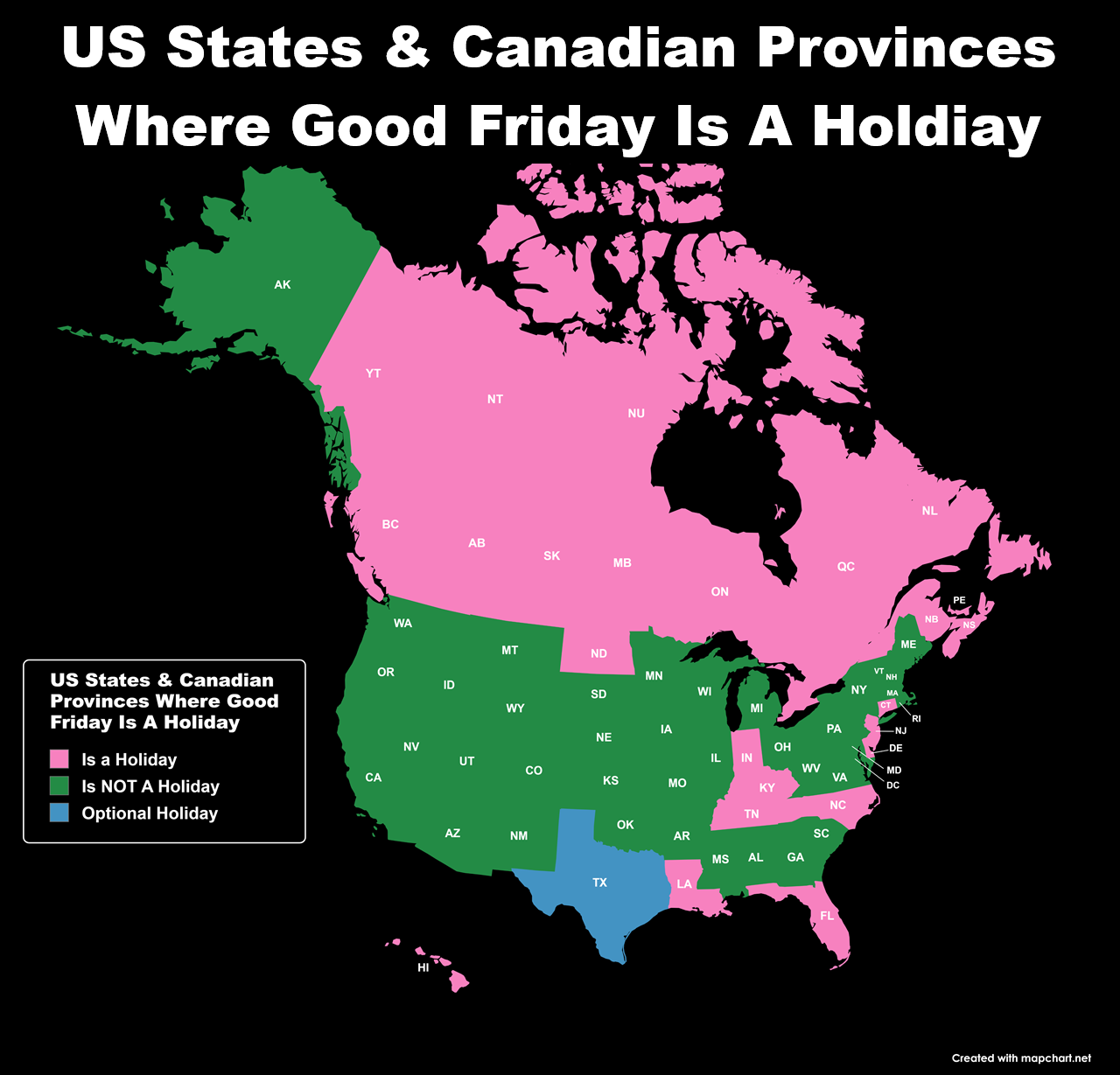
The map above shows the 12 states where Good Friday is a state holiday as well as being holiday in all 10 Canadians provinces and 3 territories.
The 12 states are:
- Connecticut
- Delaware
- Florida
- Hawaii
- Indiana
- Kentucky
- Louisiana
- New Jersey
- North Carolina
- North Dakota
- Tennessee
- Texas *Optional holiday
I find it very interesting that in a country where 69% of people identify as Christian, Easter is not a Federal Holiday. I thought this may be due to the separation between Church and state but that does not explain why Christmas is a Federal Holiday.
Here’s what ChatGPT has to day about it:
Easter isn’t a U.S. federal holiday mainly because of how the U.S. government handles religion and public holidays.
Here are the key reasons:
- Separation of church and state
The United States follows the principle of separation of church and state (from the First Amendment).
Easter is a Christian religious holiday, so making it a federal holiday could be seen as the government endorsing one religion over others.
- Federal holidays are mostly secular (or broadly cultural)
Most U.S. federal holidays are either:
- Secular/national (like Independence Day, Labor Day), or
- Culturally widespread but not strictly religious in law (like Christmas, which has become heavily secularized)
Easter, unlike Christmas, is:
- More explicitly religious
- Less universally celebrated across all Americans
- It falls on a Sunday
Easter is always celebrated on a Sunday, and:
- Many federal employees already don’t work Sundays
- So making it a federal holiday wouldn’t change much operationally
- Religious diversity
The U.S. is religiously diverse (Christian, Jewish, Muslim, Hindu, non-religious, etc.).
If Easter were made a federal holiday, it could raise questions like:
- Why not holidays from other religions too?
Quick comparison
- Christmas → Federal holiday (but widely secular + cultural)
- Easter → Not federal (more strictly religious + always Sunday)
Here’s how Christmas ended up with that status:
Christmas became culturally “American,” not just religious
By the 1800s, Christmas in the U.S. had evolved beyond a purely Christian observance into a broad cultural holiday.
Influences included:
- Charles Dickens: helped popularize themes of generosity, family, and goodwill
- Thomas Nast: shaped the modern image of Santa Claus
- German and Dutch traditions (trees, gift-giving, St. Nicholas)
The result: Christmas became something even non-religious Americans participated in.
It was officially made a federal holiday in 1870
Christmas was declared a federal holiday by the U.S. Congress in 1870, during a period of national rebuilding after the Civil War.
Key point:
- It was framed less as a religious endorsement and more as a unifying national celebration
Strong commercial and social adoption
Over time, Christmas became deeply tied to:
- Gift-giving 🎁
- Retail and the economy
- Family gatherings
This made it:
- Economically significant
- Socially universal
Easter never developed this same level of nationwide commercial importance.
Easter stayed more strictly religious
Easter is central to Christianity (arguably more important theologically than Christmas), but:
- It remained focused on church observance
- Its secular elements (eggs, bunnies) are lighter and less universal
- It lacks the same cultural takeover that Christmas achieved
Timing matters (Sunday issue again)
Easter always falls on a Sunday, which:
- Reduces the need for an official day off
- Limits pressure to make it a federal holiday
Christmas, by contrast:
- Falls on a fixed date (Dec 25)
- Often lands on a weekday → making a federal holiday more practical
Ok but why not Good Friday a Holiday?
Good Friday commemorates the crucifixion of Jesus, which is:
- One of the most solemn and specifically Christian observances
- Less “culturally adaptable” than Christmas
Unlike Christmas, there’s almost no secular version of Good Friday.
So making it a federal holiday would raise stronger concerns about:
- Government endorsing a specific religion
The U.S. avoids picking one religion’s sacred days
If Good Friday became a federal holiday, it would open the door to questions like:
- Why not Jewish holidays like Yom Kippur?
- Why not Muslim holidays like Eid?
- Why not Hindu festivals like Diwali?
Because the U.S. is highly religiously diverse, the government generally avoids:
Officially recognizing religious observances as national holidays
Federal holidays are about shared civic life
U.S. federal holidays usually mark:
- National identity (Independence Day)
- Civic values (Labor Day, MLK Day)
- Broad cultural traditions (Thanksgiving, Christmas)
Good Friday doesn’t really fit those categories, it’s:
- A theological event, not a civic one
Why countries like the UK do have it
Countries such as the UK historically had:
- Established Christian churches (e.g. Church of England)
- Less strict separation of church and state
So Good Friday became embedded as a national holiday long ago.
It is a holiday in some U.S. states
Interesting twist: it’s not totally ignored.
Some states do observe Good Friday as a holiday or partial holiday, including: all the states mentioned above, so at a local level, there’s more flexibility than at the federal level.
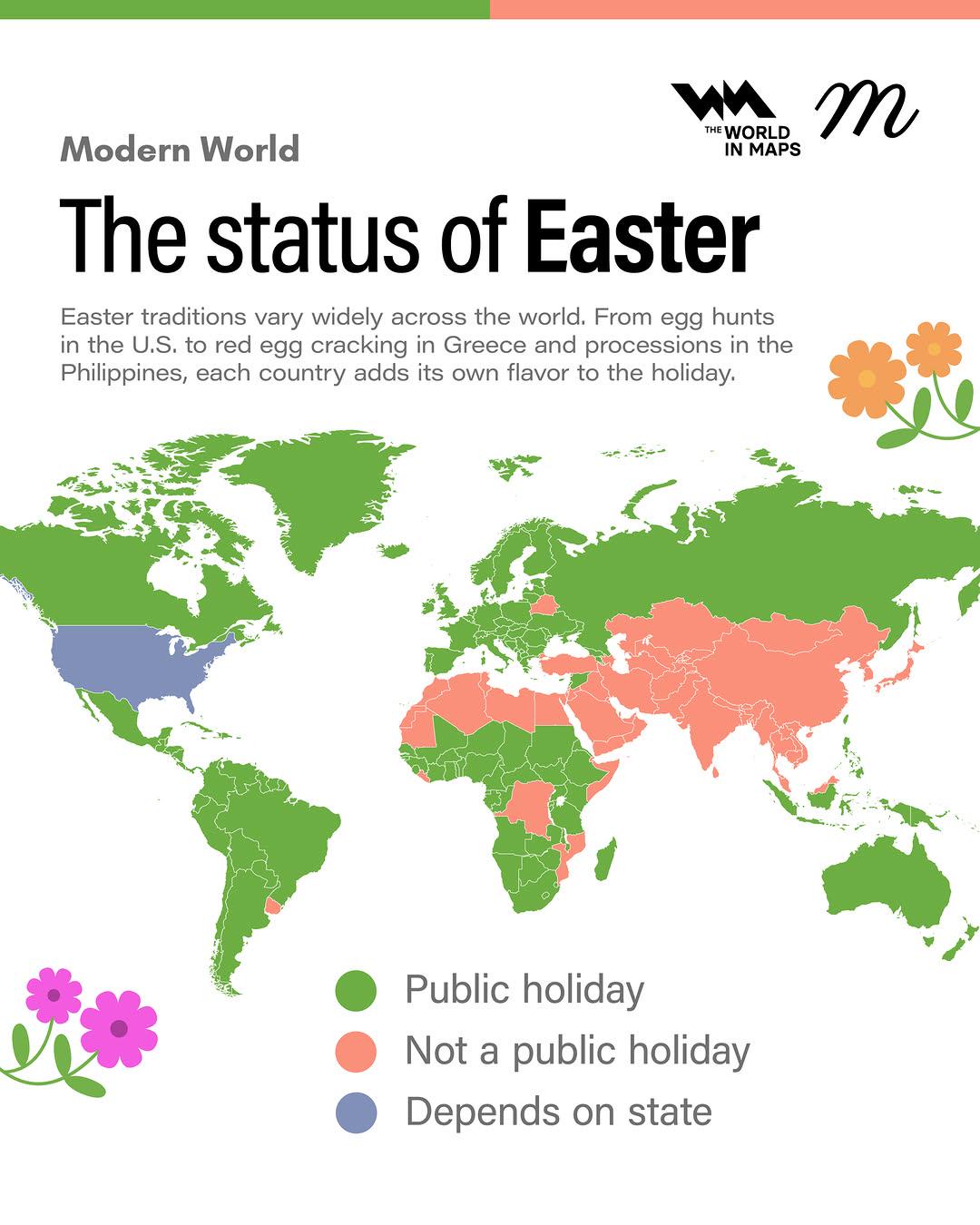
Here is where Easter is Celebrated as a holiday:
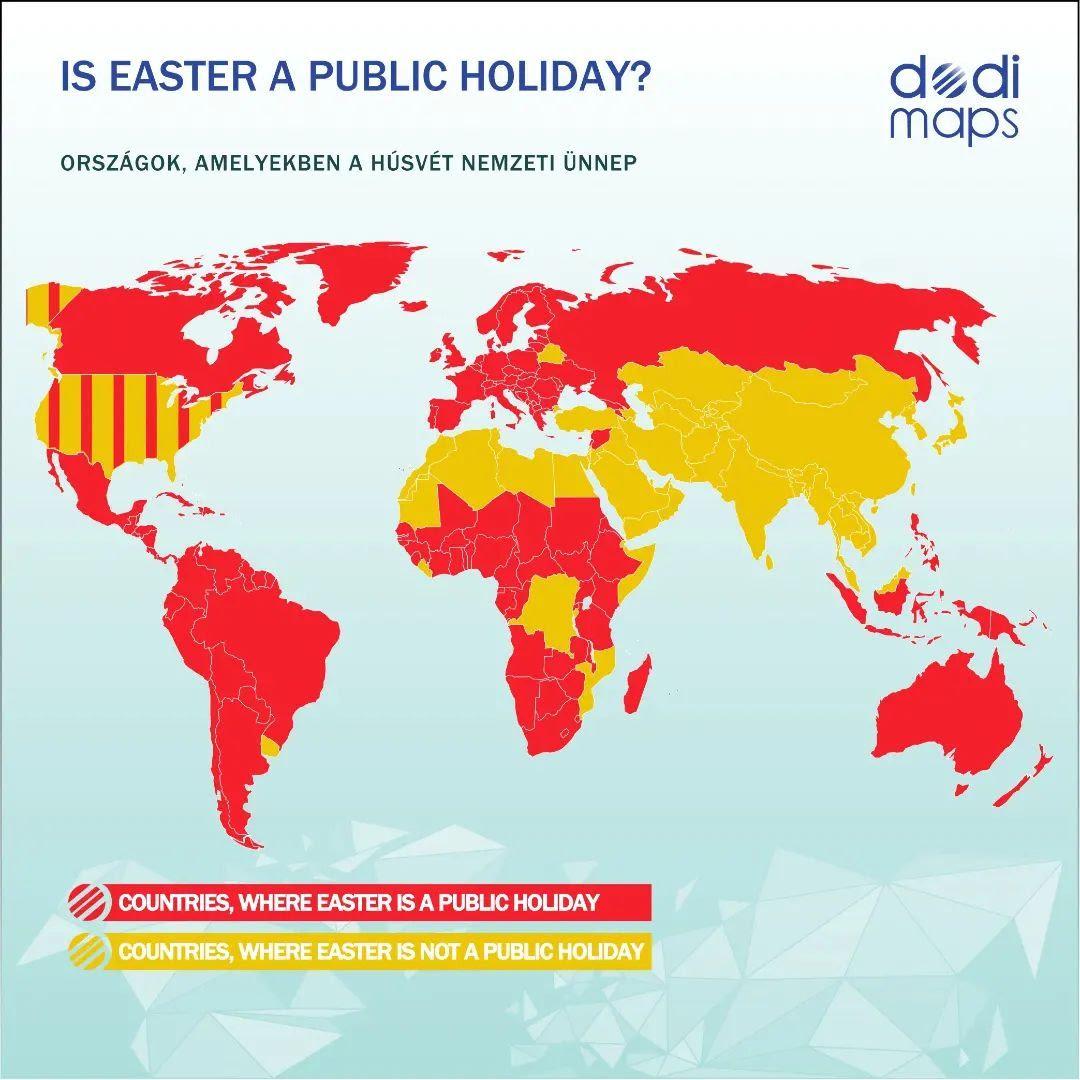
and here’s another version of the map:
Do you celebrate Easter where you live?





![Where is the north/south divide? [Map Men]](https://brilliantmaps.com/wp-content/uploads/hqdefault-19-300x200.jpg)
Leave a Reply