
They are:
1. United Ireland (Republic of Ireland and Northern Ireland)
- Population:
- Republic of Ireland: ~5.1 million (2023 estimate)
- Northern Ireland: ~1.9 million (2021 census)
- Combined: ~7 million
- Recent Polling:
- Republic of Ireland: Support at 46% (from map)
- Northern Ireland: Support at 38% (from map); other polls suggest a range from 30%-40%, with higher support among younger demographics.
- Obstacles:
- Political division: Unionist communities in Northern Ireland strongly oppose unification.
- Economic integration: Questions about the financial impact on both regions.
- Constitutional barriers: Requires referenda in both jurisdictions under the Good Friday Agreement.
More about a United Ireland
2. Greater Netherlands (Netherlands and Flanders, Belgium)
- Population:
- Netherlands: ~17.8 million (2023)
- Flanders: ~6.7 million (2023 estimate)
- Combined: ~24.5 million
- Recent Polling:
- Netherlands: Support at 72% (from map)
- Flanders: Support at 26% (from map); limited interest among Flemish people despite cultural and linguistic similarities.
- Obstacles:
- Low support in Flanders: Many Flemish nationalists prefer independence from Belgium over unification with the Netherlands.
- EU dynamics: Such a unification would require renegotiation of treaties and borders.
- Economic disparities: Concerns about wealth distribution and governance.
More about Greater Netherlands
3. Rattachism (France and Wallonia, Belgium)
- Population:
- France: ~67.8 million (2023)
- Wallonia: ~3.7 million (2023 estimate)
- Combined: ~71.5 million
- Recent Polling:
- France: Support at 58% (from map)
- Wallonia: Support at 35% (from map); interest in unification is often linked to dissatisfaction with Belgium’s federal structure.
- Obstacles:
- Political identity: Many Walloons value their Belgian identity and prefer reforms within Belgium rather than unification with France.
- Economic integration: Wallonia’s struggling economy may be a burden on France.
- International politics: Belgium’s dissolution would involve complex negotiations.
More about Rattachism
4. Albania-Kosovo
- Population:
- Albania: ~2.8 million (2023 estimate)
- Kosovo: ~1.8 million (2023 estimate)
- Combined: ~4.6 million
- Recent Polling:
- Albania: Support at 68% (from map); other surveys suggest support fluctuates between 60%-80%.
- Kosovo: Support at 75% (from map); support is consistently high due to shared ethnic Albanian identity.
- Obstacles:
- International recognition: Kosovo’s independence is not universally recognized, complicating unification efforts.
- Regional stability: Opposition from Serbia and other neighboring countries.
- Economic and political challenges: Harmonizing political systems and economies.
- EU and NATO considerations: Both entities would need to align their foreign policies.
More about the Unification of Albania and Kosovo
5. Romania-Moldova
- Population:
- Romania: ~19 million (2023)
- Moldova: ~2.6 million (2023 estimate, excluding Transnistria)
- Combined: ~21.6 million
- Recent Polling:
-
- Romania: Support at 77% (from map); other polls show consistent strong support, although this has dropped considerably since the invasion of Ukraine.
- Moldova: Support at 24% (from map); low support stems from political and ethnic diversity.
-
- Obstacles:
- Political opposition: Many Moldovans fear losing sovereignty and cultural identity.
- Economic disparities: Moldova is significantly less developed than Romania.
- Geopolitical tensions: Russia’s influence in Moldova and the Transnistrian conflict are significant hurdles.
More about Unification of Moldova and Romania
Independence movements in Europe
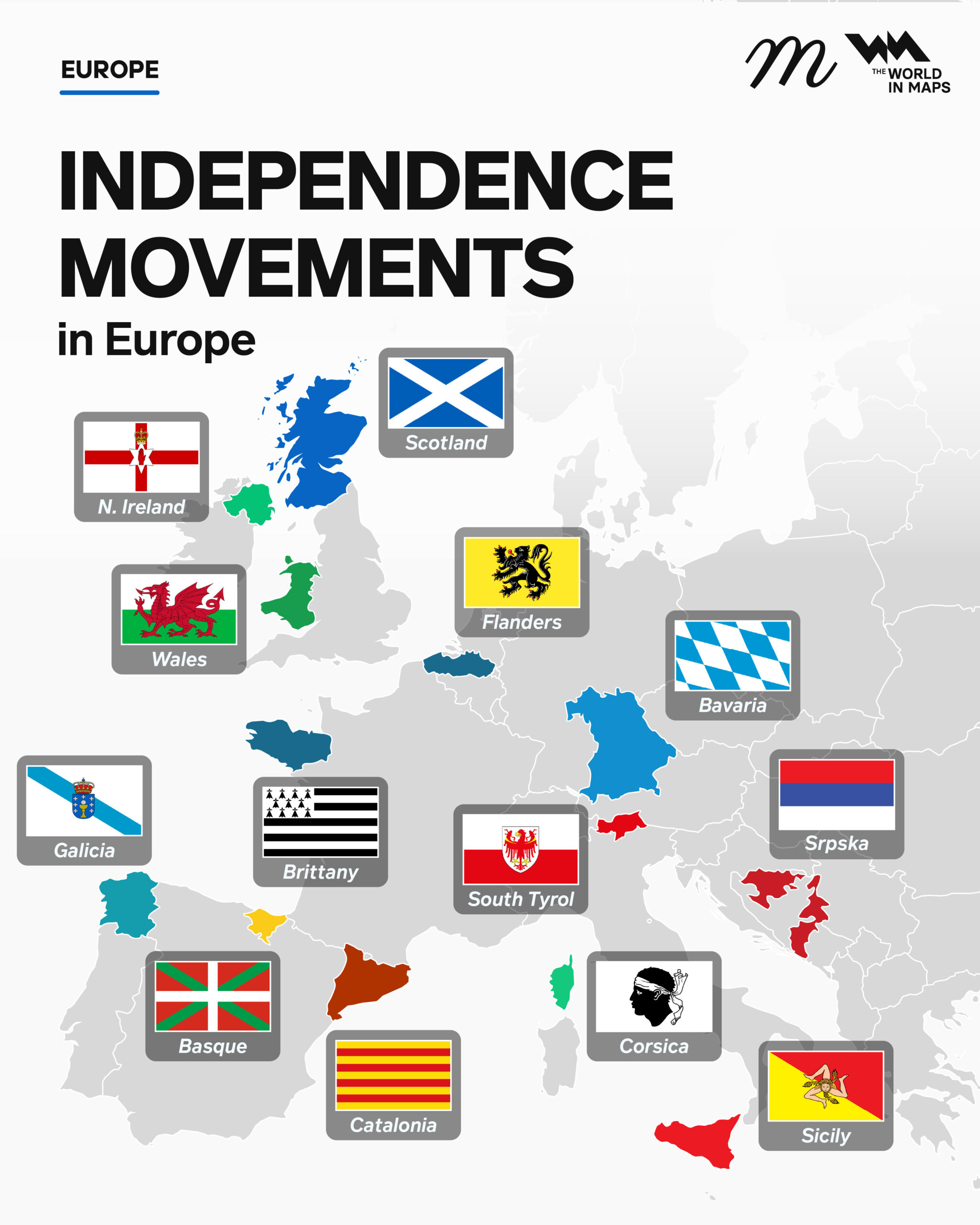
Northern Ireland
- Population: ~1.93 million
- Polling: Around 5% support Northern Ireland becoming an independent state. By comparison, roughly 36% would vote for Irish reunification.
- Main obstacles:
- Very little mainstream support for an independent Northern Ireland.
- Nationalists overwhelmingly favour reunification with Ireland instead.
- Major questions over public finances, security and relations with Britain and Ireland.
- A United Ireland already has a constitutional route through the Good Friday Agreement, whereas Northern Irish independence does not.
More about Ulster nationalism
Scotland
- Population: ~5.55 million
- Polling: Recent polling has generally placed independence close to 50%, with an August 2026 Survation poll giving roughly 52% Yes / 48% No among decided voters.
- Main obstacles:
- Westminster would almost certainly have to approve another legal referendum.
- The UK Supreme Court ruled that the Scottish Parliament cannot hold one unilaterally.
- Disputes over which currency an independent Scotland would use.
- Scotland’s fiscal deficit and public spending.
- Trade with the rest of the UK.
- Terms and timing of possible EU membership.
More about Scottish independence
Wales
- Population: ~3.18 million
- Polling: Around 32% support independence, compared with 68% opposed among decided voters in an August 2026 poll.
- Main obstacles:
- Independence remains well short of majority support.
- Wales has no unilateral legal route to secession.
- Concerns about the Welsh government’s fiscal position.
- Heavy economic integration with England.
- Questions surrounding currency, pensions, borders and trade.
- Economic concerns consistently rank among the biggest reasons voters oppose independence.
More about Welsh independence
Galicia
- Population: ~2.72 million
- Polling: One of the clearest surveys found only around 7% supporting outright independence, although another 23% favoured greater autonomy.
- Main obstacles:
- Independence has relatively little public support.
- Many Galician nationalists favour stronger autonomy rather than separation.
- Spain’s constitution describes the Spanish nation as indivisible.
- Galicia is economically and institutionally deeply integrated with Spain.
- Support for nationalist parties such as the BNG should not automatically be interpreted as support for independence.
More about the Galician independence movement
Brittany
- Population: ~3.51 million in administrative Brittany, or roughly 5.0 million if Loire-Atlantique is included in historical Brittany.
- Polling: The last major direct poll found about 18% supporting independence. Much larger numbers favour increased regional autonomy.
- Main obstacles:
- Independence remains a minority position.
- France is constitutionally an “indivisible Republic”.
- Many Breton regionalists prioritise greater autonomy rather than independence.
- Disagreement exists over whether Loire-Atlantique and Nantes should be included.
- Breton language and identity have weakened considerably compared with previous centuries.
More about Breton nationalism
Basque Country
- Population: ~2.22 million in Spain’s Basque Autonomous Community.
- Polling: Around 21% firmly favour independence, 41% oppose it and approximately 33% say their position depends on circumstances.
- Main obstacles:
- There is currently no clear majority for independence.
- Spain’s constitution prevents unilateral secession.
- The Basque Country already enjoys extensive fiscal and political autonomy.
- The wider Basque homeland also includes Navarre and parts of France.
- Opinion differs considerably between these territories.
More about Basque independence
Catalonia
- Population: ~8.2 million
- Polling: Recent polling has independence at roughly 45% Yes versus 50-51% No.
- Main obstacles:
- Independence currently lacks majority support.
- Spain’s constitution declares the country indivisible.
- The 2017 unilateral referendum was ruled unconstitutional.
- Divisions remain between Catalan separatist parties over strategy.
- Questions over EU membership, currency and government debt.
- Catalonia has extensive economic ties with the rest of Spain.
More about the Catalan independence movement
Flanders
- Population: ~6.9 million
- Polling: Figures vary enormously depending on wording. Some polls have suggested as much as 40% support independence, while conventional academic polling has often found only around 5-15% favouring outright separation.
- Main obstacles:
- Many Flemish nationalists prefer confederalism rather than full independence.
- The future of Brussels would be extraordinarily difficult to resolve.
- Brussels is geographically surrounded by Flanders but predominantly French-speaking.
- Belgium’s national debt, pensions and social-security system would have to be divided.
- Belgium’s federal political system already gives Flanders considerable autonomy.
More about Flemish movement
Bavaria
- Population: ~13.25 million
- Polling: A widely cited 2017 poll found around 32% supporting Bavarian independence, although good recent polling is lacking.
- Main obstacles:
- Germany’s Federal Constitutional Court has explicitly ruled that German states cannot unilaterally secede.
- Separatist parties attract little electoral support.
- Bavarian identity is strong, but this does not necessarily translate into separatism.
- Germany’s economic and political integration makes separation difficult.
- Independence is not a major issue for the dominant CSU.
More about Bavarian nationalism
South Tyrol
- Population: ~542,000
- Polling: A 2013 survey found 54% support for independence among German- and Ladin-speakers, although Italian speakers were excluded. Overall support was estimated closer to the mid-40% range.
- Main obstacles:
- South Tyrol already enjoys very extensive autonomy.
- German-, Ladin- and Italian-speaking residents have different political preferences.
- Separatists disagree over whether South Tyrol should become independent or rejoin Austria.
- Italy’s constitution protects the unity of the Italian state.
- Any territorial change would involve both Italy and Austria.
More about the South Tyrolean independence movement
Corsica
- Population: ~366,000
- Polling: Support for autonomy is extremely high, around three-quarters of the population, but outright independence attracts much less support, probably below 20%.
- Main obstacles:
- Most Corsican nationalists currently prioritise autonomy rather than independence.
- France is constitutionally an indivisible republic.
- Corsica depends heavily on economic transfers from mainland France.
- An independent island would face questions over currency, EU membership and public finances.
- The French government has shown greater willingness to discuss autonomy than independence.
More about Corsican nationalism
Sicily
- Population: ~4.79 million
- Polling: A 2014 survey produced a surprisingly high figure of around 44% supporting independence, although there is little reliable recent polling confirming that level today.
- Main obstacles:
- Modern Sicilian separatist parties have very little electoral influence.
- Sicily already has special autonomous status.
- Italy’s constitution defines the Republic as “one and indivisible”.
- Sicily receives substantial fiscal transfers from the Italian state.
- Economic viability and public finances would be major referendum issues.
More about Sicilian nationalism
Republika Srpska
- Population: ~1.11 million
- Polling: One of the most recent clear surveys found around 41% supporting independence and 33% opposed.
- Main obstacles:
- Republika Srpska is legally an entity within Bosnia and Herzegovina, not a sovereign state.
- The Dayton Peace Agreement provides no right of unilateral secession.
- Most of the international community strongly opposes independence.
- The status of strategically important Brčko District would be particularly difficult.
- Serbia itself has generally stopped short of supporting formal secession.
- A unilateral declaration could destabilise Bosnia and potentially reignite ethnic tensions.
More about the Proposed secession of Republika Srpska
Which do you think is most likely to happen?



François Rose says
I’m afraid there is a biais in the map, as can be seen in the sources.
I live in Wallonia. The 35% figure shows the part of the Wallon population who would rather join France than stay alone IN CASE of Belgium splitting up, and ONLY in this case.
Moreover, the figures date back to 2010, a time of strong political crisis in Belgium.
The number of Walloons who would like to join France now (2025), whatever the political state of Belgium, is expected to be much lower.
I could’nt find more recent data, I guess because of lack of serious interest in French-Walloon ‘rattachism’ since then.