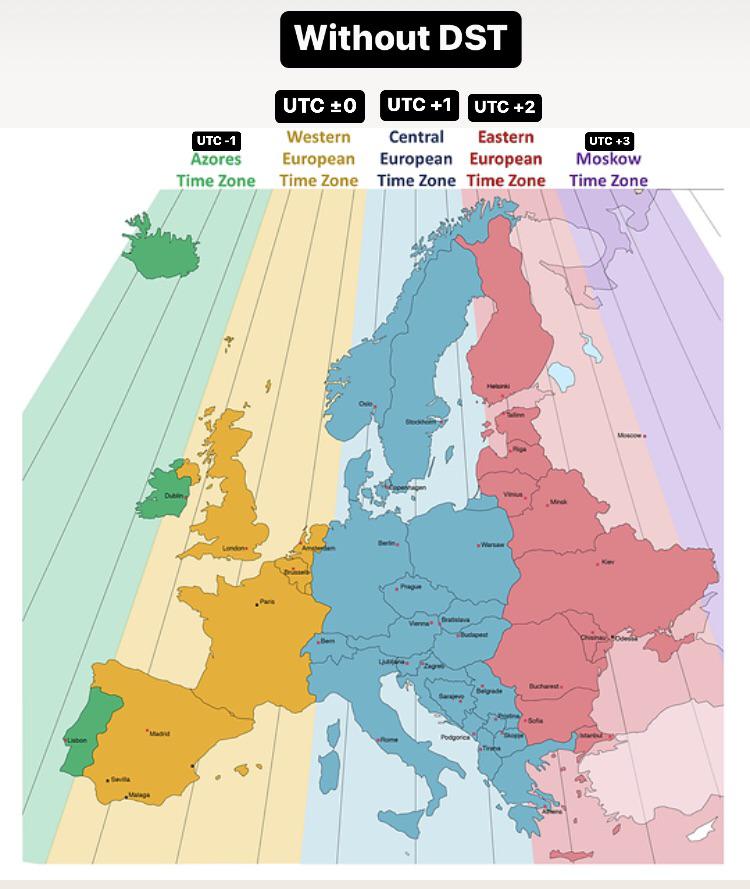
Here’s a breakdown of the map:
Time Zones:
- UTC-1: Azores Time Zone (Green)
- UTC±0: Western European Time Zone (Yellow)
- This includes countries the United Kingdom, France, Spain and the Benelux countries.
- UTC+1: Central European Time Zone (Blue)
- UTC+2: Eastern European Time Zone (Red)
- UTC+3: Moscow Time Zone (Purple)
- This includes parts of Russia, including Moscow.
Key Points:
- Without DST: This map shows the time zones as they would be without the application of Daylight Saving Time. Currently, many European countries shift their clocks forward by one hour in the spring and back by one hour in the fall to make better use of daylight during the evening hours.
- Consistency Across Countries: The map proposes a consistent time zone application across each country, simplifying the current system where some countries or regions may currently observe DST while others do not.
Implications:
- Standardization: This proposed system aims to standardize timekeeping across Europe, which could simplify scheduling and reduce confusion related to time changes.
- Impact on Daily Life: Removing DST might affect how people experience daylight throughout the year. For example, without DST, evenings might be darker in the summer and mornings darker in the winter compared to the current system.
Plans by the Time Use Initiative
The map was created by the Time Use Initiative who propose the following:
The proposal advocates for implementing permanent time zones in the European Union (EU) that align as closely as possible with solar time, citing benefits to health, the economy, education, safety, and the environment.
The Barcelona Declaration on Time Policies has outlined a plan to end seasonal clock changes and establish these permanent time zones.
Key points of the proposal include:
- The EU Commission is urged to reactivate the political process on this issue.
- EU Member States are responsible for ratifying the proposal and adopting time zones that match their natural solar time.
The proposal suggests a unified approach for the EU, with some flexibility for regions with territories in different time zones (e.g., Northern Ireland and Ireland, France and Corsica).
The transition to permanent time zones is recommended in two steps:
- Abolish the switch to Daylight Saving Time (DST) and remain on the current winter time.
- Countries not currently in their recommended time zone should adjust their clocks back by one hour in the autumn to align with their new standard time.
What do you think?





Peter B. Ives says
Better to have Ireland, North and south, in one time zone. Geopolitically stupid with two time zones.
Maria José de Vasconcelos says
Portugal e Irlanda deveriam ter a mesma hora que Galiza e Irlanda do Norte.
Daniel says
Whoever drew this map did a very bad job.
Ignoring Cyprus, putting a different color shade behind Greek islands than mainland and having Northern Ireland in a different time zone than the rest of the island are all stupid mistakes or bad ideas.
Fred says
This doesn’t match the map at the linked source. The Time Use Initiative’s “step 2” map in fact has only Iceland on UTC-1, all British Isles, Iberia, France (incl. Corsica), Benelux on UTC, and all the Greek Islands remain with Greece in UTC+1. It also clearly shows Cyprus on UTC+1 there.