
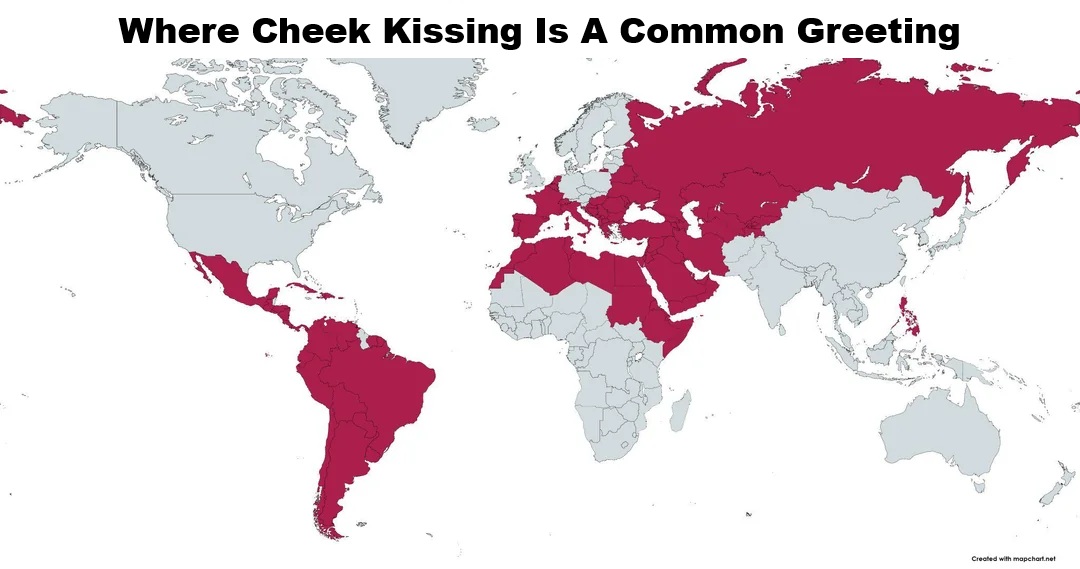
Here’s a bit more about the regional breakdown custom:
- Europe: Cheek-kissing is most common, particularly in Mediterranean and Eastern European countries. Countries like France and parts of the Balkans practice multiple kisses, with numbers varying from 2 to 4.
- South America: Cheek-kissing is prevalent, typically involving 1 or 2 kisses, especially in countries like Brazil and Argentina.
- Middle East and North Africa: The practice exists but is less uniform. Some regions might exchange 2 or more kisses.
- Asia: Cheek-kissing is uncommon in most parts of Asia, except in some Middle Eastern and parts of Southeast Asia.
- North America and Australia: The practice is relatively rare, though some immigrant communities might follow these customs.
And in case you’re wondering Afghanistan is the lone country using 8 kisses, but only in some cases the rest of the time it’s 1. Reddit user Apex2021 explains:
An Afghan there are in-betweens. In my experience It’s 1 kiss when you see someone frequently, 3 for meets of about a week and ~8 when it’s been months since you last saw them and you two are very close. Its more nuannced than that but thats the jist of it. 1, 2 and 3 kisses are the most common.
Why Do People Use Cheek-Kissing as a Greeting?
- Expression of Affection and Warmth:
- Cheek-kissing is a gesture of closeness, used to convey familiarity, friendliness, and affection.
- It creates a personal connection and is often reserved for friends, family, or acquaintances.
- Cultural and Historical Roots:
- Many Mediterranean, Latin American, and European cultures have long-standing traditions of cheek-kissing.
- In some cultures, it originated as a sign of respect or trust and evolved into a broader social norm.
- Symbol of Respect and Status:
- Historically, cheek-kissing was used in hierarchical societies to show deference (e.g., kissing a superior’s cheek or hand).
- Today, it’s often seen as a symbol of mutual respect between peers.
- Non-Verbal Communication:
- It serves as a non-verbal way of greeting that bypasses the need for verbal expressions.
- The number of kisses can carry symbolic meanings in certain regions, such as cultural traditions or specific forms of politeness.
- Breaking Personal Barriers:
- Physical gestures like cheek-kissing help break barriers of formality and make interactions feel warmer and more human.
Alternatives to Cheek-Kissing
- Handshakes:
- Common in professional and formal settings, especially in Western cultures.
- A firm handshake conveys confidence and respect.
- Hugs:
- A common alternative, particularly in more personal or informal settings.
- It signifies closeness and affection, similar to cheek-kissing.
- Bows:
- Used predominantly in East Asian cultures (e.g., Japan, Korea) to show respect and humility.
- The depth of the bow can indicate the degree of respect being expressed.
- Nods or Hand Gestures:
- In some cultures, a nod, wave, or simple hand gesture is sufficient, especially when physical contact is avoided.
- Namaste (or Prayer Hands):
- A traditional greeting in South Asian cultures where hands are brought together in front of the chest with a slight bow.
- It conveys respect and avoids physical contact.
- Verbal Greetings:
- Saying phrases like “hello,” “hi,” or specific cultural phrases (e.g., “Salam,” “Bonjour,” “Ciao”) without accompanying physical gestures.
- Elbow or Fist Bumps:
- Modern alternatives that gained popularity during the COVID-19 pandemic to minimize physical contact.
- Seen as casual, friendly, and hygienic.
- Cheek-to-Cheek Gestures:
- In some cultures, individuals bring cheeks close together and mimic a kissing sound without actual contact.
Why Alternatives Might Be Used
- Cultural Norms:
- In many cultures (e.g., much of Asia, North America), cheek-kissing may be considered overly intimate.
- Health and Hygiene:
- Concerns about spreading germs (especially during pandemics like COVID-19) have prompted people to prefer contactless greetings.
- Personal Preferences:
- Some individuals might feel uncomfortable with physical contact for personal or cultural reasons.
- Contextual Formality:
- Professional or formal settings often avoid cheek-kissing in favor of less intimate greetings like handshakes.
In summary:
What do you think of cheek-kissing as greeting?




Mario says
GREAT INFO…..THANKS….A HEALTHY NEW YEAR TO YOU ALL…Mario/Canada
Nonov Urbiznis says
I come from a cheek-kissing country, and lived for more than 20 years in a no-contact greeting country, and there’s a huge difference on social cohesion between the 2. I’m not claiming cause and effect, but they do have a relationship. When greeting with kisses or a hug, you’re really sharing a moment and space with someone else, saying “We’re together, sharing this moment.” This does not take place in my adoptive country. In fact, one of the secrets of my popularity here is that I go out of my way to touch people when greeting them (I don’t kiss them, as this is too much for most of them!), so they feel this togetherness that they don’t usually feel with other people.
Ina Vleeshouwer says
Dear Nonov,
Thank you for sharing this insight, and your hugs. The world would be a much better place if there were more people like you!
Sincerely,
Ina
Kailani says
You forgot Hawaii. Cheek kissing is cultural.
Dorothy Marette says
Belgium is 3 times, alternating cheeks
François says
3 is the exception in Belgium, it’s for someone close you didn’t see for a while, or for New Year’s midnight wishes. 1 is the default cheek-kissing number (which is confusing when meeting French people).
Allen says
Worked in factories in Mexico MANY times: it is a friendly, consensual and reciprocated Good Morning in all the places I worked.
r c says
do / show hand kissing……………..see also articles about this on ACADEMIA.EDU
A says
I hate it so much! Unfortunately, I live in a kissy country and I DREAD running into people for this reason. I’m very reserved and this feels like a violation of my personal space, I have OCD and worry about germs (I do wash/wipe my face as soon as I can) and on top of that, it makes me feel awkward and freeze while trying my best not to show it.