
Ocean salinity refers to the concentration of dissolved salts in seawater, typically measured in parts per thousand (ppt) or practical salinity units (PSU). The average salinity of ocean water is between 34 and 36 ppt, meaning that for every 1,000 grams of seawater, between 34 and 36 grams are salt.
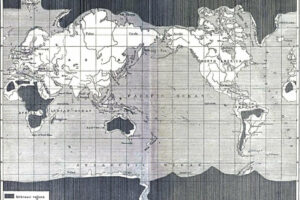
Here is an another map showing the same phenomenon:

I took a dip in the Baltic Sea a few days ago. I couldn’t resist tasting it to see if was different to what I’m used to (Atlantic Ocean, France)… Here’s what I did next:
The water didn’t feel salty at all (it was in Denmark) compared to seawater in Brittany which is much more saltier. And the water from the Gulf of Bothnia, the most remote part of the Baltic Sea has an even lower salinity value.
But then, while processing the data I found to make the map, I found out the Mediterranean sea is super salty. I know what I’ll do when I visit south of France again…
From the map:
SALINITY OF THE WORLD’S OCEANS at surface level, grams per liter
- Baltic Sea 8
- Black Sea 18
- Ocean Average 34.7
- Mediterranean Sea 38
- Red Sea 40
- Dead Sea 340
0.5 – 30: brackish water
30 – 50: seawater
- Areas of low surface salinity are areas of low evaporation with a high freshwater input from rivers…
- High salinity, on the other hand, is synonymous with high evaporation, with little or no freshwater coming from the land.
- Intense rainfall on equatorial regions bringing the surface salinity down.
- In polar areas, denser and cold, salty water doesn’t mix well and goes deep under sea level.
List of the Top 10 Saltiest Bodies of Water
| Salinity, g/100 g (%) | Name | Type | Region or countries |
|---|---|---|---|
| 20.0–50.0 | Lake Elton | salt lake | Astrakhan Oblast, Russia |
| 43.3 | Gaet'ale Pond | salt lake | Ethiopia |
| 40 | Lake Retba | salt lake | Senegal |
| 35 | Garabogazköl | lagoon | Turkmenistan |
| 34.8 | Lake Assal | salt lake | Djibouti |
| 33.8 | Don Juan Pond | salt lake | Antarctica |
| 33.7 | Dead Sea | salt lake | Israel, Jordan, Palestine |
| 32.4 | Lake Tuz (Tuz Gölü) | salt lake | Turkey |
| 31.7 | Great Salt Lake, North Arm | salt lake | Great Basin, Utah, United States |
| 30 | Lake Baskunchak | salt lake | Astrakhan Oblast, Russia |
| 30 | Lake Sărat | salt lake | Brăila, Romania |
Factors Affecting Ocean Salinity
Evaporation and Precipitation:
High Salinity: Areas with high evaporation rates, such as the subtropical regions (e.g., the Mediterranean Sea and the Red Sea), tend to have higher salinity because water evaporates, leaving salt behind.
Low Salinity: Conversely, areas with high precipitation, such as near the equator and in polar regions, have lower salinity. Rain adds fresh water to the ocean, diluting the salt concentration.
River Inflow:
Low Salinity: Where rivers discharge large amounts of freshwater into the ocean (e.g., the Amazon River in the Atlantic Ocean or the Ganges River in the Bay of Bengal), the salinity tends to be lower because the fresh water dilutes the seawater.
Ice Formation and Melting:
High Salinity: In polar regions, when sea ice forms, salt is excluded from the ice, increasing the salinity of the surrounding water.
Low Salinity: Conversely, when ice melts, fresh water is added to the ocean, lowering the salinity.
Ocean Currents:
High Salinity: Some ocean currents, such as those that are part of the global thermohaline circulation, can transport high-salinity water from one region to another. The Gulf Stream, for example, carries salty water from the subtropics to the North Atlantic.
Low Salinity: Cold and less salty currents can reduce salinity in certain regions.
Temperature:
High Salinity: Warmer waters can hold more salt, and regions with higher temperatures may have higher salinity due to enhanced evaporation.
Low Salinity: Colder waters tend to have lower salinity as they often coincide with areas of lower evaporation and higher precipitation.
Examples of Areas with High and Low Salinity
High Salinity:
The Mediterranean Sea: It has high evaporation rates and limited freshwater inflow, resulting in higher salinity (up to 38 ppt).
The Red Sea: One of the saltiest bodies of water due to extremely high evaporation and minimal rainfall, with salinity levels often exceeding 40 ppt.
Dead Sea: The dead sea is the deepest hypersaline body of water at 342 g/kg.
Low Salinity:
The Baltic Sea: It is one of the least saline seas due to low evaporation rates, high freshwater inflow from rivers, and less connection with the open ocean. Salinity can be as low as 1-2 ppt in some parts.
The Bay of Bengal: The region has significant river discharge from the Ganges and Brahmaputra rivers, combined with heavy rainfall, leading to lower salinity levels.
How Salinity Affects Marine Life
Salinity is a crucial factor that influences the distribution, physiology, and behavior of marine organisms.
Different marine species have varying tolerances for salinity levels, and changes in salinity can impact marine ecosystems in several ways:
Osmoregulation in Marine Organisms:
Marine organisms need to maintain the balance of salts and water in their bodies, a process known as osmoregulation. Fish, for example, have specialized cells in their gills to excrete excess salt in salty environments and to absorb salt in less saline waters.
Some organisms, like certain fish (e.g., salmon) and invertebrates, can tolerate a wide range of salinities (euryhaline species) and can live in both marine and freshwater environments. Others (stenohaline species), like coral and many types of fish, are adapted to a narrow range of salinity and can be stressed or even die if salinity levels deviate too much from their optimal range.
Impact on Coral Reefs:
Coral reefs thrive in stable, warm, saline conditions typically between 32-40 ppt. If the salinity is too low (due to freshwater influx from rivers or heavy rainfall) or too high (due to excessive evaporation), corals can suffer stress and potentially bleach or die.
Fluctuations in salinity can impact coral growth rates, reproduction, and resilience to diseases.
Plankton and Salinity:
Plankton, which forms the base of the marine food chain, is sensitive to salinity changes. Phytoplankton (plant-like organisms) and zooplankton (animal-like organisms) distribution is influenced by salinity, and changes can impact the entire food web, affecting fish, marine mammals, and birds.
Species Distribution and Habitats:
Salinity levels dictate the types of species found in a given region. Estuaries, where freshwater from rivers meets the salty ocean, have brackish water and are home to species uniquely adapted to these fluctuating conditions, like oysters and certain fish species.
In hypersaline environments, such as the Dead Sea or some lagoons, only extremophiles (organisms that can withstand extreme conditions) can survive.
How Salinity Affects Ocean Currents
Ocean salinity, along with temperature, plays a critical role in driving ocean currents, particularly through a process known as thermohaline circulation:
Thermohaline Circulation (Global Conveyor Belt):
The thermohaline circulation is a global-scale system of ocean currents driven by differences in temperature (thermo) and salinity (haline) of seawater. This circulation is crucial for distributing heat and nutrients around the globe, influencing climate patterns.
High Salinity and Cold Water: When surface water in polar regions cools and becomes saltier due to evaporation or ice formation, it becomes denser and sinks, driving a deep-ocean current.
Low Salinity and Warm Water: Conversely, warmer, less salty water is less dense and tends to remain on the surface, creating surface currents. The Gulf Stream is an example of a surface current driven by warm, saline water moving from the Gulf of Mexico towards the North Atlantic.
Impact on Climate:
The global conveyor belt helps regulate the Earth’s climate by redistributing heat from the equator to the poles. Changes in salinity due to freshwater influx (from melting ice caps, for instance) can disrupt this circulation, potentially leading to significant climate changes.
For example, a decrease in salinity in the North Atlantic due to increased ice melt could slow down or even disrupt the Gulf Stream, potentially causing cooler temperatures in Western Europe.
Upwelling and Nutrient Distribution:
In coastal areas, changes in salinity and temperature can cause upwelling, where deeper, nutrient-rich water rises to the surface. Upwelling zones are highly productive areas that support rich marine life, including major fisheries.
Variations in salinity can affect the strength and location of upwelling currents, which in turn influences the distribution of nutrients and the productivity of marine ecosystems.




Anthony Hammond says
Super article about ocean salinity which answered the questions I had better than Wikipedia.