
The percentages represent the proportion of each category within the respective states.
- Protestant (34.5%): Represented in shades of red, showing higher percentages in the northern and eastern states. For instance, Schleswig-Holstein (61.5%) and Saxony-Anhalt (53.8%).
- Catholic (32.2%): Represented in shades of green, with higher percentages in the southern and western states. Bavaria (58.6%) and Saarland (68.1%) are examples of states with a high Catholic population.
- Not religious (29.0%): Represented in shades of gray and black, showing higher percentages in the eastern states. For example, Saxony (74.7%) and Thuringia (70.0%).
Here is a full breakdown by state (including Muslims & other groups)
| State | Protestants | Catholics | Not religious | Muslims | Others |
|---|---|---|---|---|---|
| Baden-Württemberg | 37.60% | 40.60% | 16.40% | 2.50% | 3.00% |
| Bavaria | 23.40% | 58.60% | 15.60% | 1.10% | 1.30% |
| Brandenburg | 24.90% | 3.50% | 69.90% | 0.00% | 1.50% |
| Bremen | 51.80% | 7.80% | 39.10% | 0.00% | 1.30% |
| Berlin (former East Berlin) | 14.30% | 7.50% | 74.30% | 1.50% | 2.40% |
| Berlin (former West Berlin) | 32.00% | 12.40% | 43.50% | 8.50% | 3.50% |
| Hamburg | 34.30% | 9.00% | 44.10% | 10.90% | 1.70% |
| Hesse | 50.20% | 21.70% | 22.20% | 3.80% | 2.10% |
| Lower Saxony | 53.80% | 18.70% | 24.10% | 2.50% | 0.90% |
| Mecklenburg-Vorpommern | 24.90% | 3.90% | 70.00% | 0.30% | 0.90% |
| North Rhine-Westphalia | 30.90% | 44.60% | 18.10% | 4.40% | 2.00% |
| Rhineland-Palatinate | 34.80% | 42.40% | 19.60% | 1.00% | 2.10% |
| Saarland | 22.30% | 68.10% | 8.20% | 1.40% | 0.00% |
| Saxony | 27.60% | 4.00% | 66.90% | 0.30% | 1.10% |
| Saxony-Anhalt | 18.80% | 5.10% | 74.70% | 0.30% | 1.20% |
| Schleswig-Holstein | 61.50% | 3.20% | 31.30% | 2.20% | 1.70% |
| Thuringia | 27.80% | 9.50% | 61.20% | 0.00% | 1.50% |
| Germany (ALL) | 34.50% | 32.20% | 29.00% | 2.50% | 1.80% |
The data is from Geis for 2016.
Religion in Germany Map By District (Landkreis)

Why do so many Germans belong to a church?
Several factors contribute to the high church membership in Germany:
- Historical Roots: Germany has a deep historical connection to both Protestantism and Catholicism. Martin Luther, the founder of the Protestant Reformation, was German, and many regions in Germany have long traditions of church membership.
- Cultural Tradition: For many Germans, being a member of a church is part of their cultural identity and heritage. It’s often seen as a continuation of family traditions, even if individuals are not actively religious.
- Church Tax (Kirchensteuer): In Germany, registered church members are required to pay a church tax, which is collected by the state. This tax supports church activities, maintenance, and salaries. While this may seem like a reason for lower membership, it actually provides significant financial support for the churches, allowing them to maintain a strong presence in the community.
- Social Services: Churches in Germany provide a wide range of social services, including kindergartens, hospitals, elderly care, and counseling services. Many people support the church because of these community services, even if they are not particularly religious.
- Legal Recognition: Churches in Germany have a unique legal status and are recognized as public law corporations, giving them certain privileges and responsibilities. This legal recognition can reinforce the role of churches in public and civic life.
- Education and Schools: Religious education is a part of the curriculum in many schools, and there are numerous church-run schools across the country. This educational role helps maintain the churches’ influence and membership.
- Community and Social Networks: Churches often serve as important community centers where people can meet, socialize, and support each other. This community aspect can attract members who value these social connections.
- Ceremonial Functions: Many Germans choose to remain members of a church to participate in important life ceremonies such as baptisms, weddings, and funerals, which are traditionally conducted by the church.
Why is the former East Germany so much less religious than West Germany?
The significant difference in religiosity between former East Germany and West Germany can be attributed to several historical, political, and social factors:
- State Atheism in East Germany: The German Democratic Republic (GDR), or East Germany, was a socialist state with a government that promoted atheism and discouraged religious practice. The state actively promoted secularism and viewed the church as a potential threat to its authority. This led to policies that marginalized religious institutions and reduced their influence in society.
- Suppression of Religion: During the GDR era (1949-1990), religious activities were often suppressed. Churches were closely monitored, and religious education in schools was limited. Public displays of faith could lead to social and professional disadvantages. This suppression contributed to a decline in religious affiliation and practice over time.
- Social and Cultural Shift: Over four decades, the secular policies of the GDR led to a cultural shift where religious practices and identities were not passed down through generations. This break in tradition resulted in lower levels of religious adherence among the population.
- Lack of Religious Institutions: Many churches and religious institutions were weakened or dismantled during the GDR period. Without strong religious institutions, there was less opportunity for community-building around faith, leading to lower religious engagement.
- Economic and Social Factors: The economic and social changes that followed reunification in 1990 also played a role. The rapid transformation and the challenges of integrating into a unified Germany might have further distanced people from religious institutions, as immediate survival and adaptation took precedence.
- Cultural Identity: In East Germany, a secular or atheist identity became a significant part of the cultural fabric. Even after reunification, this cultural identity persisted, leading to continued low levels of religious affiliation.
- Generational Effects: The secular policies of the GDR influenced multiple generations. Older generations who lived most of their lives under the GDR’s atheist policies were less likely to practice or pass on religious beliefs to their children, perpetuating a cycle of secularism.
What was Germany’s religious make-up prior to the Nazis and World War 2?
Germany’s religious mix in 1933, the year the Nazis came to power, was very different than it is today.
Here are the numbers:
- Protestants: 40,865,000 (62.7%)
- Catholics: 21,172,000 (32.5%)
- Jews: 500,000 (0.8%)
- Other (including No religion): 2,681,000 (4.0%)
And finally here’s a great map from Nerdy Maps showing the same thing, again using data from 2011.

And what’s even more interesting is that this divide goes back to the end of the 30 Years War in 1648:
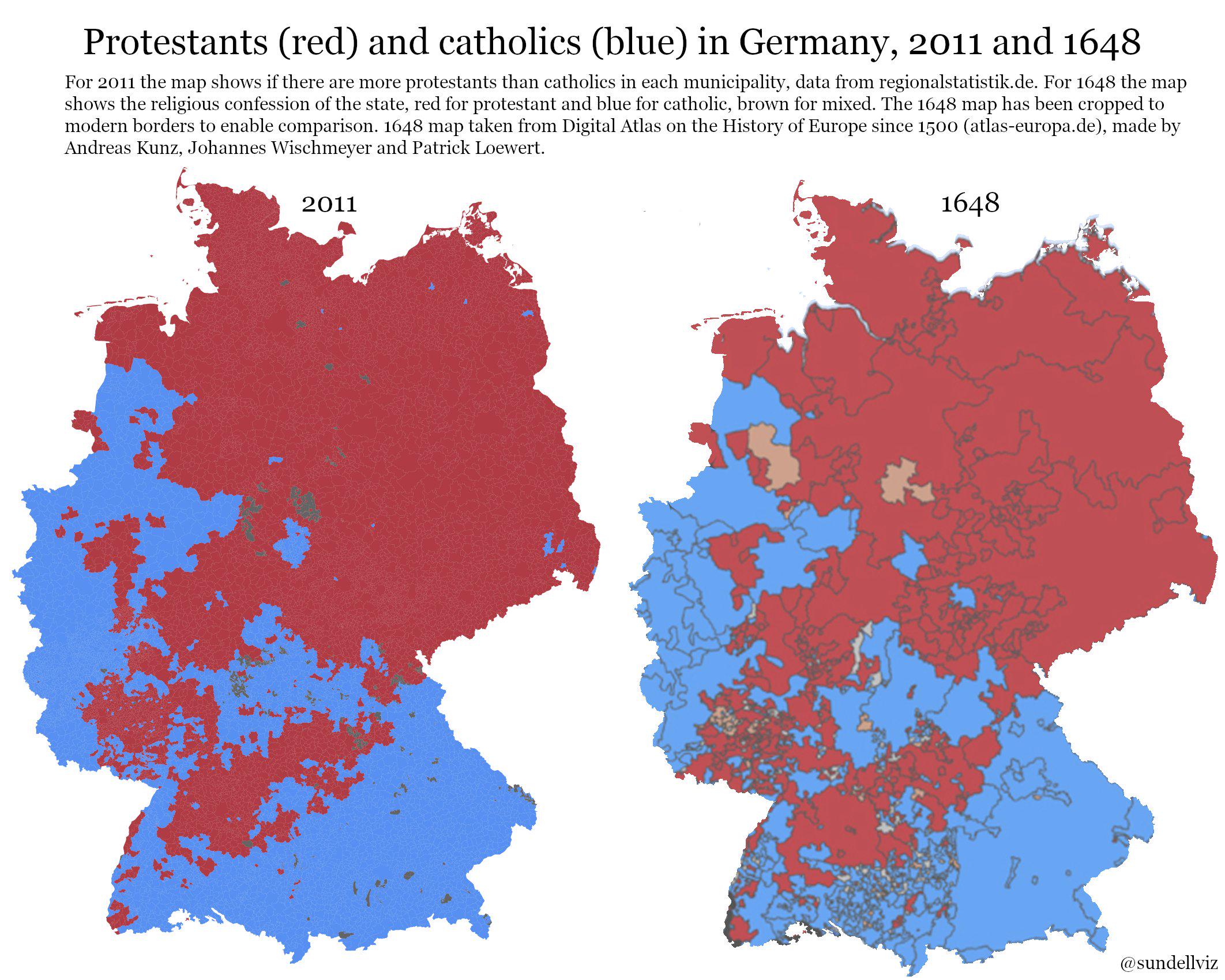
From the map:
Protestants (red) and catholics (blue) in Germany, 2011 and 1648
For 2011 the map shows if there are more protestants than catholics in each municipality, data from regionalstatistik.de.
For 1648 the map shows the religious confession of the state, red for protestant and blue for catholic, brown for mixed.
The 1648 map has been cropped to modern borders to enable comparison. 1648 map taken from Digital Atlas on the History of Europe since 1500 (atlas-europa.de), made by Andreas Kunz, Johannes Wischmeyer and Patrick Loewert.
Does this map surprise you? Please leave your comments below:






Sinon says
Those numbers are completely outdated. Nowadays more than 50% of all Germans follow neither of the big Christian denominations. Here’s a recent overview: https://www.nzz.ch/visuals/in-diesen-staedten-haben-die-kirchen-keine-mehrheit-mehr-ld.1838125
Kaspar says
There’s one religion missing in the map: islamic.
Can you add that?