
The countries shown include the United Kingdom, Ireland, France, Germany, the Netherlands, Belgium, Switzerland, Austria, Spain, Portugal, Denmark, Sweden and Norway.
Here’s what the numbers look like:
| Country | Population in 1950 | Population in 2020 | Population Growth | Population Growth Percentage |
|---|---|---|---|---|
| Germany | 68,000,000 | 83,000,000 | 15,000,000 | 22.1% |
| United Kingdom | 50,000,000 | 67,000,000 | 17,000,000 | 34.0% |
| France | 41,500,000 | 65,000,000 | 23,500,000 | 56.6% |
| Italy | 50,000,000 | 58,000,000 | 8,000,000 | 16.0% |
| Spain | 28,000,000 | 47,000,000 | 19,000,000 | 67.9% |
| Netherlands | 10,000,000 | 17,400,000 | 7,400,000 | 74.0% |
| Belgium | 8,600,000 | 11,500,000 | 2,900,000 | 33.7% |
| Portugal | 8,400,000 | 10,300,000 | 1,900,000 | 22.6% |
| Sweden | 7,000,000 | 10,300,000 | 3,300,000 | 47.1% |
| Austria | 7,000,000 | 8,900,000 | 1,900,000 | 27.1% |
| Switzerland | 4,700,000 | 8,600,000 | 3,900,000 | 83.0% |
| Denmark | 4,200,000 | 5,800,000 | 1,600,000 | 38.1% |
| Norway | 3,200,000 | 5,300,000 | 2,100,000 | 65.6% |
| Ireland | 2,950,000 | 5,000,000 | 2,050,000 | 69.5% |
| Luxembourg (not on map) | 300,000 | 630,000 | 330,000 | 110.0% |
Why did some European countries populations grow so quickly during this period while others did not?
The varying rates of population growth among European countries between 1950 and 2020 can be attributed to a combination of factors including economic conditions, immigration policies, birth rates, and social policies. Here are some key reasons:
Economic Conditions:
- Economic Growth: Countries that experienced strong economic growth, such as Germany and the Netherlands, attracted immigrants looking for better job opportunities. This influx contributed significantly to population growth.
- Industrialization: Post-World War II industrialization in Western Europe led to a demand for labor, which was met by both natural population growth and immigration.
Immigration:
- Immigration Policies: Countries with more open and favorable immigration policies, like Germany and the United Kingdom, saw higher population growth due to the influx of workers from other parts of Europe and the world.
- Labor Shortages: Post-war labor shortages led to guest worker programs in countries like Germany (Gastarbeiter), which initially brought in temporary workers but many stayed permanently.
Birth Rates:
- Fertility Rates: Higher fertility rates in some countries contributed to population growth. For example, France has traditionally maintained higher fertility rates compared to other European countries due to supportive family policies.
- Declining Fertility Rates: Some countries experienced declining fertility rates, which slowed their population growth. This was often seen in Southern European countries like Italy and Spain.
Social Policies:
- Family Support Policies: Countries with strong family support policies, including generous parental leave and childcare support (e.g., France and Sweden), tended to have higher birth rates and thus higher population growth.
- Healthcare: Improved healthcare systems reduced infant mortality rates and increased life expectancy, contributing to population growth.
Historical and Political Factors:
- Post-War Recovery: After World War II, countries like Germany and the United Kingdom underwent significant rebuilding and economic recovery, which attracted workers and boosted population growth.
- Reunification of Germany: The reunification of East and West Germany in 1990 contributed to a significant population increase in Germany as the two populations merged.
Migration Patterns:
- Internal Migration: Rural-to-urban migration within countries also played a role, as people moved to cities for better economic opportunities, leading to urban population growth.
- European Union: The formation and expansion of the European Union facilitated easier movement of people across member countries, affecting population dynamics.
Demographic Trends:
- Aging Population: Countries with an aging population, like Italy and Spain, saw slower population growth due to lower birth rates and higher death rates.
- Young Population: Countries with a younger population structure, such as Ireland, experienced higher growth rates.
And here’s a bonus map of the most commonly spoken languages in Western Europe:
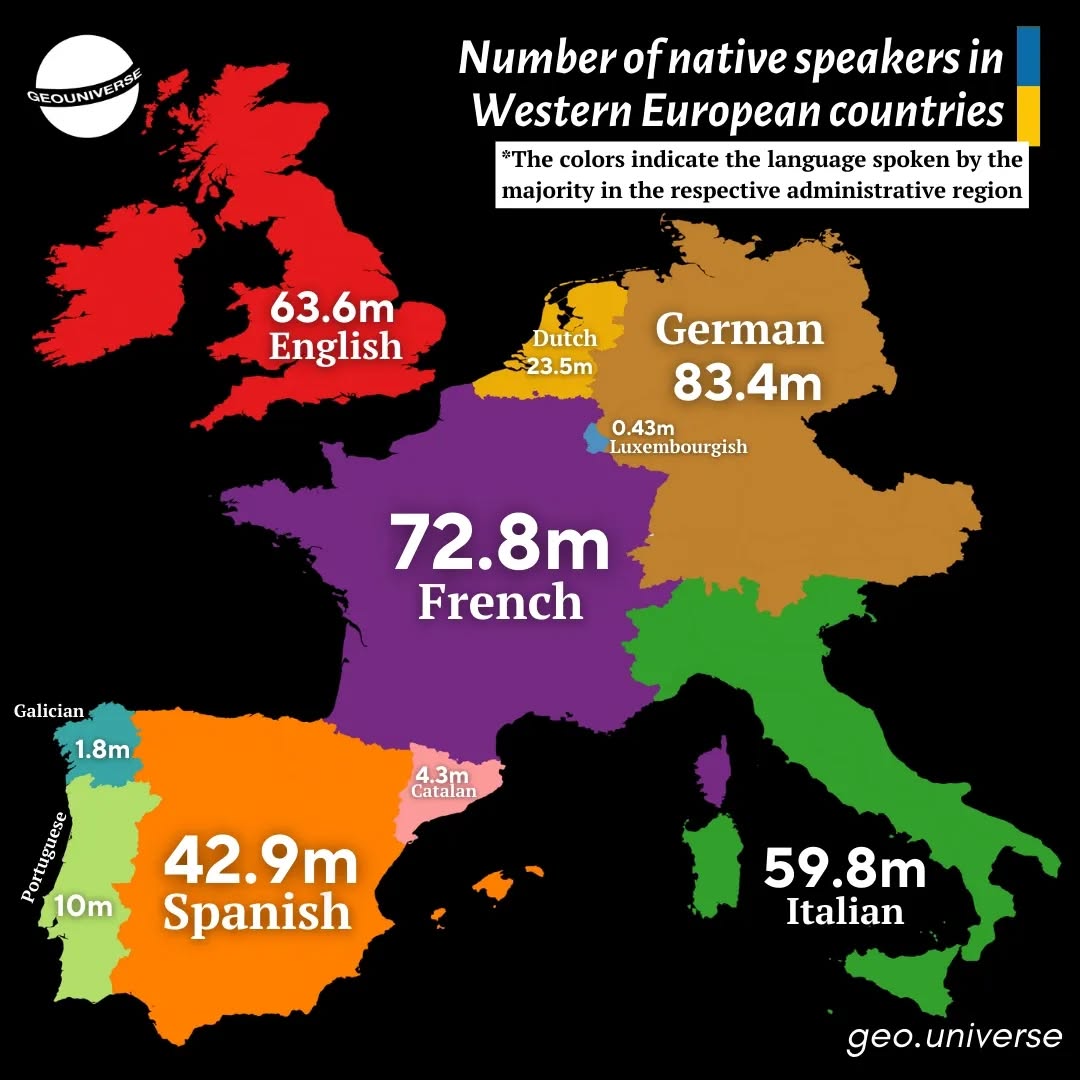
What surprises you most about this map? leave your comments below:





Chris Irwin says
Ref the Number of native speakers in Western European countries map:
How can there be 72.8m French speakers when this several million more than the population of France, even when you include their overseas territories?