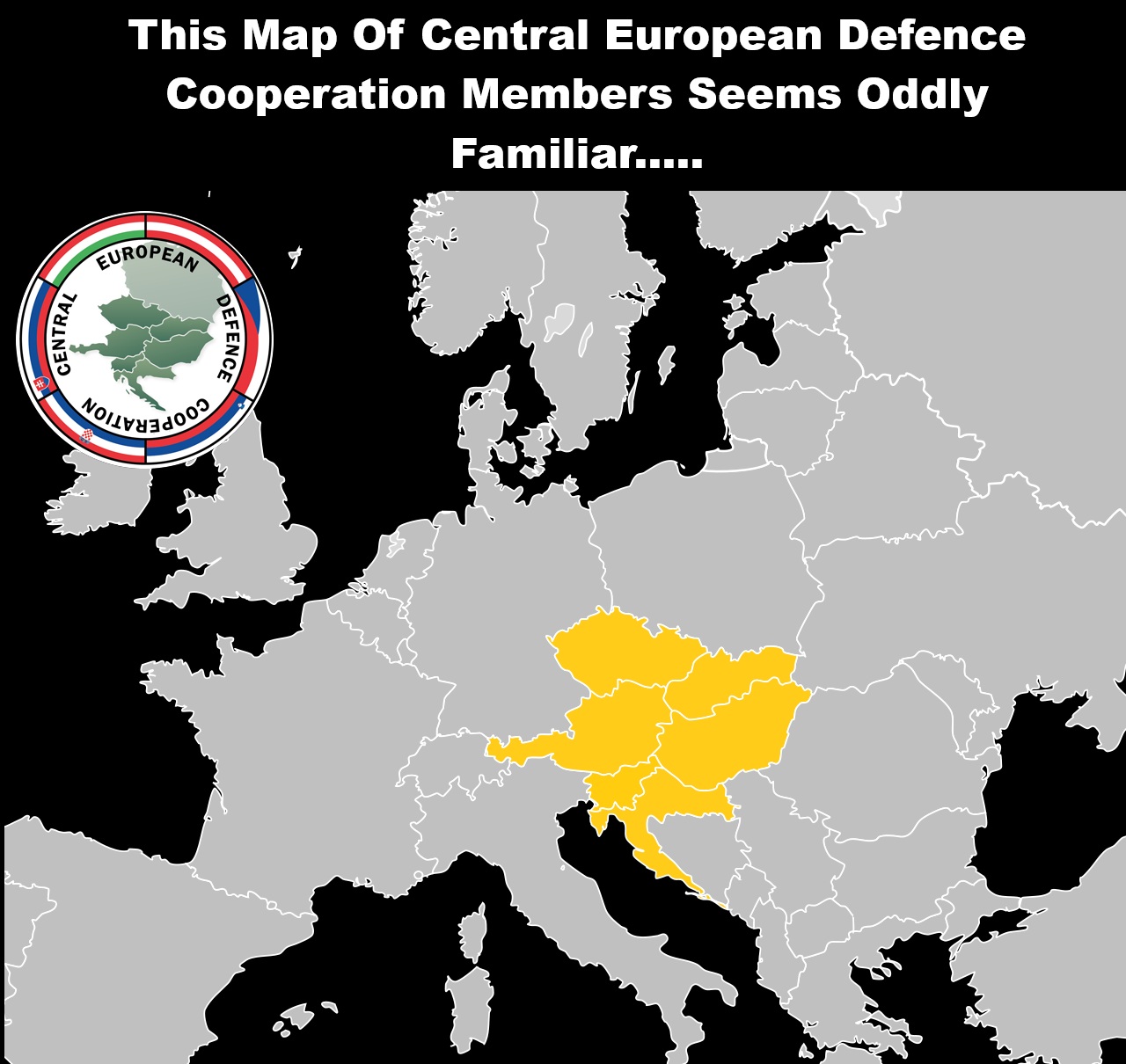
The Central European Defence Cooperation (CEDC) is a regional military and security cooperation initiative established in 2010 at the instigation of Austria and Hungary.
It consists of six full member states:
- Austria
- Croatia
- Czech Republic (Czechia)
- Hungary
- Slovakia
- Slovenia
- Poland also participates as an observer, rather than a full member.
The organisation aims to strengthen military cooperation between Central European countries, improve regional security and allow its members to make better use of their combined defence resources.
All six members are part of the European Union, and all except Austria, which maintains a policy of military neutrality, are members of NATO.
The CEDC is not intended to replace NATO or establish a separate military alliance with its own mutual defence obligations. Instead, it complements existing European defence arrangements. Its chairmanship rotates annually between member countries, with Slovenia holding it in 2026.
What does the Central European Defence Cooperation actually do?
The CEDC focuses on several areas of practical military and security cooperation:
Joint military exercises: Member countries conduct training exercises together, allowing their armed forces to work more effectively alongside one another.
Sharing military resources: Countries cooperate on developing military capabilities, including special forces, pilot training, military medical support and protection against chemical, biological, radiological and nuclear threats.
Border security and migration: Following the European migrant crisis of 2015–2016, the CEDC became an important forum for coordinating military assistance with border security. Its COOPSEC exercises in 2017 and 2019 simulated responses to migration crises.
Military mobility: The organisation works to make it easier to move military personnel, equipment and supplies across national borders.
Disaster relief: Members cooperate on responding to natural disasters and other emergencies, including coordination between military and civilian authorities.
Western Balkan security: Since 2020, the CEDC has operated an expanded cooperation format known as CEDC+, which works with Western Balkan countries to improve regional stability and support their integration into European defence structures.
Defence policy coordination: Defence ministers and military officials meet regularly to discuss common threats and coordinate their positions on European security issues.
So, Why does it look so much like the Austro-Hungarian Empire?
The striking resemblance between the CEDC and the former Austro-Hungarian Empire (1867–1918) is largely a consequence of historical geography.
All six full members of the CEDC were entirely or almost entirely within the borders of Austria-Hungary before its collapse at the end of the First World War.
| Modern country | Status within Austria-Hungary |
| Austria | Core of the Austrian half of the empire |
| Hungary | Core of the Hungarian half of the empire |
| Czechia | Primarily the Austrian crownlands of Bohemia and Moravia, and Austrian Silesia |
| Slovakia | Part of the Kingdom of Hungary |
| Slovenia | Predominantly part of the Austrian half |
| Croatia | Divided between the Austrian and Hungarian halves |
| Poland (observer) | Southern Poland formed part of Austrian Galicia |
The main territories of the former empire missing from the CEDC are Bosnia and Herzegovina, Transylvania and other parts of Romania, western Ukraine, northern Serbia, parts of Montenegro and northeastern Italy.
The resemblance is particularly amusing given that it was Austria and Hungary themselves that proposed the creation of the CEDC in 2010, just 92 years after their empire collapsed.
However, the similarities are not entirely coincidental. The Austrian military explicitly identifies geographical, cultural and historical proximity, alongside shared security challenges, as the basis for the organisation’s cooperation.
The countries also share many of the same strategic concerns, including the security of the Danube region, the Western Balkans and the migration routes through southeastern Europe.
Nevertheless, there is no evidence that the CEDC was designed to recreate Austria-Hungary. Its members are independent, sovereign states cooperating on matters of mutual interest.
Austria-Hungary hasn’t come back, but many of the countries that emerged from its collapse have once again decided that working together on defence makes sense.





Leave a Reply