
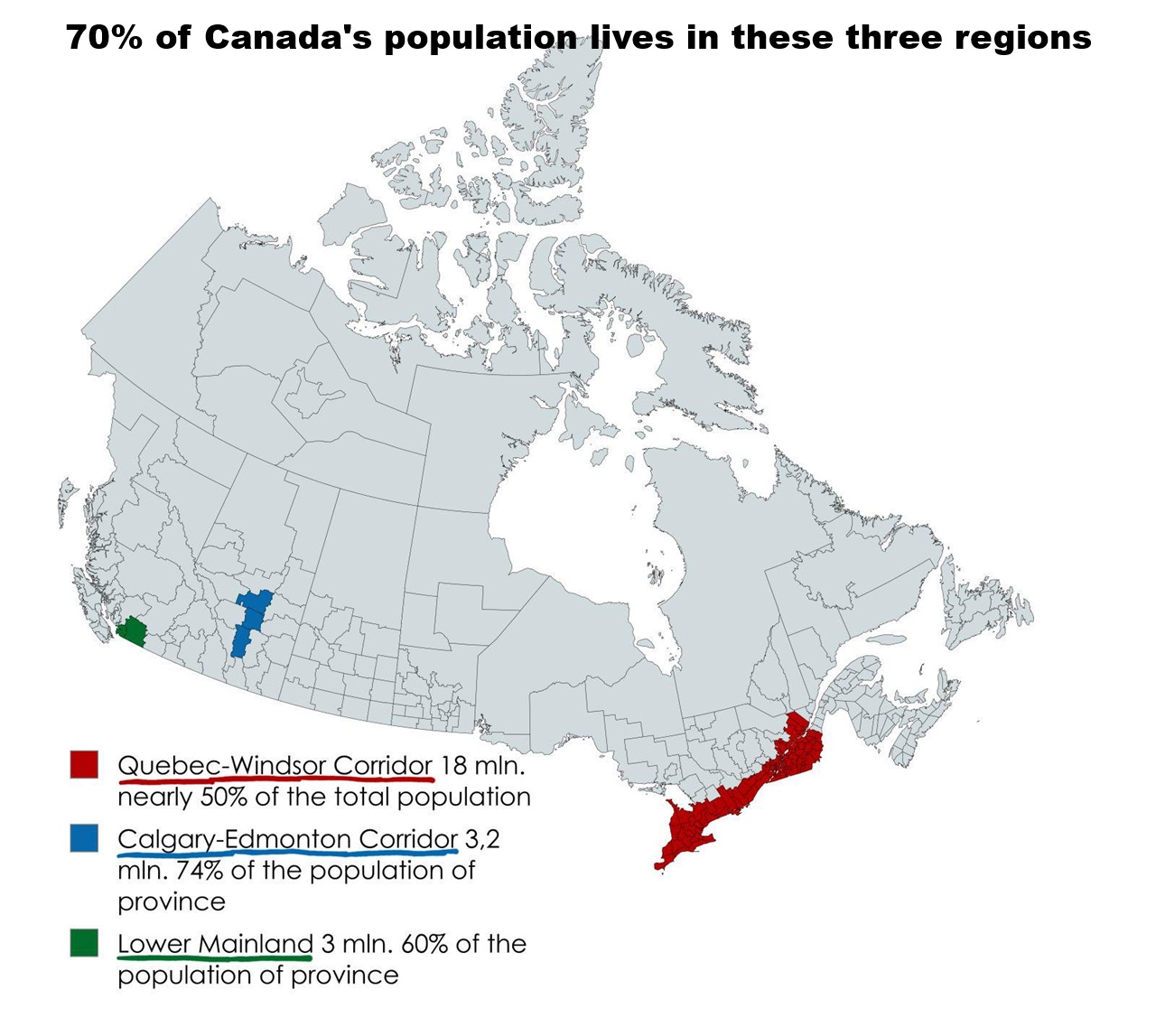
This map highlights how Canada’s population is heavily concentrated in just a few key regions.
Although Canada is the second-largest country in the world by land area, more than 70% of its 40 million residents, or 28 million people live within the coloured zones:
🔴 The Quebec City–Windsor Corridor
Stretching between Toronto, Montreal, and Ottawa, this region alone accounts for over 55% of Canada’s population, with more than 20 million people and seven of Canada’s 12 largest metropolitan areas.
🟢 Greater Vancouver
Canada’s third biggest city, Greater Vancouver is home to around 2.6 million people — despite its relatively small footprint on the map. It contains around 6-7% of Canada’s population.
🔵 The Calgary–Edmonton Corridor
Alberta’s primary population belt, this corridor houses over 3 million people, representing roughly 7–8% of the country’s total population.
In terms of total area the Quebec City–Windsor Corridor covers 230,000 km2 (90,000 sq mi), Greater Vancouver just 2,882.68 km2 (1,113.01 sq mi) and The Calgary-Edmonton Corridor is 38,323.18 km2 (14,796.66 sq mi).
This means in total all 3 areas cover a combined 271,206 km2 (105,910 sq mi) which sounds like a lot but represents just under 3% of the country’s land area or about the same area as the US state of Colorado (population 6 million).
For similar maps see:
Another version of the map:
What do you think?




Leave a Reply