
Here are some quick facts:
- China’s HSR Network:
- World’s longest and most extensively used HSR network.
- Total length: 45,000 kilometres (28,000 miles) by end of 2023.
- Carries 1.3 billion passengers in 2022
- Design speed: 200–380 km/h (120–240 mph).
- Accounts for two-thirds of the world’s total high-speed railway networks.
- Owned and operated by China Railway Corporation under the brand China Railway High-speed (CRH).
- Development and Coverage:
- Rapid development since mid-2000s.
- CRH introduced in April 2007.
- Beijing-Tianjin intercity rail opened in August 2008 as the first passenger dedicated HSR line.
- Extends to all provincial-level administrative divisions and Hong Kong SAR (except Macau SAR).
- Notable HSR Lines:
- Beijing–Kunming high-speed railway: World’s longest HSR line in operation (2,760 km/1,710 mi).
- Beijing–Shanghai high-speed railway: Fastest operating conventional train services.
- Shanghai Maglev: World’s first high-speed commercial magnetic levitation line, top speed of 431 km/h (268 mph).
- Economic Impact:
- 2019 TransFORM study: Estimated annual economic return of 8% for 2015.
- Benefits: Shortened travel times, improved safety, tourism facilitation, labor and mobility improvements, reduced highway congestion, accidents, and greenhouse emissions.
- 2020 Paulson Institute study: Estimated net benefit of $378 billion, with an annual return on investment of 6.5%.
How fast are China’s fastest high-speed trains?
The “fastest” commercial train service can be defined by either its top speed or its average trip speed.
- Peak Operational Speed: The Shanghai Maglev Train holds the record for the highest operational speed, reaching up to 431 km/h (268 mph). However, due to the relatively short length of its track, which is only 30 km (18.6 mi), its average trip speed is 245.5 km/h (152.5 mph). During a test in 2003, the maglev train achieved a Chinese record speed of 501 km/h (311 mph).
- Average Trip Speed: The CRH express service on the Beijing–Shanghai high-speed railway is the fastest in terms of average trip speed. It reaches a top speed of 350 km/h (220 mph) and covers the 1,302 km (809 mi) distance between Shanghai Hongqiao and Beijing South, with two stops, in 4 hours and 24 minutes. This results in an average speed of 291.9 km/h (181.4 mph), making it the fastest train service in the world by average trip speed.
- Fastest Non-Stop Run: The fastest timetabled start-to-stop runs between two stations are the G17/G39 trains on the Beijing–Shanghai high-speed railway, which average 317.7 km/h (197.4 mph) between Beijing South and Nanjing South before continuing to other destinations.
- Top Speed by Non-Maglev Train: The highest speed attained by a non-maglev train in China is 487.3 km/h (302.8 mph), achieved by a CRH380BL train on the Beijing–Shanghai high-speed railway during a test run on January 10, 2011.
List of high-speed railway lines in China
If you want a detailed look at the history of China’s high speed lines I strongly recommend the Wikipedia article. Here is a brief summary:
The original plan, had 4 vertical (North-South) and 4 horizontal lines (East-West):
Original North-South lines:
- Beijing–Harbin high-speed railway – 350 km/h – 1,700 km
- Beijing–Shanghai high-speed railway – 380 km/h – 1,433 km
- Beijing–Guangzhou–Shenzhen–Hong Kong High-Speed Railway – 350 km/h – 2,229 km
- Hangzhou–Fuzhou–Shenzhen High-Speed Railway – 350–250 km/h – 1,495 km
Original East-West Lines
- Qingdao–Taiyuan High-Speed Railway – 250 km/h – 873 km
- Xuzhou–Lanzhou High-Speed Railway – 350 km/h – 1,363 km
- Shanghai–Wuhan–Chengdu High-Speed Railway – 350–200 km/h – 2,078 km
- Shanghai–Kunming high-speed railway – 350 km/h – 2,066 km
In 2016 the original 4+4 network was supplemented by an expanded 8+8 network.
- Eight vertical lines
| No. | Line | Passing Cities | Changes from 4+4 Network |
|---|---|---|---|
| 1 | Coastal corridor (沿海通道) |
Dalian (Dandong)-Qinhuangdao-Tianjin-Dongying-Weifang-Qingdao (Yantai)-Lianyungang-Yancheng-Nantong-Shanghai-Ningbo-Fuzhou-Xiamen-Shenzhen-Zhanjiang-Beihai (Fangchenggang) | Extensions of Hangzhou–Fuzhou–Shenzhen High-Speed Railway; north from Hangzhou to Dalian/Dandong, and south from Shenzhen to Fangchenggang. |
| 2 | Beijing–Shanghai corridor (京沪通道) |
Beijing, Tianjin, Jinan, Nanjing, Shanghai (Hangzhou) | Incorporates all of Beijing–Shanghai High-Speed Railway and other parallel line sections connecting Beijing and Shanghai. |
| 3 | Beijing–Hong Kong (Taipei) corridor (京港(台)通道) |
Beijing-Hengshui-Heze-Shangqiu-Fuyang-Hefei (Huanggang)-Jiujiang-Nanchang-Ganzhou-Shenzhen-Hong Kong (Kowloon) | New line. |
| 4 | Beijing–Harbin, Beijing–Hong Kong (Macau) corridor (京哈~京港澳通道) |
Harbin-Changchun-Shenyang-Beijing-Shijiazhuang-Zhengzhou-Wuhan-Changsha-Guangzhou-Shenzhen-Hong Kong, and Guangzhou-Zhuhai-Macau. | Merger of Beijing–Harbin High-Speed Railway and Beijing–Guangzhou–Shenzhen–Hong Kong High-Speed Railway, with a branch line to Macau. |
| 5 | Hohhot–Nanning corridor (呼南通道) |
Hohhot-Taiyuan- Zhengzhou-Xiangyang-Changde-Yiyang-Shaoyang-Yongzhou-Guilin-Nanning. | New line |
| 6 | Beijing–Kunming corridor (京昆通道) |
Beijing-Shijiazhuang-Taiyuan-Xi’an-Chengdu (Chongqing)-Kunming, including Beijing-Taiyuan-Zhangjiakou-Datong. | New line |
| 7 | Baotou (Yinchuan)–Hainan corridor (包(银)海通道) |
Baotou-Yan’an-Xi’an-Chongqing-Guiyang-Nanning-Zhanjiang-Haikou (Sanya). | New line |
| 8 | Lanzhou (Xining)–Guangzhou corridor (兰(西)广通道) |
Lanzhou (Xining), Chengdu (Chongqing), Guiyang, Guangzhou. | New line |
Eight horizontal lines
| No. | Line | Passing Cities | Changes from 4+4 Network |
|---|---|---|---|
| 9 | Suifenhe–Manzhouli corridor (绥满通道) |
Suifenhe, Mudanjiang, Harbin, Qiqihar, Hailar, Manzhouli. | New line |
| 10 | Beijing–Lanzhou corridor (京兰通道) |
Beijing, Hohhot, Yinchuan, Lanzhou. | New line |
| 11 | Qingdao–Yinchuan corridor (青银通道) |
Qingdao, Jinan, Shijiazhuang, Taiyuan, Yinchuan. | West extension of Qingdao–Taiyuan high-speed railway from Taiyuan to Yinchuan. |
| 12 | Eurasia Continental Bridge corridor (陆桥通道) |
Lianyungang, Xuzhou, Zhengzhou, Xi’an, Lanzhou, Xining, Urumqi. | Extensions of Xuzhou–Lanzhou high-speed railway; east from Xuzhou to Lianyungang, and west from Lanzhou to Urumqi. |
| 13 | Yangtze River corridor (沿江通道) |
Shanghai-Nanjing-Hefei-Wuhan-Chongqing-Chengdu, including Nanjing-Anqing-Jiujiang-Wuhan-Yichang-Chongqing, and Wanzhou-Dazhou-Suining-Chengdu. | Incorporates all of Shanghai–Wuhan–Chengdu high-speed railway and other parallel line sections connecting Shanghai and Chengdu. |
| 14 | Shanghai–Kunming corridor (沪昆通道) |
Shanghai, Hangzhou, Nanchang, Changsha, Guiyang, Kunming. | Route is identical to the Shanghai–Kunming high-speed railway. |
| 15 | Xiamen–Chongqing corridor (厦渝通道) |
Xiamen, Longyan, Ganzhou, Changsha, Changde, Zhangjiajie, Qianjiang, Chongqing. | New line |
| 16 | Guangzhou–Kunming corridor (广昆通道) |
Guangzhou, Nanning, Kunming. | New line |
Other regional lines:
- Guangxi Coastal high-speed railway – 250 km/h – 261 km
- Datong–Xi’an high-speed railway – 200–250 km/h – 859 km
Brief History of High Speed Rail In China
The history of high-speed trains in China is a story of rapid development and innovation over the past few decades. Here is a chronological overview of key milestones:
Early Concepts and Planning
- 1990s: Initial research and planning for high-speed rail (HSR) in China began. The idea was to modernize the rail network and reduce travel times across the vast country.
- 1997: The Chinese government introduced the “Speed Up” campaigns, which gradually increased the speeds of conventional trains.
Early Development and Trials
- 2003: The first major step towards high-speed rail was the introduction of the China Star, a domestically developed high-speed train that reached a speed of 321 km/h (199 mph) during trials. However, it did not enter commercial service due to technical issues.
Launch of High-Speed Rail Services
- 2004: China signed agreements with foreign companies like Alstom, Siemens, Bombardier, and Kawasaki to transfer technology and expertise, which would later be crucial in the development of domestic high-speed trains.
- 2007: The China Railway High-speed (CRH) brand was launched. The first CRH trains began operating on April 18, 2007, significantly reducing travel times on several key routes.
Expansion and Key Milestones
- 2008: The Beijing-Tianjin Intercity Railway opened in August, becoming China’s first passenger-dedicated high-speed rail line. This line allowed trains to operate at speeds of up to 350 km/h (220 mph).
- 2009: The Wuhan-Guangzhou High-Speed Railway opened, extending the high-speed network to southern China.
Rapid Network Expansion
- 2010s: The 2010s saw explosive growth in China’s high-speed rail network:
- 2010: The Shanghai–Nanjing High-Speed Railway and the Shanghai–Hangzhou High-Speed Railway opened.
- 2011: The Beijing–Shanghai High-Speed Railway, one of the world’s busiest and fastest high-speed rail lines, was inaugurated. It covers a distance of 1,302 km (809 mi) and connects two of China’s most important cities.
- 2012: The high-speed network reached over 10,000 km (6,214 mi), becoming the longest in the world.
Technological and Operational Innovations
- 2013-2017: Continued expansion included the opening of the Lanzhou–Urumqi High-Speed Railway, which extended high-speed service into western China, and the Guangzhou–Shenzhen–Hong Kong Express Rail Link.
- 2016: China’s high-speed rail network surpassed 20,000 km (12,427 mi), further cementing its status as the largest in the world.
Recent Developments
- 2020s: By 2023, the network had expanded to approximately 45,000 kilometers (28,000 miles). New lines continued to open, including those connecting less economically developed regions, ensuring comprehensive national coverage.
- Technological Advancements: The introduction of the Fuxing (Rejuvenation) series trains, capable of speeds up to 350 km/h (220 mph), and the continuous development of more advanced models.
Economic and Social Impact
- The high-speed rail network has had a profound impact on China’s economy, reducing travel times, facilitating business and tourism, and contributing to regional development.
- Environmental benefits include reduced greenhouse gas emissions as more travelers opt for rail over air or car travel.
Future Plans
- Further Expansion: Plans are in place to continue expanding the network to reach a target of 50,000 km (31,068 mi) by the mid-2020s.
- Technological Innovations: Continued advancements in high-speed rail technology, including research into new maglev trains and hyperloop systems.
How did China build so much high speed rail so quickly?
China’s rapid construction of its high-speed rail (HSR) network can be attributed to several key factors:
Government Support and Planning
- Strong Government Commitment: The Chinese government has demonstrated a strong commitment to infrastructure development, viewing HSR as a national priority.
- Centralized Planning: The government’s centralized planning allowed for efficient decision-making and coordination across various regions and departments.
Funding and Investment
- Significant Investment: The Chinese government invested heavily in HSR, providing substantial funding through state-owned enterprises and direct government spending.
- Low-Cost Financing: Access to low-cost financing through state-owned banks helped to fund large-scale HSR projects.
Technological and Engineering Capabilities
- Acquisition and Adaptation of Technology: China initially acquired HSR technology through partnerships with foreign companies, which was then adapted and improved domestically.
- Large Workforce: A vast and skilled workforce enabled rapid construction and deployment of HSR projects.
Economies of Scale
- Mass Production: Large-scale production of HSR components, such as trains and tracks, reduced costs and sped up the construction process.
- Standardization: Standardized designs and construction practices increased efficiency and reduced the time needed for planning and building.
Efficient Construction Practices
- Streamlined Construction: Use of advanced construction techniques and equipment facilitated quicker construction.
- 24/7 Construction Schedules: Around-the-clock construction schedules helped expedite project completion.
Political and Social Factors
- Political Will: Strong political will and support from top leadership ensured consistent progress and minimized bureaucratic delays.
- Public Support: Public support and understanding of the long-term benefits of HSR helped to minimize opposition and delays.
Strategic Vision
- Long-Term Vision: The Chinese government’s long-term vision for economic growth and regional development included HSR as a crucial component.
- Integrated Transportation Network: Integration of HSR with other forms of transportation, such as conventional rail, roads, and airports, enhanced the overall efficiency of the transportation system.
Why are western countries so bad at building high speed rail compared to China?
The disparity between the success of high-speed rail (HSR) development in China and the challenges faced by Western countries can be attributed to a variety of factors:
Political and Administrative Factors
- Centralized Government and Planning: China’s centralized government can make swift decisions and implement large-scale projects without the extensive political debate and bureaucratic hurdles often seen in democratic countries.
- Political Will and Long-Term Vision: Chinese leadership has consistently prioritized infrastructure development, including HSR, as a key component of national growth and modernization strategies.
Funding and Economic Factors
- Substantial Government Funding: China has invested heavily in HSR, often through state-owned enterprises and banks. Western countries frequently face budget constraints and competing priorities that limit large-scale infrastructure spending.
- Economic Returns and Justification: In China, HSR has been justified not only for its direct economic benefits but also for its role in regional development and social cohesion. Western countries may struggle to justify the high upfront costs without clear short-term economic returns.
Land Acquisition and Environmental Regulations
- Land Acquisition: In China, the government can more easily acquire land for infrastructure projects, whereas in Western countries, land acquisition is often complicated by property rights, public opposition, and lengthy legal processes.
- Environmental and Regulatory Hurdles: Western countries have stringent environmental and regulatory requirements that can delay projects. While these regulations are important for sustainability, they can significantly slow down the approval and construction process.
Social and Cultural Factors
- Public Support and Acceptance: In China, there is strong public support for HSR as it symbolizes modernization and progress. In contrast, Western countries may face public opposition due to concerns over cost, environmental impact, and changes to local communities.
- Population Density and Urbanization: China’s high population density and urbanization levels create a strong demand for efficient mass transit systems like HSR. Many Western countries have lower population densities, making it harder to justify the high costs of HSR.
Technological and Logistical Factors
- Technological Transfer and Adaptation: China initially benefited from technology transfer agreements with foreign companies, allowing rapid development and domestic adaptation of HSR technology. Western countries often have to develop or adapt technologies domestically, which can be slower and more costly.
- Project Management and Efficiency: China’s ability to manage large-scale projects with efficiency and speed is partly due to experience and streamlined processes. Western countries might struggle with coordination among various stakeholders and managing large projects within time and budget constraints.
Comparative Case Studies
- Spain: Spain has developed a significant HSR network with the AVE trains, showcasing that Western countries can build effective HSR systems. However, the scale and speed of development are much smaller compared to China.
- United States: The U.S. has faced numerous challenges in developing HSR, including political opposition, funding issues, and public resistance. Projects like California’s HSR have experienced significant delays and cost overruns.
Also see:
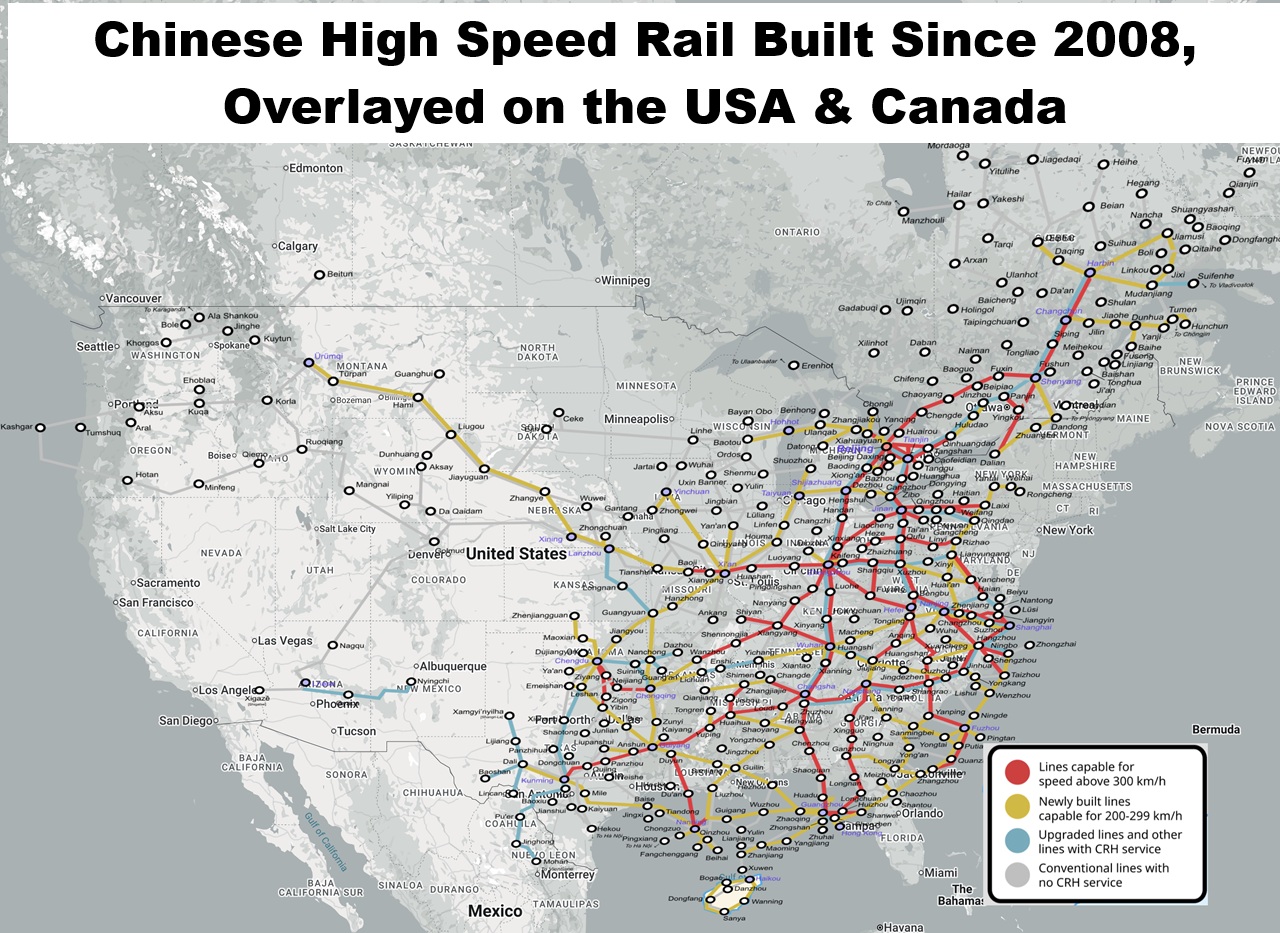
Chinese High Speed Rail built since 2008, overlayed on the USA and Canada





Bic says
Nice piece of research>
Wonder if you have travelled on CNHS rail?
Also an interesting article as i just read this from BBC, in essence how UK can save money by running HS trains more slowly.
https://www.bbc.co.uk/news/articles/czex3lj077xo