
The map above was created by the Center for Eurasian Strategic Intelligence to warn of about growing Russian influence in Europe.
However, the as reddit user adawkin explains:
Wow, the most interesting thing about this are the authors:
So, this map was created by an organization called the “Center for Eurasian Strategic Intelligence”, supposedly a British think tank. (Note they spelled Centre wrong)
This group was created in 2014 in the UK, but ceased operations in 2016, after an internet investigation discovered that most members of the group are made up – starting with their “Chairman and CEO”, supposedly named William Fowler, who’s Facebook profile picture turned out to be a stock image of “Old Gentleman with Glasses”.
The website itself was registered to Abigail Kalopong, a citizen of Vanuatu, who at that time was also a “nominal director” of 59 other companies.
All of those companies were registered to the same adress, a mailbox in London.
They had ties to both Russia and Ukraine (and also Kazakhstan).
The only thing the internet investigation fail to ultimately discover, is whether CESI was run by Ukrainians pretending to be British (who were genuinely anti-Russian because of the war in Donbass); or by Russians pretending to be British while working for Russia (as a dis-information tactic).
PS. If you want to read more, check this blog post… and don’t do what I initially did with my Google search – when you search for this “Center for Eurasian Strategic Intelligence“, Google will also point you to the “Center for Eurasian Studies“, which is a different think tank, this time a Turkish one, and they are all about discovering “the truth” of what they refer by the name of “1915 events” in the Ottoman Empire.
Man, I don’t think I’ll ever trust any organization with “Center” and “Eurasian” in its name.
And from Anton Shekhovtsov’s blog post (linked to above):
At the first glance, the website of CESI seems to be anti-Putin, as it presumably aims to show the threats that Putin’s regime poses to Western democracies.
However, a more nuanced analysis would probably show that the aims of CESI are very different.
To fully understand these objectives, I suggest reading The Menace of Unreality: How the Kremlin Weaponizes Information, Culture and Moneyby Peter Pomerantsev and Michael Weiss.
In this report, the authors, in particular, argue that one of the strategies of the Kremlin’s foreign policy is a reversal of “soft power”: Putin’s aim is not to be attractive, but to present himself as a bogeyman.
CESI pictures Russia as an immediate threat to the West, but it does so in a manner that exaggerates the threat in order to discourage the West from opposing the aggressive politics of Moscow and impel to appease Putin’s Russia at all costs.
Here’s a more updated map from Adorn Mapper.
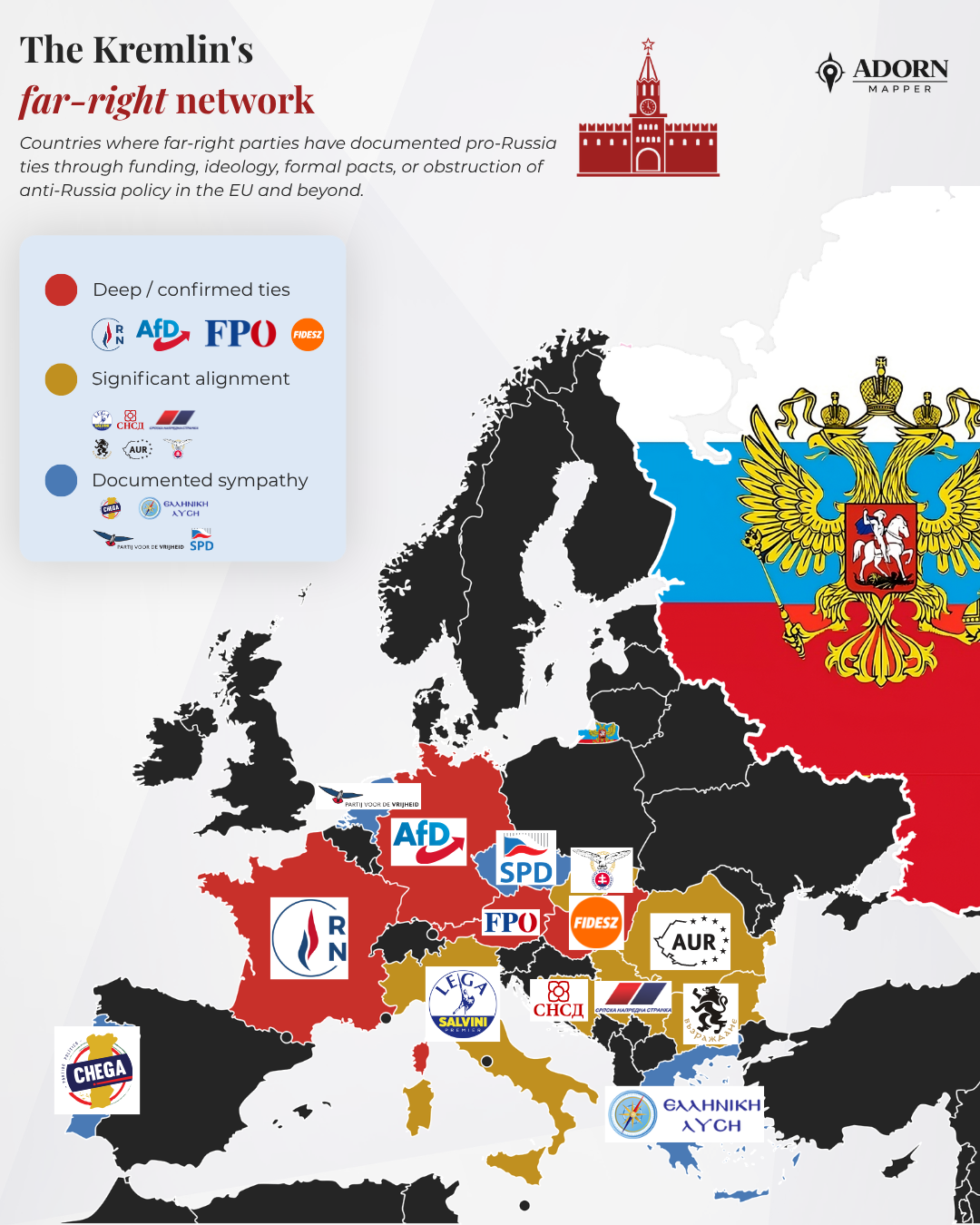
What do you think of the map and Russia’s influence on the West over the past 2 decades?



Tom Kinne says
What strikes me at first glance is that the French Front national has been calling themselves Rassemblement National for at least 7 years and that the German NPD is a totally irrelevant entity in German politics the equally pro-Russian far-right Alternative für Deutschland (AfD) is getting 20 to 30 percent of the votes in some elections and thus is much more of a threat than the NPD.
Steven C says
What I found interesting is that any political party in Europe which actually has policies that favor the native population of that country is always slandered as a “Russian puppet”, “fascist”, or “extremist”.