
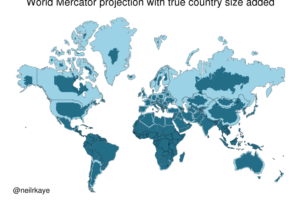
The map above shows one of the world’s craziest population disparities. Bangladesh which is 148,460 km2 (57,320 sq miles), roughly the size of Illinois, has a population of 172 million now 176 million!
This is 28 million 32 million more people than Russia, by far the world’s largest country (17,098,246 km2; 6,601,670 sq miles), which only has 144 million.
To put this another way, Russia has 8 people per km2 (21 per sq mile) vs Bangladesh which has 1,165 per km2 (3,020 per sq mile).
Why does Bangladesh have such a high population density?
Bangladesh has the highest population density of any country in the world with a population over 10 million. This is down to a combination of geographic, historical, and socio-economic factors:
1. Geographic Size and Fertility of the Land
- The country’s alluvial plains, formed by three major river systems (the Ganges, Brahmaputra, and Meghna), are extremely fertile. This fertility has historically supported high agricultural productivity, allowing large populations to thrive.
2. Historical Population Growth
- Bangladesh has experienced rapid population growth over the last century due to high birth rates and improvements in public health. While birth rates have declined in recent decades, the large base population and continued growth mean the population remains very dense.
3. Cultural and Social Factors
- In traditional Bangladeshi society, large families have been valued due to cultural norms, social security in old age, and the agrarian lifestyle where more children mean more labor. Though family planning initiatives have been relatively successful in reducing the birth rate, the effects of past high birth rates continue to be felt.
4. Rural Economy and Migration Patterns
- Bangladesh has a predominantly agrarian economy with limited arable land. As a result, the population is concentrated in fertile areas and cities. Rapid urbanization and migration to cities like Dhaka have exacerbated population density in urban centers.
5. Low Mortality Rates
- Significant improvements in healthcare, access to clean water, and sanitation have decreased infant and child mortality rates. This, combined with the large base population, has contributed to continued population growth.
6. Early Marriage and High Fertility Rates in the Past
- Bangladesh traditionally had early marriage practices, leading to early childbearing and higher fertility rates. While policies have pushed back the average age of marriage, the effects of previous generations’ practices still contribute to the large population.
7. Limited Emigration
- While there is significant migration from Bangladesh to other countries (particularly the Middle East), the rate of emigration is not sufficient to offset the population growth.
8. Lack of Geographic Dispersal
- The country is largely flat with few uninhabitable areas. Unlike countries with large deserts, mountains, or frozen regions, almost all of Bangladesh is habitable and supports agriculture, leading to a very evenly spread population with high density across the entire country.
Why is Russia’s population density so low?
Russia’s low population density, despite being the largest country in the world by land area, is due to several geographic, historical, and climatic factors:
1. Vast Land Area with Harsh Climate
- Russia covers over 17 million square kilometers, but much of this land is in Siberia and the Russian Far East, where conditions are extremely harsh. These regions have long, bitterly cold winters, permafrost, and limited arable land, making them unsuitable for large-scale human settlement. This results in vast areas being sparsely populated or entirely uninhabited.
2. Concentration of Population in the European Part
- While Russia spans two continents, the majority of its population lives in the western part of the country, in the European section. Major cities like Moscow and St. Petersburg are densely populated, but they represent only a small fraction of the country’s total land area. The Asian part of Russia, which makes up about 77% of the country’s territory, is home to only about 20% of the population, contributing to the overall low population density.
3. Historical Factors and Migration Patterns
- Throughout history, Russian settlement has been concentrated in more hospitable western regions. While there have been government programs, especially during Soviet times, to encourage migration to Siberia and the Far East for economic and resource-extraction purposes, these areas have never attracted large populations due to their challenging living conditions.
4. Low Fertility Rates and Aging Population
- Russia has been experiencing low birth rates and an aging population for decades, leading to slow population growth. With a declining or stable population and a vast land area, the population density remains low.
5. Economic Concentration in Urban Areas
- Economic activity is heavily concentrated in a few key cities and regions, leading to significant urban-rural disparities. People tend to migrate toward urban centers for better opportunities, leaving vast rural areas sparsely populated.
6. Geographic Barriers and Inhospitable Terrain
- The vast tundra, taiga (boreal forests), mountains, and remote wilderness areas make large portions of Russia difficult to settle and develop. Many regions are isolated, lacking infrastructure, making them unappealing for large-scale human habitation.
7. Resource-Based Economy
- Russia’s economy is heavily dependent on natural resources, many of which are located in remote areas. While there are some population centers near resource extraction sites, these tend to be small and specialized, further contributing to low overall population density.
8. Historical Conflicts and Demographic Shocks
- Russia’s population suffered significant losses during World War II and other historical events, including famines, purges, and migrations. The recovery from these population shocks was uneven and concentrated mostly in more favorable regions.
Here’s an updated map:

Enjoy this map? Please help us by sharing it:





Leave a Reply