
In that year here’s how large each group was:
Total Population: 573,566
- Greeks: 442,363 (77.1%)
- Turks: 104,333 (18.2%)
- Armenians: 3,630 (0.6%)
- Maronites: 2,752 (0.5%)
- Other: 20,488 (3.6%)
But, as you’ll note Turks could be in both the north and south of the island.
The Muslim population from 1831 – 1960
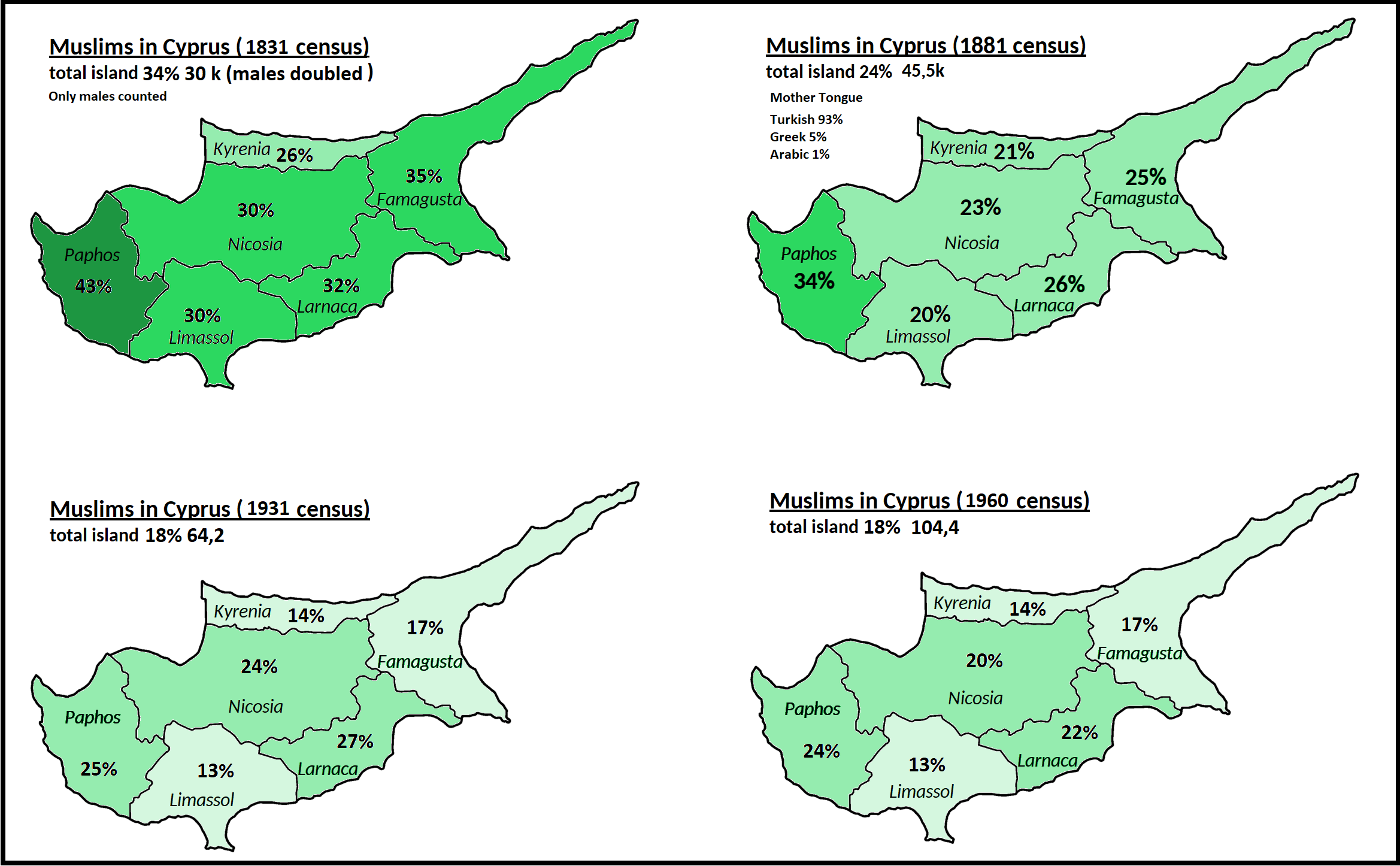
Note: “The 1831 census was done by the Ottomans, 1881 and 1931 by the UK and 1960 by Cyprus.
There was emigration of the Muslims and the Greek population seems to have higher population growth.
The Muslim grew from around 30 thousand in 1831 (when the 15 thousand recorded males are doubled) to 104 thousand in 1960. They fell as a percentage from 34% to 18%.”
Turkish Invasion
The Turkish invasion of Cyprus, also known as the Turkish Peace Operation in Cyprus or the Cyprus Crisis of 1974, was a military intervention by Turkey in response to a coup d’état in Cyprus that was backed by the Greek military junta.
This conflict resulted in the division of the island and had significant and lasting consequences.
Background
- Historical Tensions: Cyprus, an island in the eastern Mediterranean, has a long history of tension between its Greek Cypriot majority and Turkish Cypriot minority. After gaining independence from Britain in 1960, the Republic of Cyprus was established, but intercommunal violence soon erupted between the Greek and Turkish communities.
- Coup d’état: On July 15, 1974, the Greek military junta orchestrated a coup in Cyprus, aiming to unite the island with Greece (a concept known as Enosis). This move threatened the Turkish Cypriot population, and Turkey viewed it as a violation of the constitutional order established under the 1960 agreements that granted Turkey, Greece, and the UK guarantor powers over Cyprus.
The Invasion
- Turkish Military Intervention: On July 20, 1974, Turkey launched a military operation, citing its rights as a guarantor under the 1960 Treaty of Guarantee. The operation was executed in two phases:
- Phase One (July 20-23, 1974): Turkey landed troops in the northern part of the island, seizing control of key areas, including Kyrenia.
- Phase Two (August 14-16, 1974): After failed peace talks in Geneva, Turkey expanded its military presence, eventually controlling about 37% of the island.
- Division of the Island: The invasion resulted in the de facto partition of Cyprus along the “Green Line,” a demilitarized zone controlled by the United Nations. The northern third of the island came under Turkish control, while the south remained under the control of the Republic of Cyprus.
Aftermath
- Displacement: Approximately 200,000 Greek Cypriots were displaced from the north to the south, and around 60,000 Turkish Cypriots moved from the south to the north. This mass displacement created a refugee crisis and significantly altered the island’s demographics.
- Declaration of the Turkish Republic of Northern Cyprus (TRNC): In 1983, the northern part of Cyprus declared itself the Turkish Republic of Northern Cyprus, recognized only by Turkey. The international community continues to consider this area as part of the Republic of Cyprus, making TRNC an unrecognized state.
- Continued Division: Despite numerous negotiations and peace talks over the years, the island remains divided. The UN continues to maintain a peacekeeping force in Cyprus (UNFICYP), and the Green Line still separates the two communities.
- Economic Impact: The division has had profound economic implications. The south, controlled by the internationally recognized Republic of Cyprus, has developed into a prosperous EU member state, while the north has faced economic challenges, relying heavily on Turkish support and facing international isolation.
- Property Issues: One of the most contentious issues is property rights. Many Greek Cypriots lost their homes in the north, and similarly, Turkish Cypriots lost properties in the south. Efforts to resolve these issues, including compensation or restitution, have been a significant stumbling block in peace negotiations.
- Regional Tensions: The invasion and subsequent division have had broader geopolitical ramifications, straining relations between Greece and Turkey and impacting Turkey’s EU accession process.
Demographics Today
Republic of Cyprus (63.7% of the island):
Total Population: 923,272
- Cypriot Greek (98.8%)
- Oher, including Maronite, Other Lebanese, Armenian, Turkish Cypriot (1%)
- Unspecified (0.2%)
Turkish Republic of Northern Cyprus (36.3% of the island)
Total Population: 382,836
- Turks (99.2%)
- Greeks (0.2%)
- English (0.2%)
- Maronites (0.1%)
- Other (0.3%)



Leave a Reply