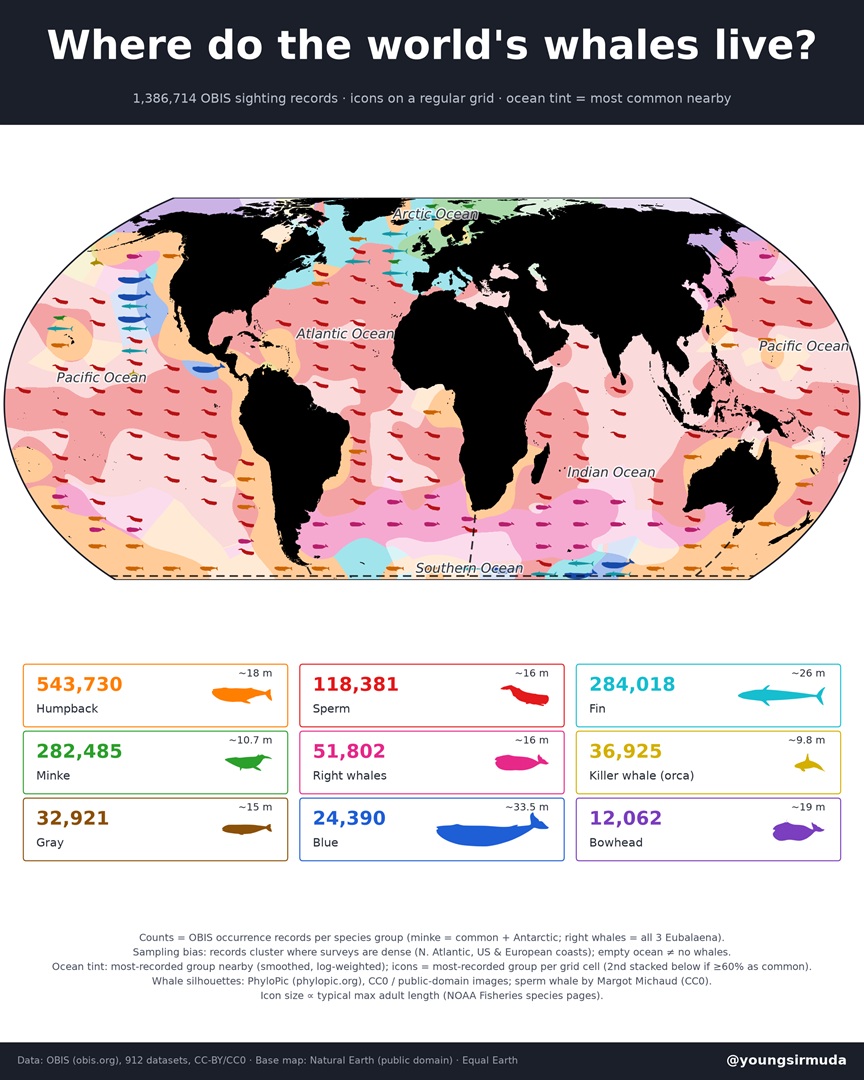
The map above shows the most common species of whale spotted in each part of the ocean. More about the data behind the post below:
Every icon on this map shows the most-recorded whale group in that patch of ocean, and the ocean tint shows which group is most common nearby. It’s built from 1,386,714 occurrence records in the Ocean Biodiversity Information System (OBIS), pooled from 912 datasets.
Humpbacks dominate the records by a wide margin, with 543,730 of them, roughly two in every five.
Fin whales (284,018) and minke whales (282,485) come next, mostly across the North Atlantic.
Sperm whales have fewer records (118,381) but are spread more widely than any other group, turning up in 27,477 map cells.
Gray whales are the opposite: 32,921 records packed into just 841 cells, almost all along the North Pacific coasts.
Icons are scaled by typical maximum adult length from NOAA Fisheries.
The blue whale is the largest at about 33.5 m, though it has only 24,390 records. The orca is the smallest at about 10 m. The rarest group in the data is the Arctic bowhead, with 12,062 records.
Big caveat: these are records, not populations. Sightings cluster where surveys are dense, around the North Atlantic and the US and European coasts. An empty stretch of ocean doesn’t mean there are no whales there, only that nobody logged any.





Leave a Reply