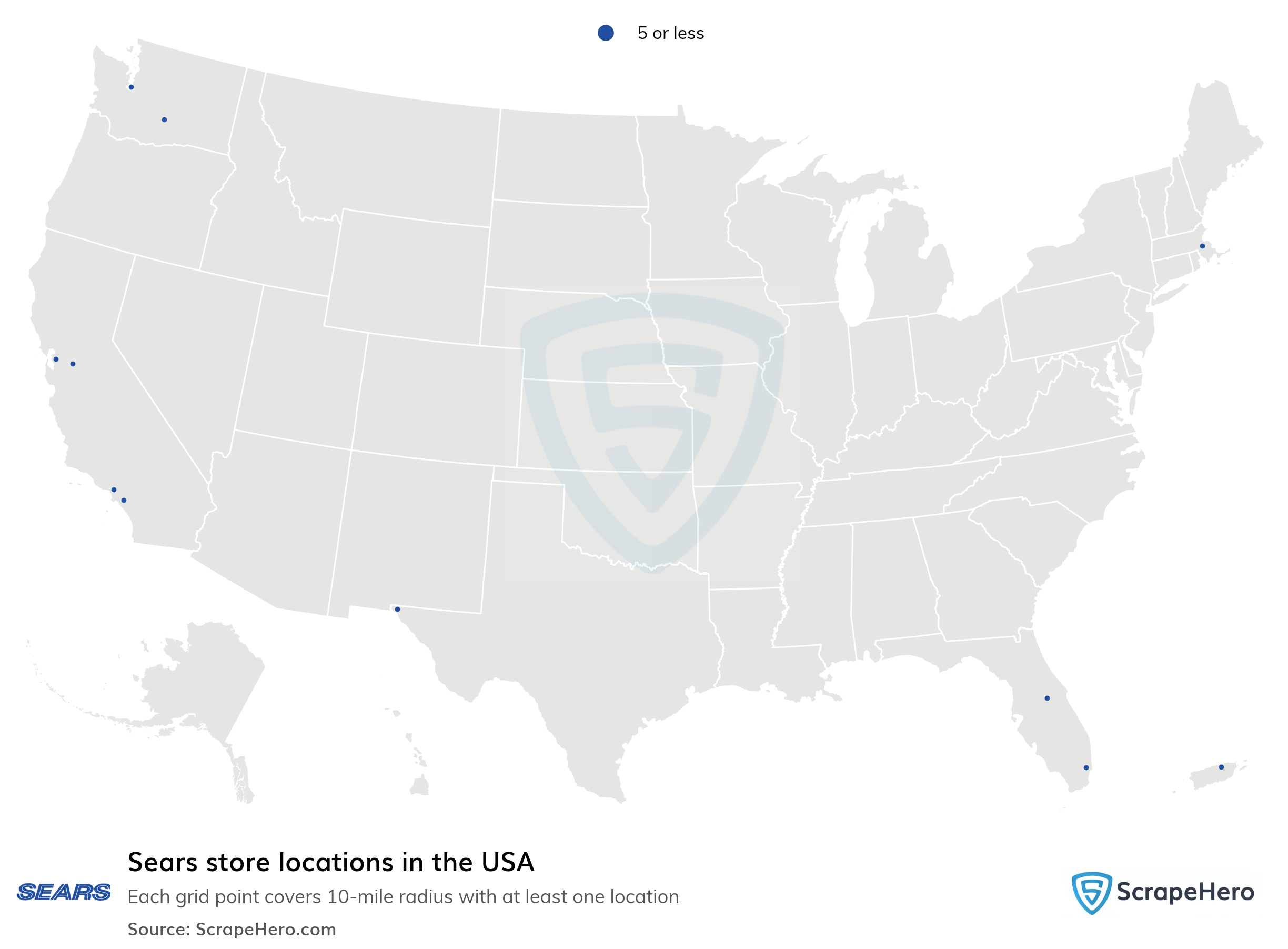
| Name | Street Address | City | State | Zip Code |
|---|---|---|---|---|
| Hato Rey - A | Ave Fd Roosevelt 525 | Hato Rey | PR | 918 |
| Sunvalley Mall | 1001 Sunvalley Blvd | Concord | CA | 94520 |
| Florida Mall | 8001 S Orange Blossom Trl | Orlando | FL | 32809 |
| Whittier - A | 15600 Whittwood Lane | Whittier | CA | 90603 |
| South Shore Plz | 250 Granite St | Braintree | MA | 2184 |
| Coral Gables | 3655 Sw 22nd St | Miami | FL | 33145 |
| Valley Mall | 9 E Valley Mall Blvd | Union Gap | WA | 98903 |
| Weberstown Mall | 5110 Pacific Ave | Stockton | CA | 95207 |
| Media City Ctr | 111 E Magnolia Blvd | Burbank | CA | 91502 |
| Tukwila - A | 301 Southcenter Mall | Tukwila | WA | 98188 |
| Cielo Vista | 8401 Gateway Blvd W | El Paso | TX | 79925 |
Books About Sears
- The 1945 Sears Christmas Book
- The Houses That Sears Built: Everything You Ever Wanted to Know About Sears Catalog Homes
- 1897 Sears, Roebuck & Co. Catalogue
How many sears stores are left and where are they?
As stated above only 11 Sears stores remain in the United States: 4 in California, 2 in Florida, 2 in Washington, 1 in Texas, 1 in Massachusetts and 1 in Puerto Rico.
How many stores did Sears have at its peak?
At its peak, Sears had approximately 3,500 stores in operation.
This number includes both Sears department stores and Sears-owned Kmart stores. The peak of Sears’ retail presence was around the mid-20th century, particularly in the 1970s and 1980s, when the company was the largest retailer in the United States.
What Happened to Sears?
Sears, once a retail giant and a cornerstone of American shopping, has faced a dramatic decline over the past few decades due to various factors. Here are some key points about what happened to Sears:
Historical Background
- Founding and Growth: Founded in 1892 by Richard Sears and Alvah Roebuck, Sears became a retail behemoth, known for its catalog and department stores that offered a wide range of products.
- Peak and Expansion: In the mid-20th century, Sears was the largest retailer in the United States, with a strong presence in both urban and suburban areas.
Decline Factors
- Competition:
- Management Decisions:
- Poor strategic decisions, including the acquisition of Kmart in 2005, which itself was struggling, did not help in turning around Sears’ fortunes.
- Leadership under Eddie Lampert, who became CEO in 2013, was criticized for focusing on cost-cutting rather than investing in the brand and improving customer experience.
- Financial Issues:
- Sears faced mounting debt, which limited its ability to invest in store renovations and technology.
- Declining sales and profitability led to numerous store closures and layoffs.
- Changing Consumer Habits:
- Shifts in consumer preferences toward online shopping and experiences rather than traditional brick-and-mortar stores left Sears struggling to attract customers.
Bankruptcy and Restructuring
- Bankruptcy Filing: In October 2018, Sears Holdings filed for Chapter 11 bankruptcy protection, citing liabilities of $11.34 billion.
- Store Closures: Since filing for bankruptcy, Sears has closed hundreds of stores, leaving only a small fraction of its former footprint.
- Attempts at Revival: Efforts to revive the brand have included selling off assets, reducing store sizes, and attempting to focus on smaller, more profitable locations.
Current Status
- Limited Presence: As of 2024, Sears has a minimal presence in the retail market, with only a few remaining stores and a focus on maintaining its online operations.
- Legacy and Impact: Despite its decline, Sears’ impact on American retail and consumer culture remains significant, with many remembering it as a key player in the retail landscape of the 20th century.
Who owns Sears?
Sears is nowowned by Transform Holdco LLC (also known as Transformco). Transformco is a private holding company formed to acquire the assets of Sears Holdings Corporation after it filed for Chapter 11 bankruptcy in October 2018.
Key Details:
- Formation of Transformco: Transformco was created by Eddie Lampert, the former CEO of Sears Holdings and the head of ESL Investments, his hedge fund. This move was part of a bankruptcy auction to keep parts of the Sears and Kmart brands alive.
- Acquisition of Assets: In February 2019, Transformco officially acquired the assets of Sears Holdings Corporation, including the remaining Sears and Kmart stores, the Kenmore and DieHard brands, and the Sears Home Services division.
- Current Operations: Transformco has been managing the remaining Sears and Kmart stores, although the number of operating locations has continued to decrease. The company has focused on a smaller footprint, online retail, and leveraging its service-oriented businesses like Sears Home Services.
Timeline on the rise and fall of Sears
19th Century: Founding and Early Growth
- 1886: Richard W. Sears founds R.W. Sears Watch Company in Minneapolis, Minnesota.
- 1887: Alvah C. Roebuck joins the company, which becomes Sears, Roebuck, and Co.
- 1892: The company is officially incorporated in Chicago, Illinois.
Early 20th Century: Expansion and Dominance
- 1906: Sears becomes a publicly traded company.
- 1925: The company opens its first suburban retail store in North Lawndale, Chicago.
- 1931: Sears introduces the Allstate insurance brand.
- 1933: Launches first of its Christmas catalogs known as the “Sears Wishbook“
- 1945-1950s: Post-WWII economic boom leads to rapid suburban expansion, and Sears becomes the largest retailer in the U.S.
Mid 20th Century: Peak and Innovation
- 1960s-1970s: Sears continues to expand, opening new stores and becoming a major player in both urban and suburban areas.
- 1973: The Sears Tower (now Willis Tower) is completed in Chicago, becoming the world’s tallest building at the time.
- 1980s: Sears introduces the Discover credit card and continues to expand its product lines and services.
Late 20th Century: Competition and Decline
- 1980s-1990s: Competition from Walmart, Target, and other discount retailers begins to erode Sears’ market share.
- 1993: Sears discontinues its famous catalog, signaling a shift away from its traditional business model.
- 1998: Sears acquires the remaining 50% of Western Auto, expanding its automotive service offerings.
21st Century: Struggles and Bankruptcy
- 2004: Sears merges with Kmart, creating Sears Holdings Corporation.
- 2005-2010s: The combined company struggles with debt, declining sales, and competition from e-commerce giants like Amazon.
- 2013: Eddie Lampert, CEO of Sears Holdings, tries various strategies to turn the company around, including selling off assets and closing unprofitable stores.
- 2018: Sears Holdings files for Chapter 11 bankruptcy protection in October, citing liabilities of $11.34 billion.
- 2019: Transform Holdco LLC (Transformco), led by Eddie Lampert, acquires the assets of Sears Holdings through a bankruptcy auction.
Recent Developments: Minimal Presence
- 2019-2024: Transformco continues to operate a reduced number of Sears and Kmart stores, focusing on a smaller footprint and online operations. The number of stores continues to decline.
- 2024: Sears has a minimal presence in the retail market, with only a few remaining stores and a focus on maintaining its online operations and service-oriented businesses like Sears Home Services.
What made Sears a success?
Sears achieved significant success due to several key factors that positioned it as a retail giant for much of the 20th century. Here are the main elements that contributed to Sears’ success:
1. Innovative Catalog
- Sears Catalog: The introduction of the Sears catalog revolutionized shopping for rural Americans by providing access to a wide range of products that were otherwise unavailable. The catalog offered everything from clothing and household items to farm equipment and even homes.
- Convenience and Variety: Customers could order products by mail and have them delivered to their doorstep, which was a groundbreaking convenience at the time.
2. Strategic Store Locations
- Suburban Expansion: Sears strategically opened stores in suburban areas, which were rapidly growing post-World War II. This made shopping more accessible to the growing middle class.
- Anchor Stores: Sears often served as an anchor store in shopping malls, drawing significant foot traffic and benefiting from the synergy with other retailers.
3. Wide Range of Products
- One-Stop Shopping: Sears offered a diverse range of products under one roof, including clothing, appliances, tools, automotive products, and even financial services. This made it a convenient destination for families.
- Exclusive Brands: Sears developed and promoted its own exclusive brands, such as Kenmore (appliances), Craftsman (tools), and DieHard (automotive batteries), which became well-known for their quality.
4. Customer Service and Satisfaction
- Satisfaction Guarantee: Sears emphasized customer satisfaction and offered a generous return policy, which built consumer trust and loyalty.
- Comprehensive Services: In addition to retail products, Sears provided various services, including automotive repair, home improvement, and insurance, enhancing its value proposition to customers.
5. Innovation and Adaptation
- Retail Innovations: Sears was an early adopter of retail innovations, such as establishing a credit system, which eventually led to the introduction of the Discover credit card.
- Product Lines and Services: The company continuously expanded its product lines and services, adapting to changing consumer needs and preferences.
6. Strong Brand Identity
- Reputation for Quality: Sears built a strong reputation for quality and reliability, particularly with its proprietary brands.
- Marketing and Advertising: Effective marketing campaigns, including the widespread distribution of the Sears catalog, helped establish and maintain brand recognition.
7. Economies of Scale
- Buying Power: As one of the largest retailers, Sears had significant buying power, which allowed it to negotiate favorable terms with suppliers and offer competitive prices to customers.
- Distribution Network: Sears developed an extensive distribution network, which enabled efficient logistics and inventory management.
8. Adaptation to Consumer Trends
- Suburban Growth: By targeting the burgeoning suburban market post-WWII, Sears aligned itself with the demographic and economic shifts of the era.
- Introduction of Services: Recognizing the importance of services, Sears introduced a variety of offerings, such as Sears Home Services, which provided installation, repair, and maintenance services.
Related Stores: