The map above shows District of Columbia and Mississippi side by side at exactly the same scale, using equal-area projections, so their true relative sizes are preserved.
District of Columbia vs Mississippi Geography
Land area
- District of Columbia has a land area of 61 square miles (158 km²), while Mississippi has 46,925 square miles (121,534 km²).
- Mississippi's land area is 769.2 times larger than District of Columbia's.
Total area
- District of Columbia: 68 square miles (177 km²) vs Mississippi: 48,436 square miles (125,448 km²), including inland and coastal water.
- Mississippi's total area is 708.7 times larger than District of Columbia's.
Length
- District of Columbia is 13 miles (22 km) long from north to south; Mississippi is 337 miles (542 km).
- Mississippi's north-south length is 25.9 times longer than District of Columbia's.
Width
- District of Columbia spans 12 miles (19 km) east to west; Mississippi spans 340 miles (547 km).
- Mississippi's east-west width is 28.3 times wider than District of Columbia's.
Highest point
- District of Columbia's highest point is Fort Reno at 429 feet (131 m); Mississippi's is Woodall Mountain at 805 feet (245 m).
- Woodall Mountain is 376 feet higher than Fort Reno.
Lowest point
- District of Columbia's lowest point is Potomac River at 0 feet; Mississippi's is Gulf of Mexico at 0 feet.
- Both lowest points are at or near sea level.
District of Columbia vs Mississippi Population and History
Population
- District of Columbia has a population of 702,250 (2024), while Mississippi has 2,943,045 (2024).
- Mississippi's population is 4.2 times (319%) larger than District of Columbia's.
Population density
- District of Columbia: 11,493.5 people per square mile vs Mississippi: 62.7.
- District of Columbia's population density is 183.3 times higher than Mississippi's.
Biggest city
- District of Columbia's biggest city is Washington with 702,250 people; Mississippi's is Jackson with 141,449.
- Washington's population is 5.0 times (396%) larger than Jackson's.
Largest metro area
- District of Columbia's largest metropolitan area is Washington-Arlington-Alexandria, DC-VA-MD-WV metro area (6,436,489 people) vs Mississippi's Memphis, TN-MS-AR metro area (1,339,345).
- Washington-Arlington-Alexandria, DC-VA-MD-WV metro area's population is 4.8 times (381%) larger than Memphis, TN-MS-AR metro area's.
History
- District of Columbia: The federal district, established by the Residence Act on July 16, 1790; not a state.
- Mississippi: Admitted to the Union on December 10, 1817, as the 20th state.
- In its current form, District of Columbia is the older of the two by 27 years.
District of Columbia vs Mississippi Economy
GDP
- District of Columbia's GDP is $184.3 billion (2024) vs Mississippi's $158.2 billion.
- District of Columbia's economic output is 1.2 times (16%) larger than Mississippi's.
GDP per capita
- District of Columbia: $262,439 per person vs Mississippi: $53,751.
- District of Columbia's GDP per capita is 4.9 times (388%) higher than Mississippi's.
Average income
- District of Columbia: $111,185 vs Mississippi: $52,074 average income per person (per capita personal income).
- District of Columbia's average income is 2.1 times (114%) higher than Mississippi's.
District of Columbia vs Mississippi Counties
Number of counties
- District of Columbia has 1 counties, while Mississippi has 82.
- Mississippi's county count is 82.0 times higher than District of Columbia's.
Biggest county by area
- District of Columbia's largest county is District of Columbia at 61 square miles; Mississippi's is Yazoo County at 922 square miles.
- Yazoo County's land area is 15.1 times larger than District of Columbia's.
Smallest county by area
- District of Columbia: District of Columbia (61 sq mi) vs Mississippi: Alcorn County (400 sq mi).
- Alcorn County's land area is 6.5 times (555%) larger than District of Columbia's.
Most populous county
- District of Columbia: District of Columbia (702,250 people) vs Mississippi: Harrison County (213,730 people).
- District of Columbia's population is 3.3 times (229%) larger than Harrison County's.
Least populous county
- District of Columbia: District of Columbia (702,250 people) vs Mississippi: Issaquena County (1,295 people).
- District of Columbia's population is 542.3 times larger than Issaquena County's.
Richest county
- District of Columbia: District of Columbia ($111,185 per capita income) vs Mississippi: Madison County ($90,668).
- District of Columbia's income is 1.2 times (23%) richer than Madison County's.
Poorest county
- District of Columbia: District of Columbia ($111,185 per capita income) vs Mississippi: Issaquena County ($27,264).
- District of Columbia's income is 4.1 times (308%) richer than Issaquena County's.
District of Columbia vs Mississippi Taxes
State income tax
- District of Columbia has a top income tax rate of 10.75%, while Mississippi has a top income tax rate of 4%.
- District of Columbia's top rate is 6.75 percentage points higher.
Property tax
- District of Columbia: 0.63% effective rate vs Mississippi: 0.65% of home value per year.
- Mississippi's rate is 0.02 percentage points higher.
Sales tax
- District of Columbia: 6% combined state and average local rate vs Mississippi: 7.06%.
- Mississippi's combined rate is 1.06 percentage points higher.
Official Websites
District of Columbia official website · Mississippi official website
Download the District of Columbia vs Mississippi Size Comparison Map for free
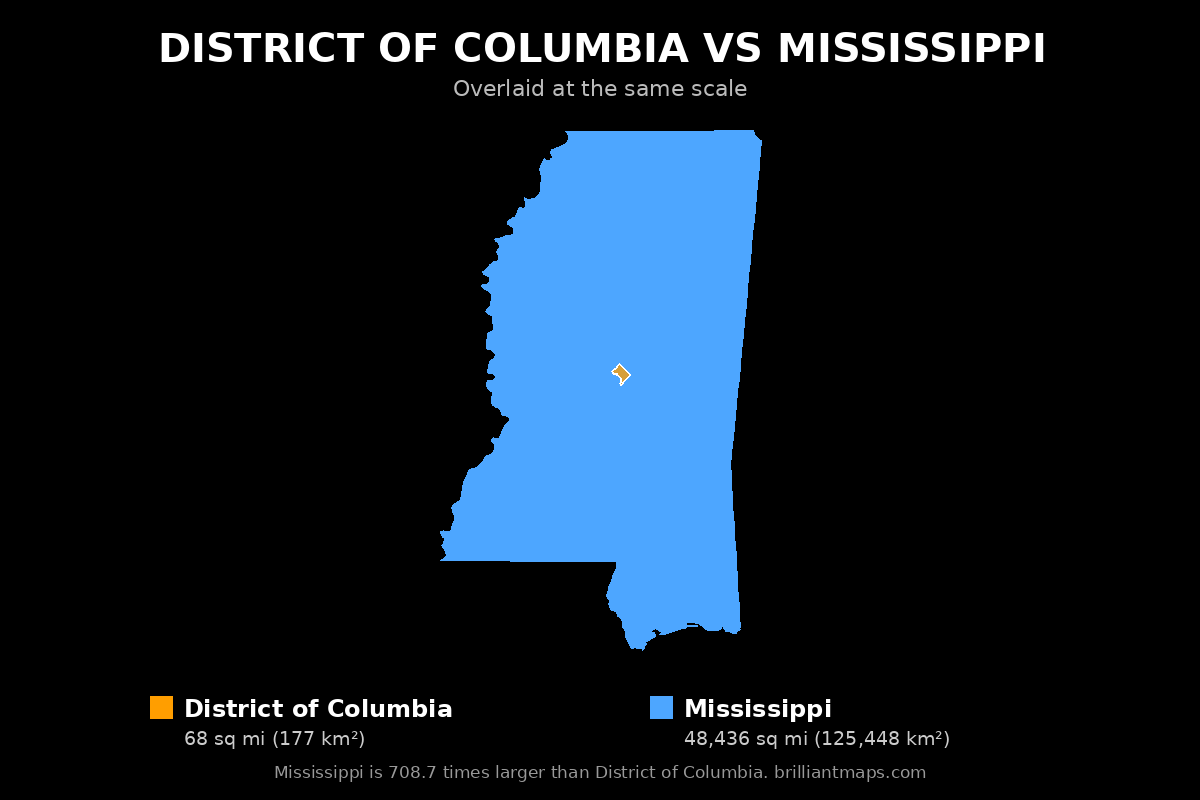
To download the map, right-click the image above (or press and hold on a phone or tablet) and choose Save image as. The map is free to use anywhere, including on your own website or in print, as long as you credit it with a link back to this page or to BrilliantMaps.com.
More Size Comparisons
All District of Columbia size comparisons · All Mississippi size comparisons
Area, elevation and boundary figures come from official national statistics and US Census Bureau and Natural Earth boundary data; US state population, economic, county and tax figures come from the US Census Bureau, the Bureau of Economic Analysis and the Tax Foundation. Figures are rounded and for general reference.