
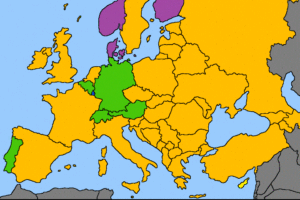
The Platypus is native to Australia, and was not encountered by Europeans until as late as 1798. Yet despite their relatively recent discovery, there is no agreed upon etymology for their name across European languages, as you can see in the map above.
According to Wikipedia: “The scientific name Ornithorhynchus anatinus is derived from ορνιθόρυνχος (ornithorhynkhos), which literally means “bird snout” in Greek; and anatinus, which means “duck-like” in Latin.”
Yet, both the English ‘Platypus’ and Greek ‘Platypodas’ are derived from “flat-foot.” Although in Britain the term duck billed platypus is also used as is the term ornithorynchos (meaning: Chicken-nosed) in Greek.
The romance languages on the other hand have names based on the more scientifically correct “bird-snout.”
Further adding to the confusion, most (but not all), central European names for the animal come from “beak-animal,” whereas those countries that were part of the 19th century Russian Empire refer to it by names originating from “duck-beak.”
Other odd names include: ‘Water Mole’ in Arabic, ‘broad-nose’ in Icelandic (which tries to avoid loan words), ‘duck-billed mammal’ in Hungarian and ‘water beak animal’ in Finish.
On top of their somewhat odd appearance the platypus is also the only mammals that lay eggs instead of giving birth and is one of the few venomous mammals.
Its history is also rather interesting:
George Shaw, who produced the first description of the animal in the Naturalist’s Miscellany in 1799, stated it was impossible not to entertain doubts as to its genuine nature, and Robert Knox believed it might have been produced by some Asian taxidermist. It was thought that somebody had sewn a duck’s beak onto the body of a beaver-like animal. Shaw even took a pair of scissors to the dried skin to check for stitches.
You can learn more about the Platypus from the following books:
- Platypus: The Extraordinary Story of How a Curious Creature Baffled the World
- A Platypus, Probably
- Platypus! (Step into Reading)
Know anyone else who likes Platypuses (aka platypodes aka platypi)? Then please share this map with them:






Krajcsik Béláné says
The hungarian term is duck-beak mammal.
Mak Vujanović says
Accurate Croatian translation would be something like “strange/odd beak-animal”. 🙂
Jau says
Belarusian language has its own Latin alphabet and two variants of its name: Kačkanos or Kačkadziub.
Darcy says
The Platypus isn’t actually the only egg laying mammal. Another Australian Marsupial, the Echidna, does the same.
Jan Willem says
The Dutch word actually isn’t beak-animal, but bird-beak-animal.
angryfinn says
Finnish, not Finish…
Masoud says
Arabic is incorrectly shown for non-Arab regions where Kurdish (N Iraq, SE Turkey, and NW Iran) and Persian (Iran) are spoken. It is an entirely different word in both languages.