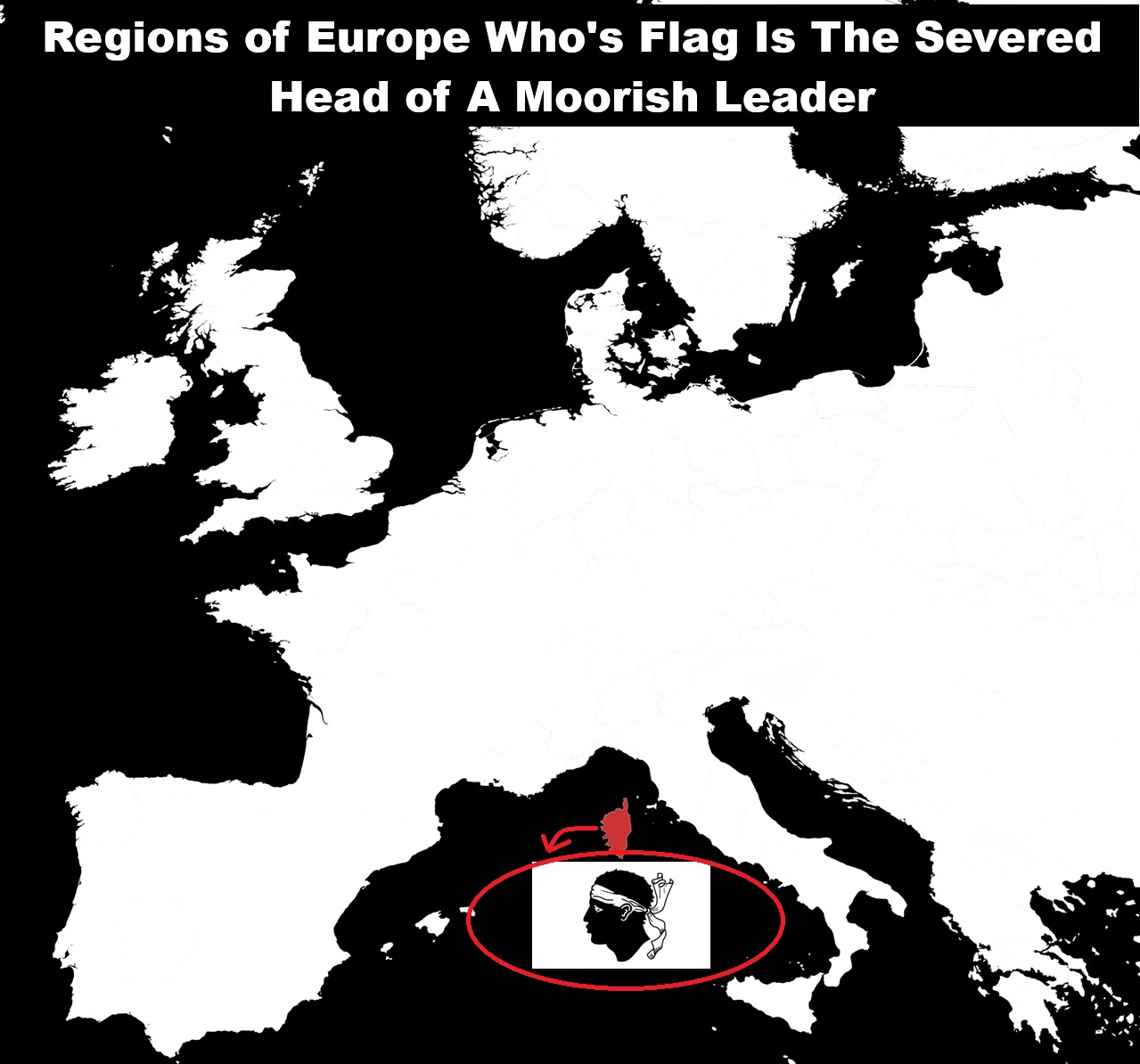
The flag of Corsica (Corsican: A bandera testa mora or simply A Bandera) shows a black Moor’s head in profile wearing a white bandana (or headband) tied above the eyes, set against a plain white background.
Although it looks like a severed head, its exact origin is uncertain and surrounded by several competing legends.
Why?
According to Wikipedia:
“According to the legend, it originates from the 13th century when a young Corsican woman named Diana was captured by Moorish slavers who planned to sell her to the slave market of Granada. Her fiancé Pablo managed to free her and a battle ensued between Corsicans and Moors, during which the Moorish leader Mansour Ben Ismaïl was beheaded. His severed head then became the symbol of Corsica in remembrance of the event.”
However, there are some other explanations:
The Moor’s Head (Testa di Moru): This motif comes from medieval European heraldry, especially linked to the Crown of Aragon.
It originally commemorated Christian victories over Muslim (“Moorish” or Saracen) forces during the Reconquista.
The most commonly cited historical root is the Battle of Alcoraz (1096), after which Aragonese arms featured Moor’s heads. Corsica appeared with an unblindfolded Moor’s head in the late-14th-century Gelre Armorial as a claimed Aragonese territory.
The same symbol appears (with four heads) on the flag of neighboring Sardinia.
Popular Corsican legends offer more dramatic origin stories.
One well-known tale involves a young woman named Diana kidnapped by a Moorish leader (often called Mansour Ben Ismaïl); her fiancé rescues her, the Moor is killed and beheaded, and the head becomes a trophy of victory against raiders. These stories are folklore rather than verified history, but they reinforce the idea of the island defending itself against external threats.
The White Bandana: This is the most important symbolic detail today.
In earlier versions the white cloth was often a blindfold covering the eyes, marking a defeated or captive enemy (a common heraldic convention).
In the mid-18th century, Pasquale Paoli (leader of the short-lived independent Corsican Republic) ordered the bandana raised above the eyes onto the forehead. This change, formalized around 1755–1762, deliberately transformed the meaning: the Corsicans were no longer “blind” under Genoese rule; they could now see clearly and were free.
Paoli also removed earlier attributes such as earrings or a necklace that suggested captivity. The open-eyed version became the official emblem of the Corsican nation.During periods of French control after 1769, some patriots deliberately used the older blindfolded version as a form of protest.
Historical Context and Modern Use
Paoli’s republic (1755–1769) made the flag a national symbol of Enlightenment-inspired independence and self-rule.
After French annexation it largely fell out of official use (though it appeared briefly during the Anglo-Corsican Kingdom of 1794–1796). It was officially restored as the regional flag of Corsica in 1980 and remains a ubiquitous marker of Corsican cultural pride and distinctiveness, flown far beyond strictly nationalist circles.
What do you think?





Jelle Helsen says
Sardinia has 4 times the Moorish heads compared to Corsica.