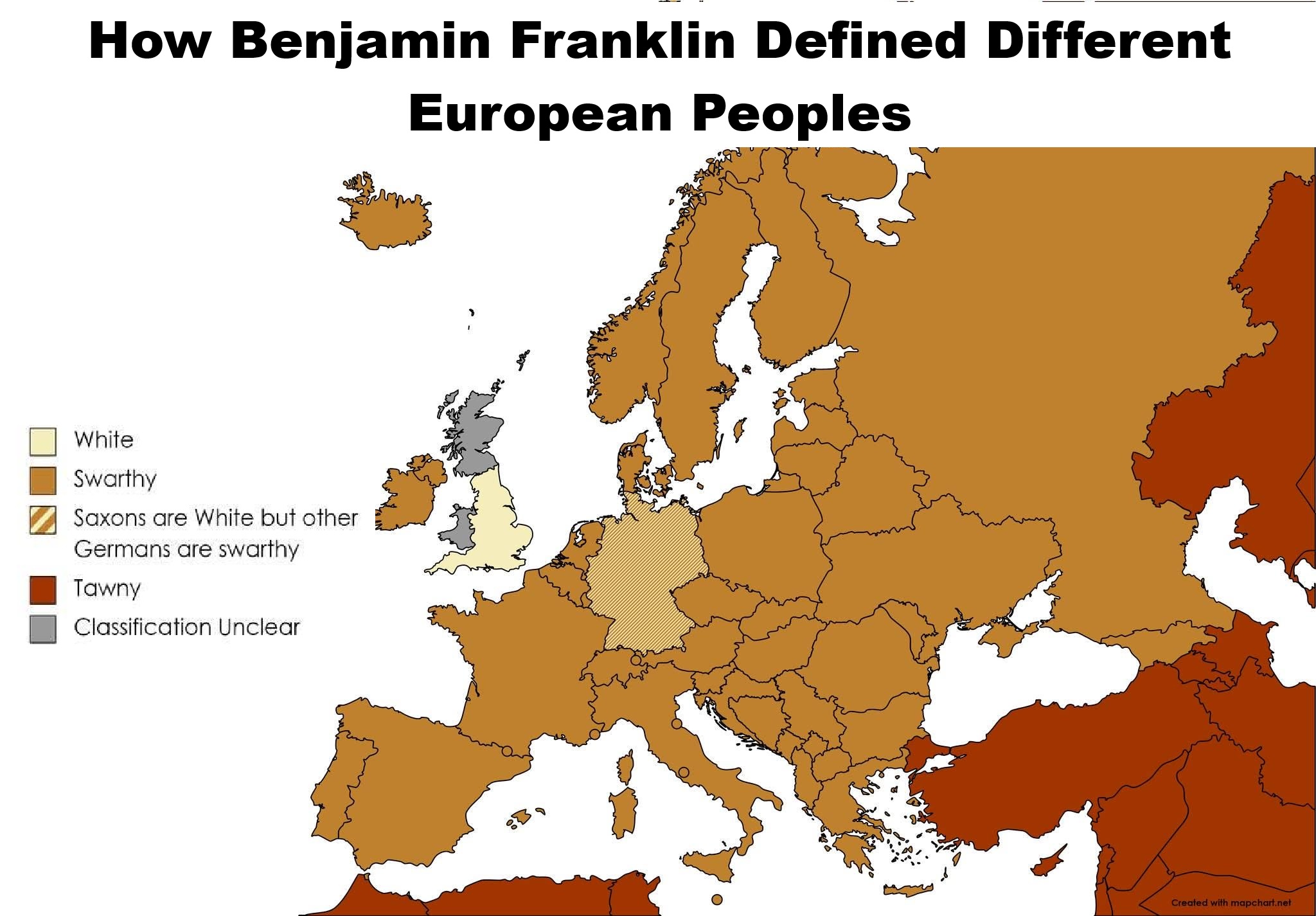
One important caveat: Franklin was not laying out a systematic racial map of Europe.
He was talking about “complexion”, and the map extrapolates his comments onto modern borders, including countries he never explicitly classified.
Franklin wrote that the number of “purely white” people in the world was relatively small.
He described Africans as “black or tawny,” Asians as “chiefly tawny,” Indigenous Americans as “wholly” tawny, and then called Spaniards, Italians, French, Russians, Swedes and most Germans “swarthy.”
The exceptions, in his view, were the English and Saxons, whom he regarded as the principal “white” peoples.
Here is roughly what the terminology meant in mid-18th-century English:
- White: Franklin seems to mean an exceptionally fair or pale complexion, rather than exactly the modern American racial category “white.” Samuel Johnson’s contemporary dictionary defined “fair,” when describing complexion, as essentially not black or brown; white. So Franklin’s claim that French or Swedish people were not “purely white” sounds much stranger to us than it necessarily would have sounded when “white” could be used literally as a shade of complexion.
- Swarthy: meant dark-complexioned, dusky or brownish. Johnson’s dictionary defined it as “dark of complexion; black; dusky; tawney.” Importantly, it did not necessarily mean someone was considered African or “Black” in the modern racial sense. An Englishman with dark skin, hair and features could also be called swarthy. Franklin was effectively saying that Frenchmen, Spaniards, Russians, Swedes and most Germans looked darker than his idealized English/Saxon norm.
- Tawny: literally a yellowish-brown or tan colour. Johnson defined it as “yellow, like things tanned.” In European descriptions of people it was a very broad and imprecise colour term applied to populations Europeans perceived as brown-skinned, including Asians, Indigenous Americans and sometimes North Africans.
- “Saxons are white but other Germans are swarthy:” This comes directly from Franklin. By “Saxons” he meant people associated with Saxony, not all Germanic peoples. The map’s striped section therefore represents an attempt to translate this statement geographically. Franklin offered no rigorous biological reason for the distinction.
- Classification unclear: this is the mapmaker’s category, not Franklin’s. Franklin never tells us, for example, precisely where Scots, Welsh, Poles, Norwegians or many other Europeans fit. Any colouring of those areas therefore requires inference.
Why was Franklin saying this?
The context is crucial.
The passage comes immediately after Franklin complains about German immigration into Pennsylvania.
He worried that German-speaking settlers would remain culturally separate and “Germanize” Pennsylvania rather than become Anglicized. He complained that they were maintaining their own language and customs and then jumped directly from that cultural argument to their “complexion.”
So the passage is partly about skin colour, but it is also about English ethnic nationalism and assimilation.
Franklin was essentially putting the English at the top of a preferred hierarchy and using appearance to reinforce his preference for English immigration.
That also means the often-repeated claim that “Benjamin Franklin didn’t consider Germans, Frenchmen or Swedes white” needs qualification.
He really did call them “swarthy” and reserve “purely white” primarily for Englishmen and Saxons, but this was not necessarily equivalent to saying they belonged to a legally or socially separate “race” in the later American sense.
Scholars have described the passage as a racialization of Franklin’s hostility toward German immigrants rather than a formal racial taxonomy.
There’s another interesting wrinkle: Franklin himself closes the passage by admitting that he may simply be “partial to the complexion of my Country.” In other words, even he recognized that his preference for English appearance was subjective.
And his racial views evolved considerably over his lifetime.
By 1790, shortly before his death, Franklin was president of the Pennsylvania abolition society and submitted a petition to Congress calling for action against slavery and the slave trade.
So the best title for the map would probably be something like “How Benjamin Franklin Described European Complexions in 1751”, rather than “Race According to Benjamin Franklin.”
The latter makes his remarks look more like a coherent modern racial classification system than they actually were.
What do you think?



Leave a Reply