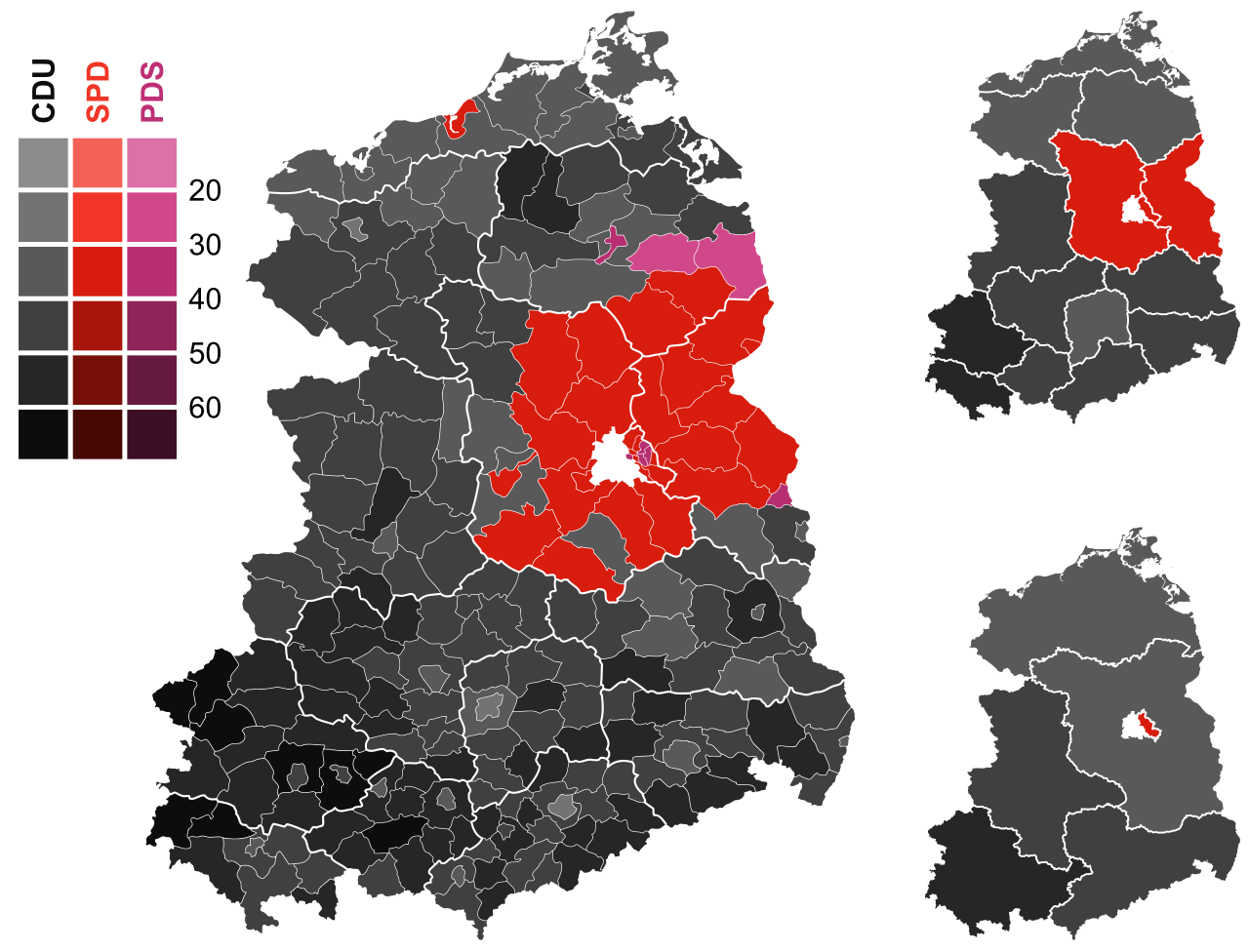
East Germany would join West Germany later that year on October 3rd.
More about this election and more maps below:
How Elections Worked in East Germany (GDR) (Prior to 1990)
The National Front System
At the center of the system was the: National Front of the German Democratic Republic.
How it worked:
- All legal parties and organizations joined the National Front
- Before elections, they agreed on a single candidate list
- Seats in the Volkskammer (parliament) were pre-allocated
- Voters could only approve or reject the entire list
In practice:
- Voting “yes” = just drop the ballot unchanged
- Voting “no” = cross out names (visible, risky)
Result:
- 95–99% approval rates were typical
- Elections were about demonstrating unity, not choosing leaders.
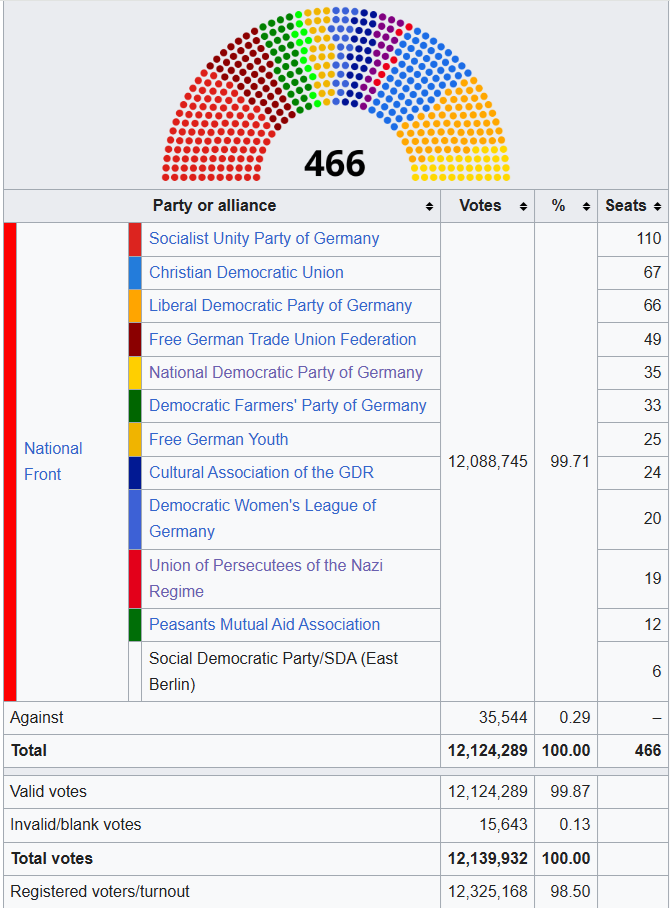
Here are the results of the first East German “election” in 1950:
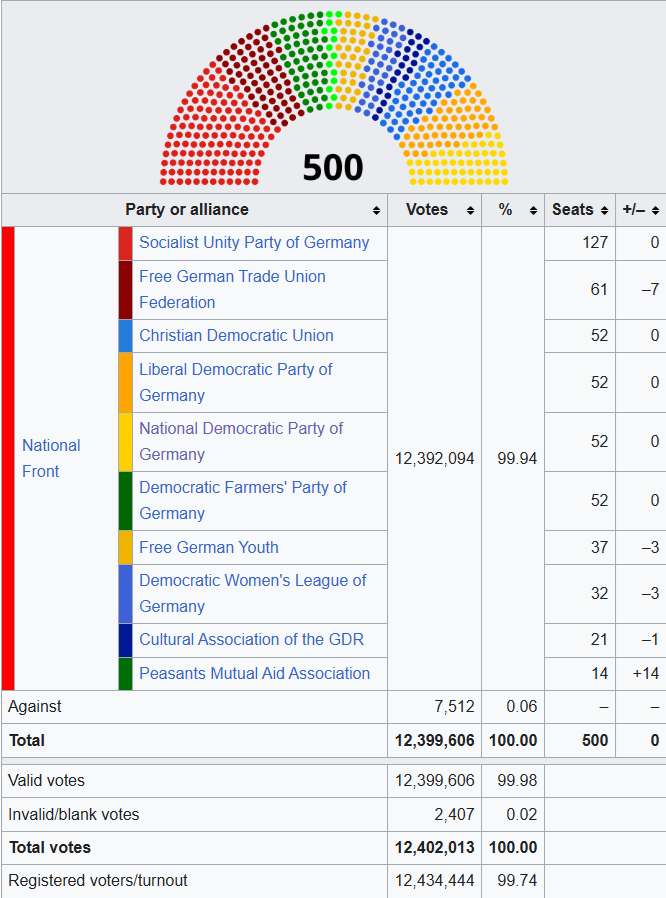
and here are the results of the last one before the collapse of the National Front system in 1986:
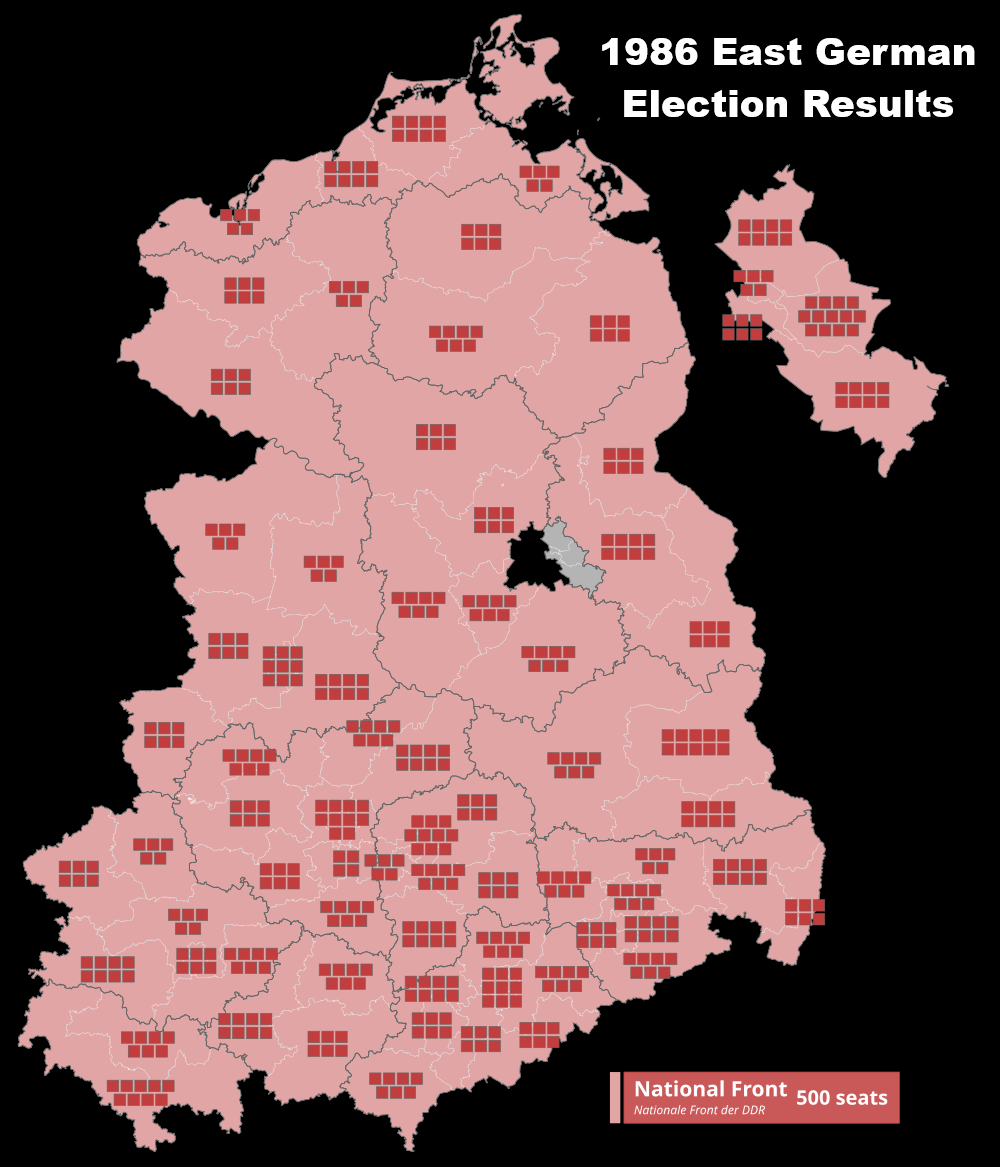
Map of the 1986 Election
Who Held Real Power?
The system was dominated by the: Socialist Unity Party of Germany
Even though multiple parties existed:
- The SED controlled policy, appointments, and state institutions
- Other parties were called “block parties” and followed its lead
Political Parties (Block Parties)
Socialist Unity Party of Germany (SED)
- Ideology: Marxism-Leninism
- Founded: 1946 (forced merger of communists + social democrats)
- Leader figures: Walter Ulbricht, Erich Honecker and Egon Krenz
Role:
- The true governing authority of the GDR
- Controlled:
- Government ministries
- Military and police
- The Stasi (secret police)
- Made all major decisions behind the scenes
Christian Democratic Union (CDU – East Germany)
- Ideology (official): Christian democracy, social conservatism
- Target group: religious citizens, middle-class conservatives
In reality:
- Accepted socialism and SED leadership
- Provided a “religious-friendly” face to the regime
- Helped integrate church-going citizens into the system
Unlike its West German counterpart, it was not independent.
Liberal Democratic Party of Germany (LDPD)
- Ideology (historical): Liberalism, civil rights, private enterprise
- Target group: professionals, small business owners
In practice:
- Abandoned true liberal opposition
- Supported:
- State-led economy
- Socialist policies
- Served as a bridge to middle-class citizens
It preserved liberal traditions symbolically, but not politically.
National Democratic Party of Germany (NDPD)
- Founded specifically by the regime
- Target group:
- Former Nazis
- Wehrmacht veterans
- Nationalists
Purpose:
- Prevent these groups from opposing the state
- Reframe nationalism into “socialist patriotism”
Unique role: Absorbed potentially hostile groups into the system
Democratic Farmers’ Party of Germany (DBD)
Represented: farmers and rural communities
Role:
- Helped enforce and legitimize:
- Collectivization of agriculture
- Encouraged farmers to join state-run cooperatives
Important function: Reduced rural resistance to socialist reforms
Mass Organizations (Not Parties, but Politically Important)
These groups were part of the National Front and had guaranteed seats in parliament.
Free German Trade Union Federation (FDGB)
- State-controlled trade union
- Represented workers, but:
- No independent labor action
- Promoted productivity & state goals
Free German Youth (FDJ)
- Official youth organization
- Focus:
- Political indoctrination
- Social activities
- Membership strongly encouraged
Democratic Women’s League of Germany (DFD)
- Represented women’s interests
- Promoted:
- Gender equality (within socialist framework)
- Workforce participation
Cultural Association of the GDR (Kulturbund)
- Organization for:
- Intellectuals
- Artists
- Encouraged cultural life aligned with socialism
Peasants’ Mutual Aid Association (VdgB)
- Supported farmers, especially during collectivization
- Provided:
- Resources
- Political integration into the regime
Union of Persecutees of the Nazi Regime (VVN)
- Represented victims of Nazism
- Important for:
- Anti-fascist legitimacy of the GDR
- Later reorganized but remained symbolic
Key Takeaway About the System
Even though it looked pluralistic:
- All parties and groups were subordinate to the SED
- Elections were confirmatory, not competitive
- The National Front ensured pre-arranged outcomes
The 1990 Election: Why This Election Was Different?
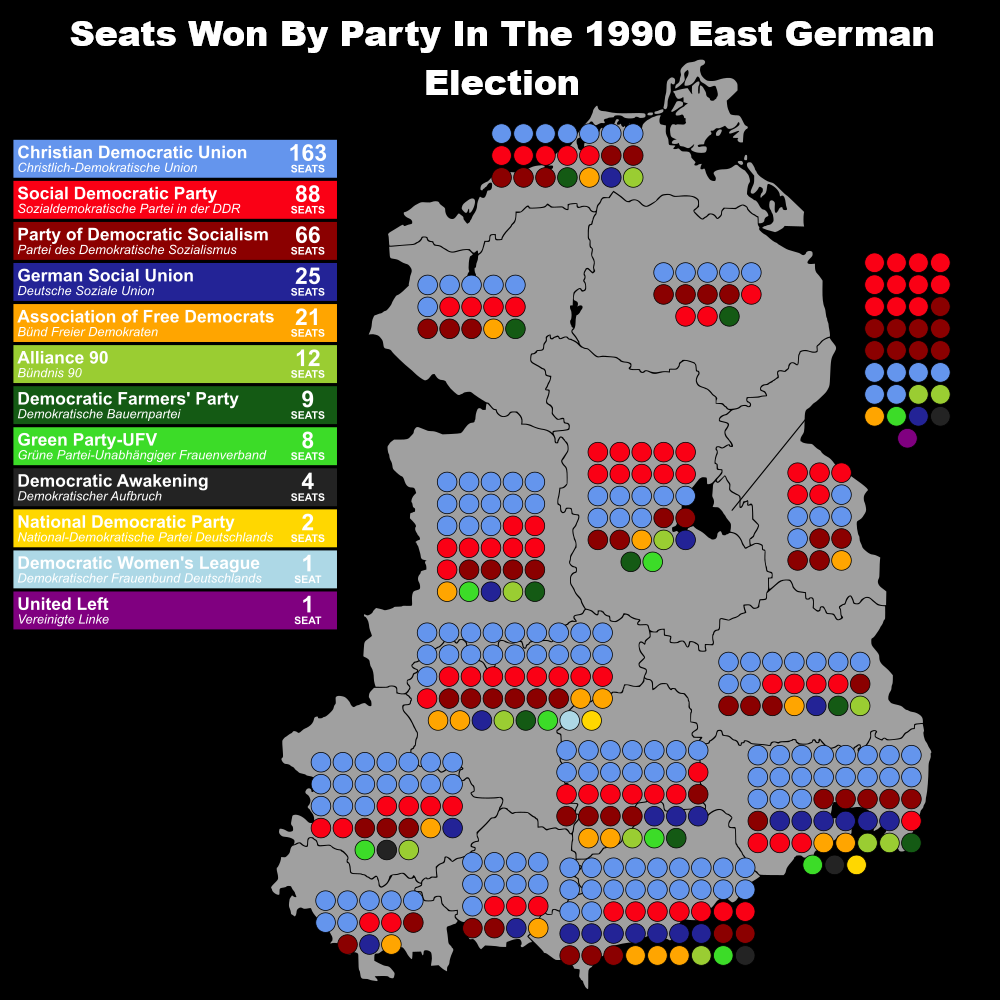
- The Berlin Wall had fallen
- The ruling system of the GDR had collapsed
- The National Front structure was effectively dead
The election (March 18, 1990) became: The first and only free, competitive election in East German history.
It also quickly turned into a referendum on: Reform vs. rapid reunification with West Germany.
Main Parties and Alliances
Alliance for Germany (Winner)
A coalition backed heavily by West German conservatives:
- East German Christian Democratic Union (CDU)
- German Social Union (DSU)
- Democratic Awakening (DA)
Position:
- Rapid reunification with West Germany
- Adoption of the West German economic and political system
- Introduction of the Deutsche Mark as soon as possible
Result:
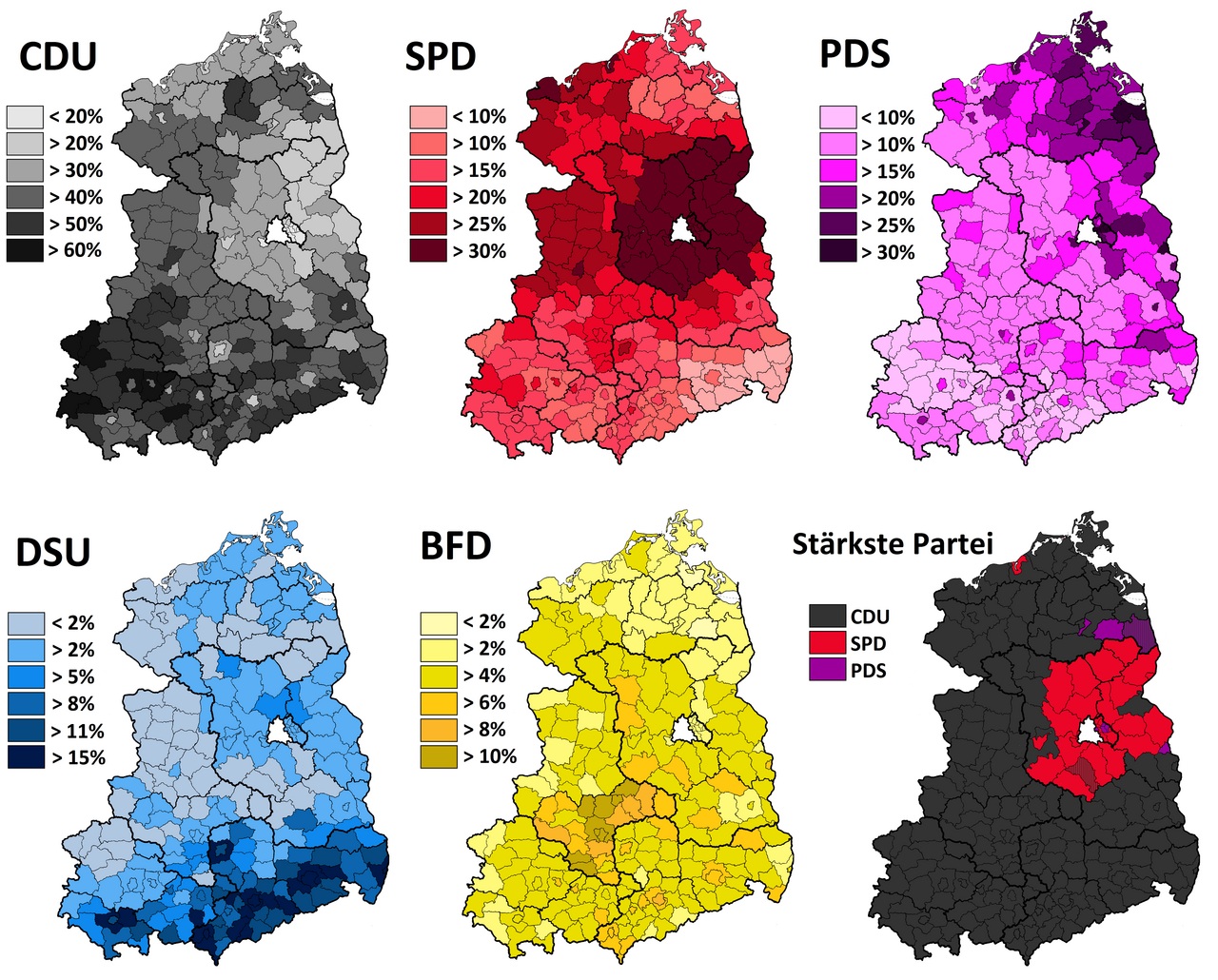
- Won ~48% of the vote (dominant victory)
Social Democratic Party (SPD – East Germany)
- Newly revived independent party (not controlled like pre-1989)
- Historically linked to pre-war German social democracy
Position:
- Supported reunification, but:
- Wanted a slower, negotiated process
- Favored a more gradual economic transition
Result:
- ~22% of the vote (much lower than expected)
Party of Democratic Socialism (PDS)
Successor to the ruling party:
- Former Socialist Unity Party of Germany
- Renamed and reformed after 1989
Position:
- Democratic socialism
- Preserve some GDR social structures
- Opposed rapid absorption by West Germany
Result:
- ~16% of the vote
Stronger than many expected, but far from power
Alliance 90 / Greens / Civil Rights Groups
- Originated from:
- Protest movements
- Dissidents
- Church-based opposition
Position:
- Democratic reform of the GDR
- Environmental protection
- Often skeptical of rapid reunification
Result:
- Performed poorly (fragmented and less organized)
Liberal Parties
- LDPD (former block party, now independent)
- FDP-linked groups
Position:
- Liberal democracy
- Market reforms
- Generally pro-reunification
What Happened to the SED?
The ruling party underwent a rapid transformation:
Late 1989:
- Leadership collapsed (e.g., fall of Erich Honecker earlier in 1989)
- Public anger toward the party was intense
Rebranding:
- Renamed: SED → SED-PDS → PDS (Party of Democratic Socialism)
Changes:
- Dropped official Marxist-Leninist orthodoxy
- Promised democratic reforms
- Tried to distance itself from:
- The Stasi
- Authoritarian rule
Reality:
- Still associated with:
- Repression
- Economic failure
Despite this, it retained a core base of support, especially among:
- Older voters
- Those worried about economic collapse
West German Influence (“Interference”)
West Germany played a major and decisive role.
Political Support
West German parties directly supported their East German counterparts:
- West German CDU (led by Helmut Kohl) backed the East CDU and Alliance for Germany
- West German SPD supported East SPD
- Funding, advisors, and campaign expertise flowed in
This gave pro-reunification parties a huge advantage.
Economic Pressure & Promises
A key factor was the promise of:
- Rapid introduction of the Deutsche Mark
- Access to West German living standards
- Economic stabilization
Kohl’s government strongly signaled: “Vote for fast reunification = faster economic help”
Media Influence
- West German television was widely watched in East Germany
- Campaign messaging from the West reached voters directly
Expected Outcome vs Reality
What Many Expected
Before the election:
- The SPD was widely expected to win or lead
- Reformist, gradual reunification seemed likely
- Civil rights groups were highly visible after the 1989 revolution
Many thought voters would choose cautious transition.
What Actually Happened
The result was a decisive vote for speed:
- Alliance for Germany (pro-rapid reunification) won clearly.
- SPD underperformed significantly
- Reformist groups were marginalized
Why the Surprise?
Economic Fear
- GDR economy was collapsing
- People feared:
- Unemployment
- Shortages
- West Germany looked like stability
Currency Issue
- The Deutsche Mark became the central issue
- Seen as:
- Security
- Prosperity
- Immediate improvement in daily life
Loss of Faith in Reform
- Many no longer believed the GDR could be “fixed”
- Preferred joining a functioning system instead
Consequences of the Election
The new government:
- Led by Lothar de Maizière (CDU)
- Immediately pursued:
Monetary Union (mid-1990)
- East Germany adopted the West German currency
Political Integration
- Negotiations with West Germany accelerated
Final Outcome:
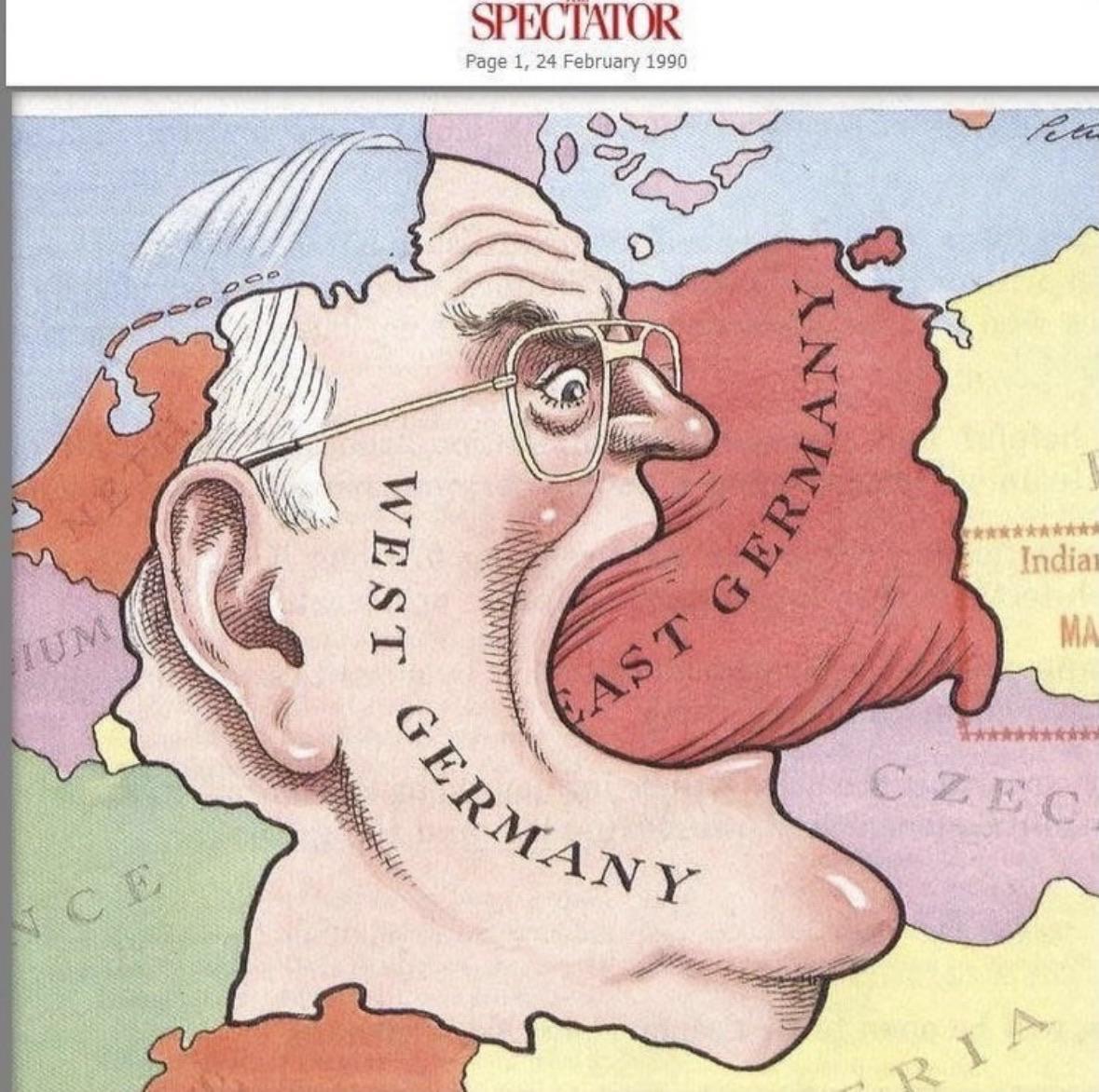
German reunification (October 3, 1990)
As shown here:




Leave a Reply