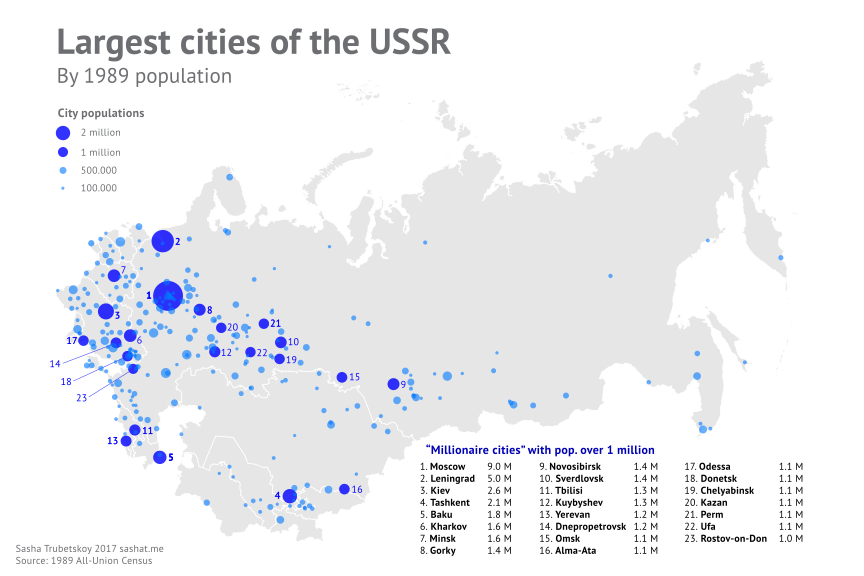
The map above shows the 296 largest Soviet cities with a population of over 100,000 people in 1989.
The 23 largest with over 1 million people are named on the map.
The map above and the one below are both the work of Sasha Trubetskoy, one of my favourite map makers. He explained why made the map:
When I was looking for the Soviet Union’s largest cities, I couldn’t find any good list, let alone a map. Strange, I thought, considering that Russian Wikipedia seems to have incredibly detailed records of every Soviet city’s population.
And yet, nobody had collected them in one place.
I managed to find a report titled Статистика для всех (“Statistics For Everyone”) that summarizes the results of the 1989 Soviet Union Census.
Inside it was a list of cities, which amazingly enough was digitized so I could just copy and paste the data into a spreadsheet.
After some cleaning, some geocoding (God bless Nominatim), and some head-scratching with python’s Basemap, I came up with these maps. The text was added later using Adobe Illustrator, because Matplotlib’s text features are very frustrating.
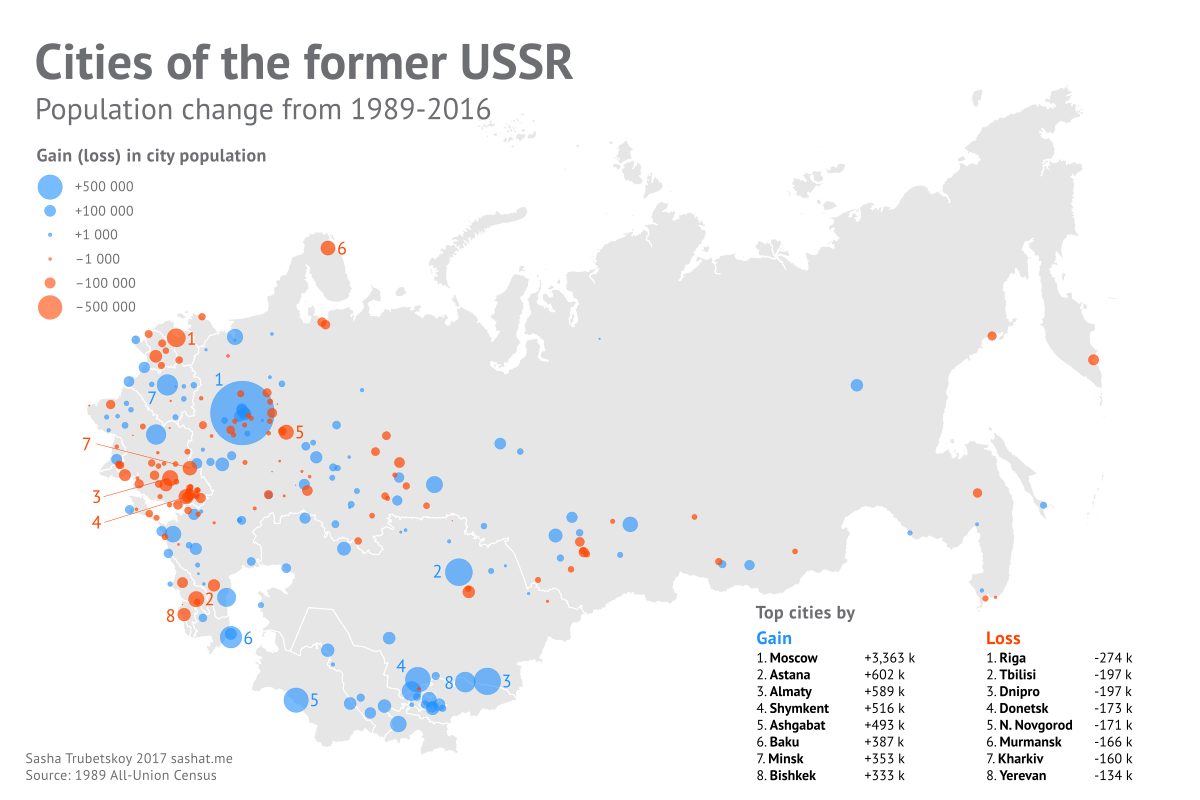
Below you can see how these cities did in terms of growth and decline up until 2016:
Here is the list of the 50 in 1989 and their size in 2016 including absolute and relative population changes:
| Soviet City Name | 1989 pop. | 2016 pop. | Absolute Population Change | Relative Population Change | Soviet Republic | Name Today |
|---|---|---|---|---|---|---|
| Moscow | 8,967,000 | 12,330,126 | 3,363,126 | 37.5% | Russian SFSR | Moscow |
| Leningrad | 5,024,000 | 5,225,690 | 201,690 | 4.0% | Russian SFSR | Saint Petersburg |
| Kiev | 2,587,945 | 2,908,703 | 320,758 | 12.4% | Ukrainian SSR | Kyiv |
| Tashkent | 2,072,459 | 2,371,300 | 298,841 | 14.4% | Uzbek SSR | Tashkent |
| Baku | 1,795,000 | 2,181,800 | 386,800 | 21.5% | Azerbaijan SSR | Baku |
| Kharkov | 1,609,959 | 1,449,700 | -160,259 | -10.0% | Ukrainian SSR | Kharkiv |
| Minsk | 1,607,100 | 1,959,781 | 352,681 | 21.9% | Byelorussian SSR | Minsk |
| Gorky | 1,438,000 | 1,266,871 | -171,129 | -11.9% | Russian SFSR | Nizhny Novgorod |
| Novosibirsk | 1,437,000 | 1,584,138 | 147,138 | 10.2% | Russian SFSR | Novosibirsk |
| Sverdlovsk | 1,365,000 | 1,444,439 | 79,439 | 5.8% | Russian SFSR | Yekaterinburg |
| Tbilisi | 1,259,692 | 1,062,282 | -197,410 | -15.7% | Georgian SSR | Tbilisi |
| Kuybyshev | 1,254,000 | 1,170,910 | -83,090 | -6.6% | Russian SFSR | Samara |
| Yerevan | 1,201,500 | 1,068,000 | -133,500 | -11.1% | Armenian SSR | Yerevan |
| Dnepropetrovsk | 1,177,897 | 980,825 | -197,072 | -16.7% | Ukrainian SSR | Dnipro |
| Omsk | 1,149,000 | 1,178,079 | 29,079 | 2.5% | Russian SFSR | Omsk |
| Alma-Ata | 1,127,884 | 1,716,779 | 588,895 | 52.2% | Kazakh SSR | Almaty |
| Odessa | 1,115,371 | 1,008,311 | -107,060 | -9.6% | Ukrainian SSR | Odessa |
| Donetsk | 1,109,102 | 936,257 | -172,845 | -15.6% | Ukrainian SSR | Donetsk |
| Chelyabinsk | 1,107,000 | 1,183,000 | 76,000 | 6.9% | Russian SFSR | Chelyabinsk |
| Kazan | 1,094,000 | 1,206,000 | 112,000 | 10.2% | Russian SFSR | Kazan |
| Perm | 1,091,000 | 1,036,000 | -55,000 | -5.0% | Russian SFSR | Perm |
| Ufa | 1,082,000 | 1,106,000 | 24,000 | 2.2% | Russian SFSR | Ufa |
| Rostov-on-Don | 1,019,000 | 1,115,000 | 96,000 | 9.4% | Russian SFSR | Rostov-on-Don |
| Volgograd | 999,000 | 1,017,000 | 18,000 | 1.8% | Russian SFSR | Volgograd |
| Riga | 915,106 | 641,007 | -274,099 | -30.0% | Latvian SSR | Riga |
| Saratov | 902,000 | 842,000 | -60,000 | -6.7% | Russian SFSR | Saratov |
| Zaporozhye | 883,909 | 756,900 | -127,009 | -14.4% | Ukrainian SSR | Zaporizhia |
| Voronezh | 882,000 | 1,024,000 | 142,000 | 16.1% | Russian SFSR | Voronezh |
| Krasnoyarsk | 869,000 | 1,052,000 | 183,000 | 21.1% | Russian SFSR | Krasnoyarsk |
| Lvov | 790,908 | 728,300 | -62,608 | -7.9% | Ukrainian SSR | Lviv |
| Kishinev | 722,000 | 809,600 | 87,600 | 12.1% | Moldavian SSR | Chisinau |
| Krivoy Rog | 713,059 | 647,727 | -65,332 | -9.2% | Ukrainian SSR | Kryvyi Rih |
| Izhevsk | 635,000 | 642,000 | 7,000 | 1.1% | Russian SFSR | Izhevsk |
| Vladivostok | 631,000 | 605,000 | -26,000 | -4.1% | Russian SFSR | Vladivostok |
| Tolyatti | 629,000 | 720,000 | 91,000 | 14.5% | Russian SFSR | Tolyatti |
| Yaroslavl | 629,000 | 604,000 | -25,000 | -4.0% | Russian SFSR | Yaroslavl |
| Ulyanovsk | 624,000 | 619,000 | -5,000 | -0.8% | Russian SFSR | Ulyanovsk |
| Krasnodar | 619,000 | 830,000 | 211,000 | 34.1% | Russian SFSR | Krasnodar |
| Karaganda | 613,797 | 496,173 | -117,624 | -19.2% | Kazakh SSR | Karaganda |
| Frunze | 611,000 | 944,300 | 333,300 | 54.5% | Kirghiz SSR | Bishkek |
| Barnaul | 599,000 | 636,000 | 37,000 | 6.2% | Russian SFSR | Barnaul |
| Khabarovsk | 598,000 | 607,000 | 9,000 | 1.5% | Russian SFSR | Khabarovsk |
| Dushanbe | 595,820 | 802,700 | 206,880 | 34.7% | Tajik SSR | Dushanbe |
| Novokuznetsk | 583,000 | 550,000 | -33,000 | -5.7% | Russian SFSR | Novokuznetsk |
| Vilnius | 576,747 | 539,939 | -36,808 | -6.4% | Lithuanian SSR | Vilnius |
| Irkutsk | 573,000 | 620,000 | 47,000 | 8.2% | Russian SFSR | Irkutsk |
| Tula | 540,000 | 488,000 | -52,000 | -9.6% | Russian SFSR | Tula |
| Penza | 522,000 | 523,000 | 1,000 | 0.2% | Russian SFSR | Penza |
| Mariupol | 518,933 | 455,063 | -63,870 | -12.3% | Ukrainian SSR | Mariupol |
| Orenburg | 517,000 | 561,000 | 44,000 | 8.5% | Russian SFSR | Orenburg |
Moscow has experienced the most dramatic growth since 1989, adding 3.3 million people as it continued to attract migrants—even after the USSR dissolved—thanks to its economic opportunities.
While Moscow and St. Petersburg remain on par with Western cities, other capitals like Kyiv and Minsk have seen similar, albeit smaller, gains.
In Central Asia, cities such as Astana, Almaty, and Shymkent have also grown rapidly.
These regions avoided the steep fertility decline seen in other parts of the former Soviet Union and benefited from both natural population growth and rural migration.
Conversely, several regions have seen significant population losses.
Riga, the capital of Latvia, is the biggest loser, largely due to EU-facilitated emigration and the return of ethnic Russians.
Eastern and southern Ukraine have also lost many residents (remember this map was made pre-war), particularly in Russian-speaking areas where locals migrated to the West or Moscow.
Similar declines are observed in parts of Georgia, Armenia, and smaller cities near Moscow, which have been overshadowed by the capital’s pull.
Industrial cities, such as Nizhny Novgorod and those in the Kuznetsk Basin, have struggled in the transition to a free-market economy, mirroring trends seen in America’s Rust Belt.
Additionally, the Far North—once bolstered by Soviet-era incentives like the “Northern Bonus”—has seen cities like Murmansk lose population as those benefits disappeared.
However, some northern cities like Surgut, Nizhnevartovsk, and Yakutsk have bucked the trend, buoyed by booming industries and internal migration from rural areas.
What do you think of this map?






Leave a Reply