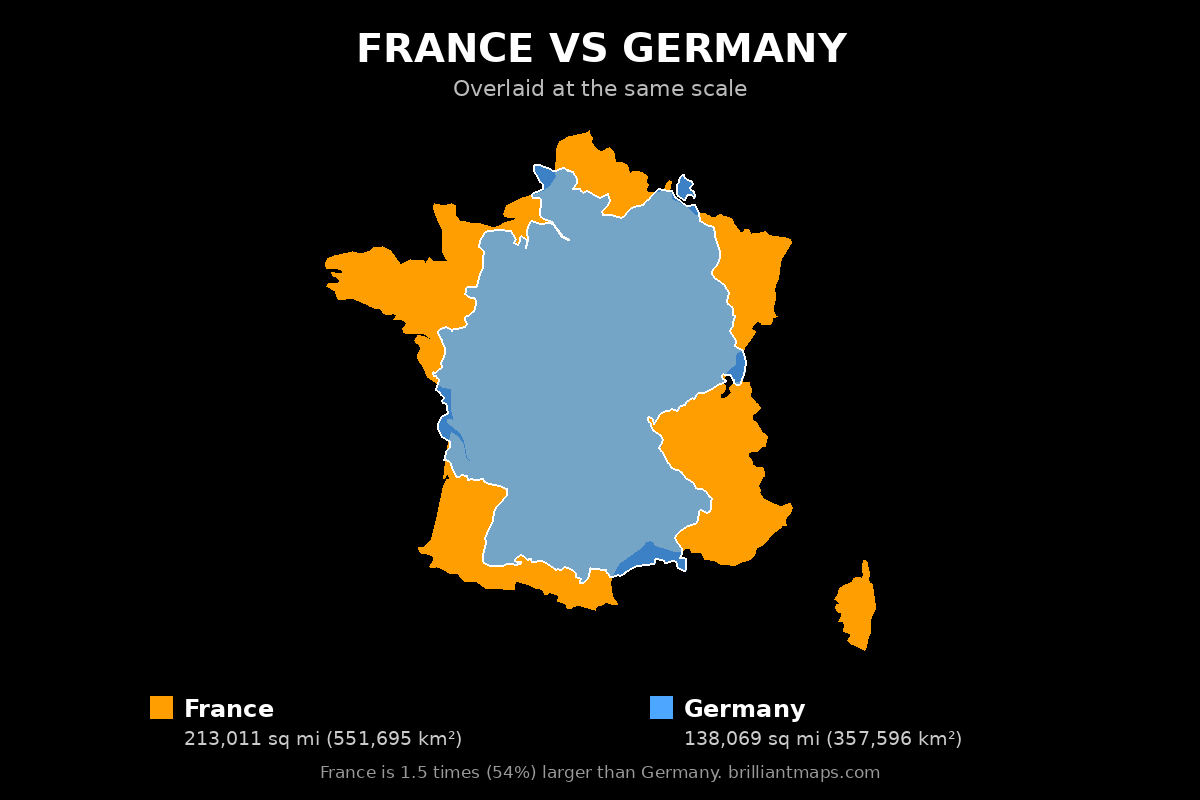
The map above shows France and Germany side by side at exactly the same scale, using equal-area projections, so their true relative sizes are preserved.
France vs Germany Geography
Land area
- France has a land area of 210,016 square miles (543,940 km²), while Germany has 134,623 square miles (348,672 km²).
- France's land area is 1.6 times (56%) larger than Germany's.
Total area
- France: 213,011 square miles (551,695 km²) vs Germany: 138,069 square miles (357,596 km²), including inland and coastal water.
- France's total area is 1.5 times (54%) larger than Germany's.
Length
- France is 742 miles (1,194 km) long from north to south; Germany is 531 miles (854 km).
- France's north-south length is 1.4 times (40%) longer than Germany's.
Width
- France spans 818 miles (1,316 km) east to west; Germany spans 397 miles (639 km).
- France's east-west width is 2.1 times (106%) wider than Germany's.
Highest point
- France's highest point is Mont Blanc at 15,778 feet (4,809 m); Germany's is Zugspitze at 9,718 feet (2,962 m).
- Mont Blanc is 6,060 feet higher than Zugspitze.
Lowest point
- France's lowest point is Etang de Lavalduc at -33 feet; Germany's is Neuendorf-Sachsenbande at -13 feet.
- France's lowest point is 20 feet lower.
France vs Germany Population and History
Population
- France has a population of 69,081,996 (2026), while Germany has 83,467,117 (2025).
- Germany's population is 1.2 times (21%) larger than France's.
Population density
- France: 328.9 people per square mile vs Germany: 620.0.
- Germany's population density is 1.9 times (89%) higher than France's.
Biggest city
- France's biggest city is Paris with 2,148,271 people; Germany's is Berlin with 3,878,100.
- Berlin's population is 1.8 times (81%) larger than Paris'.
Largest metro area
- France's largest metropolitan area is Paris (9,381,921 people) vs Germany's Berlin metropolitan region (6,200,000).
- Paris' population is 1.5 times (51%) larger than Berlin metropolitan region's.
History
- France: An independent state since the Treaty of Verdun in 843; the current Fifth Republic dates from 1958.
- Germany: Unified on January 18, 1871; the current Federal Republic dates from 1949, reunified in 1990.
- In its current form, France is the older of the two by 1,028 years.
France vs Germany Economy
GDP
- France's GDP is $3,366.3 billion (2025) vs Germany's $5,050.9 billion.
- Germany's economic output is 1.5 times (50%) larger than France's.
GDP per capita
- France: $48,986 per person vs Germany: $60,496.
- Germany's GDP per capita is 1.2 times (23%) higher than France's.
Average income
- France: $48,630 vs Germany: $60,200 average income per person (per capita personal income).
- Germany's average income is 1.2 times (24%) higher than France's.
Official Websites
France official website · Germany official website
Download the France vs Germany Size Comparison Map for free
To download the map, right-click the image above (or press and hold on a phone or tablet) and choose Save image as. The map is free to use anywhere, including on your own website or in print, as long as you credit it with a link back to this page or to BrilliantMaps.com.
More Size Comparisons
All France size comparisons · All Germany size comparisons
Area, elevation and boundary figures come from official national statistics and US Census Bureau and Natural Earth boundary data; US state population, economic, county and tax figures come from the US Census Bureau, the Bureau of Economic Analysis and the Tax Foundation. Figures are rounded and for general reference.