
Here they are ranked by the numbers:
- 6,450 words in Turkish derive from Arabic.
- 4,000 words in Spanish derive from Arabic.
- 500 words in English derive from Arabic.
- 500 words in French derive from Arabic.
- 500 words in Portuguese derive from Arabic.
- 400 words in Italian derive from Arabic.
- 150 words in Russian derive from Arabic.
- 100 words in Greek derive from Arabic.
Here are 10 English words that have Arabic origins:
- Alcohol – From the Arabic “al-kuḥl,” which originally referred to a powdered cosmetic.
- Alchemy – From the Arabic “al-kīmiyā,” referring to the early form of chemistry.
- Algorithm – Derived from “al-Khwārizmī,” the name of a Persian mathematician.
- Cotton – From the Arabic “quṭn,” which refers to the cotton plant.
- Sugar – From the Arabic “sukkar,” which comes from Persian “shakar.”
- Coffee – From the Arabic “qahwa,” referring to the drink.
- Magazine – From the Arabic “makhāzin,” meaning “storehouses.”
- Sofa – From the Arabic “ṣuffa,” which means a platform or bench.
- Admiral – From the Arabic “amīr al-baḥr,” meaning “commander of the sea.”
- Safari – From the Arabic “safar,” meaning “journey” or “travel.”
From the map creator:
The estimated number of words that derive from Arabic in selected languages, as illustrated above, showcases the significant linguistic influence Arabic has had on these languages over centuries of cultural exchange and historical interactions.
*Maltese is not included here as the words in Maltese are inherited (it descends from Siculo-Arabic).
Source: Lexico ton Xenon Lexeon stin Ellinikí Glóssa, Türk Dil Kurumu, Oxford Dictionary, and The Royal Spanish Academy (RAE).
And finally here’s an alternative map with slight different numbers:
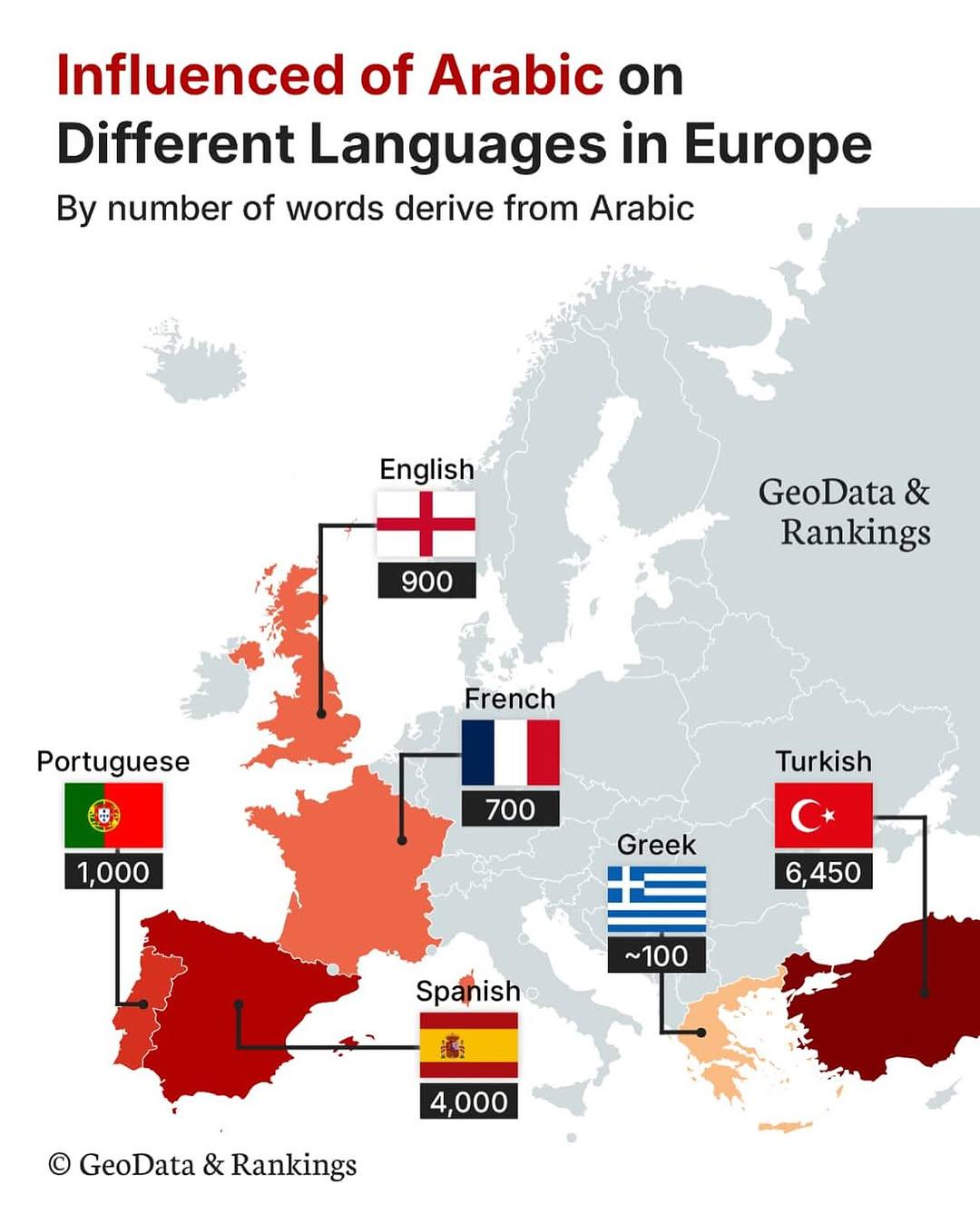
Did any of the languages surprise you? If so which one(s)?




Lans Bayoh says
Coffee is not coming from Arabic but from Ethiopic and was discovered growing wild and the cultivated. “ the Kaffa region of Ethiopia.
Key points about Kaffa and coffee:
Origin of coffee:
The “Kaffa” region is widely accepted as the place where coffee was first discovered, with the coffee plant growing wild in its forests.
Wild coffee:
Much of the coffee grown in Kaffa is considered “forest coffee” as it grows naturally in the undergrowth of the forest without extensive cultivation.
Unique taste:
Kaffa coffee is often described as having a distinct flavor profile due to the unique growing conditions in the region.
Etymology:
The word “coffee” is believed to be derived from “Kaffa
Steve Hodgson says
I would have been interested in the data for the Maltese language. Maltese is a Semitic language written in European script. Spoked Maltese is very close to Arabic — to the point where they can understand each other.