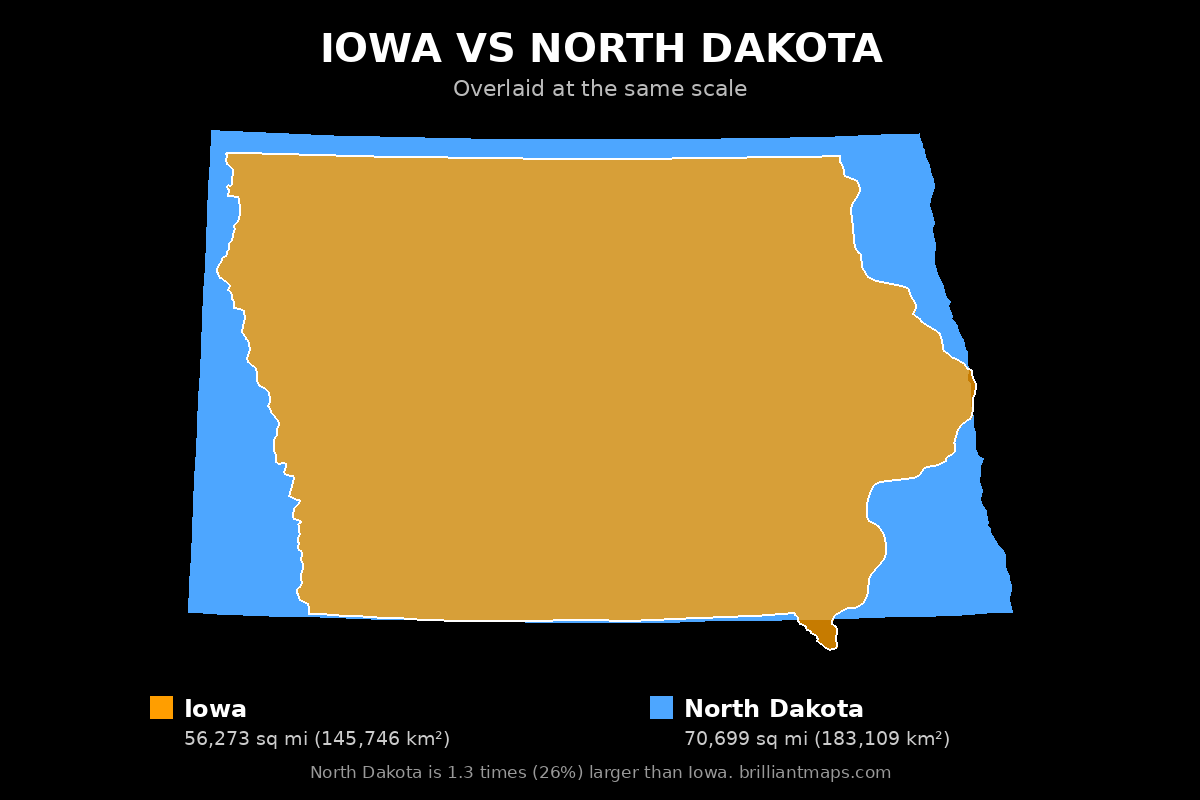
The map above shows Iowa and North Dakota side by side at exactly the same scale, using equal-area projections, so their true relative sizes are preserved.
Iowa vs North Dakota Geography
Land area
- Iowa has a land area of 55,854 square miles (144,660 km²), while North Dakota has 68,994 square miles (178,694 km²).
- North Dakota's land area is 1.2 times (24%) larger than Iowa's.
Total area
- Iowa: 56,273 square miles (145,746 km²) vs North Dakota: 70,699 square miles (183,109 km²), including inland and coastal water.
- North Dakota's total area is 1.3 times (26%) larger than Iowa's.
Length
- Iowa is 216 miles (347 km) long from north to south; North Dakota is 338 miles (544 km).
- North Dakota's north-south length is 1.6 times (56%) longer than Iowa's.
Width
- Iowa spans 335 miles (539 km) east to west; North Dakota spans 408 miles (657 km).
- North Dakota's east-west width is 1.2 times (22%) wider than Iowa's.
Highest point
- Iowa's highest point is Hawkeye Point at 1,669 feet (509 m); North Dakota's is White Butte at 3,500 feet (1,067 m).
- White Butte is 1,831 feet higher than Hawkeye Point.
Lowest point
- Iowa's lowest point is Mississippi River at 480 feet; North Dakota's is Red River of the North at 754 feet.
- Iowa's lowest point is 274 feet lower.
Iowa vs North Dakota Population and History
Population
- Iowa has a population of 3,241,488 (2024), while North Dakota has 796,568 (2024).
- Iowa's population is 4.1 times (307%) larger than North Dakota's.
Population density
- Iowa: 58.0 people per square mile vs North Dakota: 11.5.
- Iowa's population density is 5.0 times (404%) higher than North Dakota's.
Biggest city
- Iowa's biggest city is Des Moines with 213,096 people; North Dakota's is Fargo with 136,285.
- Des Moines' population is 1.6 times (56%) larger than Fargo's.
Largest metro area
- Iowa's largest metropolitan area is Omaha, NE-IA metro area (1,001,010 people) vs North Dakota's Fargo, ND-MN metro area (267,793).
- Omaha, NE-IA metro area's population is 3.7 times (274%) larger than Fargo, ND-MN metro area's.
History
- Iowa: Admitted to the Union on December 28, 1846, as the 29th state.
- North Dakota: Admitted to the Union on November 2, 1889, as the 39th state.
- In its current form, Iowa is the older of the two by 43 years.
Iowa vs North Dakota Economy
GDP
- Iowa's GDP is $265.8 billion (2024) vs North Dakota's $80.1 billion.
- Iowa's economic output is 3.3 times (232%) larger than North Dakota's.
GDP per capita
- Iowa: $81,998 per person vs North Dakota: $100,504.
- North Dakota's GDP per capita is 1.2 times (23%) higher than Iowa's.
Average income
- Iowa: $65,225 vs North Dakota: $71,749 average income per person (per capita personal income).
- North Dakota's average income is 1.1 times (10%) higher than Iowa's.
Iowa vs North Dakota Counties
Number of counties
- Iowa has 99 counties, while North Dakota has 53.
- Iowa's county count is 1.9 times (87%) higher than North Dakota's.
Biggest county by area
- Iowa's largest county is Kossuth County at 973 square miles; North Dakota's is McKenzie County at 2,760 square miles.
- McKenzie County's land area is 2.8 times (184%) larger than Kossuth County's.
Smallest county by area
- Iowa: Dickinson County (381 sq mi) vs North Dakota: Eddy County (630 sq mi).
- Eddy County's land area is 1.7 times (66%) larger than Dickinson County's.
Most populous county
- Iowa: Polk County (516,185 people) vs North Dakota: Cass County (200,945 people).
- Polk County's population is 2.6 times (157%) larger than Cass County's.
Least populous county
- Iowa: Adams County (3,606 people) vs North Dakota: Slope County (660 people).
- Adams County's population is 5.5 times (446%) larger than Slope County's.
Richest county
- Iowa: Mitchell County ($98,211 per capita income) vs North Dakota: Dunn County ($99,793).
- Mitchell County and Dunn County have about the same income.
Poorest county
- Iowa: Decatur County ($46,134 per capita income) vs North Dakota: Sioux County ($33,782).
- Decatur County's income is 1.4 times (37%) richer than Sioux County's.
Iowa vs North Dakota Taxes
State income tax
- Iowa has a top income tax rate of 3.8%, while North Dakota has a top income tax rate of 2.5%.
- Iowa's top rate is 1.3 percentage points higher.
Property tax
- Iowa: 1.29% effective rate vs North Dakota: 0.96% of home value per year.
- Iowa's rate is 0.33 percentage points higher.
Sales tax
- Iowa: 6.94% combined state and average local rate vs North Dakota: 7.09%.
- North Dakota's combined rate is 0.15 percentage points higher.
Official Websites
Iowa official website · North Dakota official website
Download the Iowa vs North Dakota Size Comparison Map for free
To download the map, right-click the image above (or press and hold on a phone or tablet) and choose Save image as. The map is free to use anywhere, including on your own website or in print, as long as you credit it with a link back to this page or to BrilliantMaps.com.
More Size Comparisons
All Iowa size comparisons · All North Dakota size comparisons
Area, elevation and boundary figures come from official national statistics and US Census Bureau and Natural Earth boundary data; US state population, economic, county and tax figures come from the US Census Bureau, the Bureau of Economic Analysis and the Tax Foundation. Figures are rounded and for general reference.