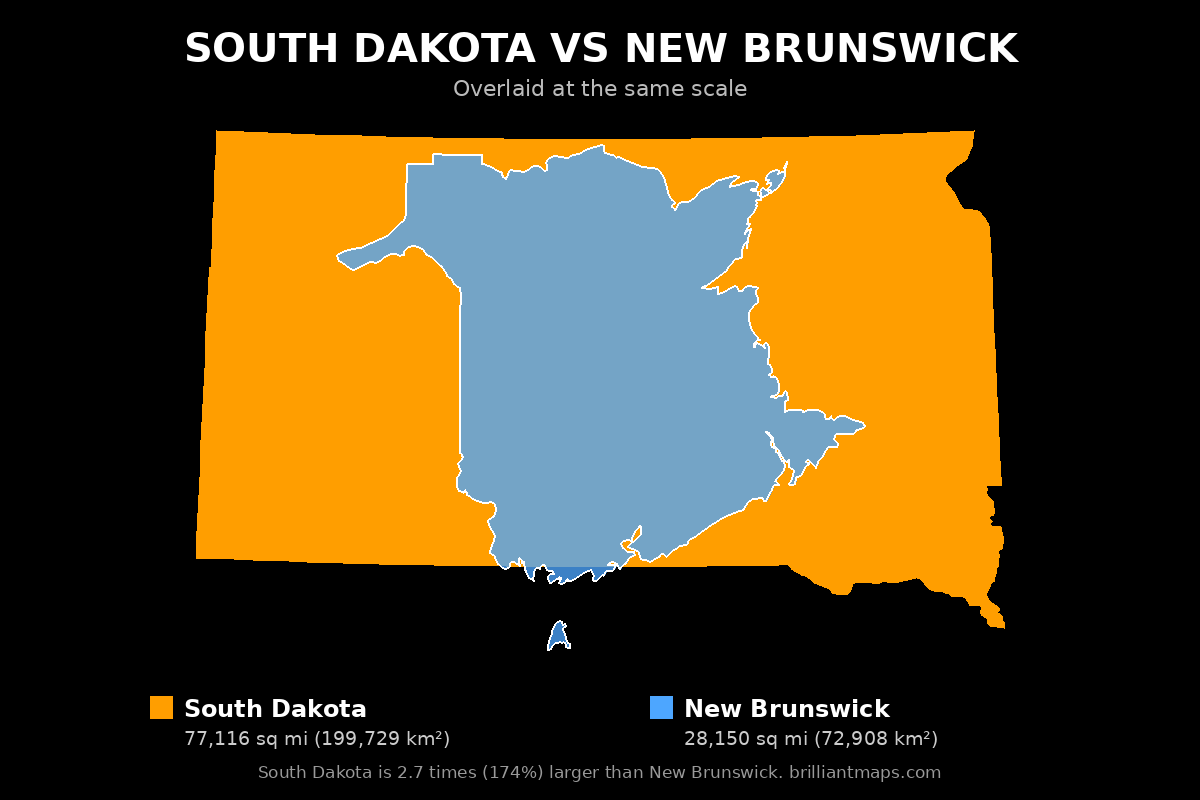
The map above shows South Dakota and New Brunswick side by side at exactly the same scale, using equal-area projections, so their true relative sizes are preserved.
South Dakota vs New Brunswick Geography
Land area
- South Dakota has a land area of 75,808 square miles (196,342 km²), while New Brunswick has 27,587 square miles (71,450 km²).
- South Dakota's land area is 2.7 times (175%) larger than New Brunswick's.
Total area
- South Dakota: 77,116 square miles (199,729 km²) vs New Brunswick: 28,150 square miles (72,908 km²), including inland and coastal water.
- South Dakota's total area is 2.7 times (174%) larger than New Brunswick's.
Length
- South Dakota is 443 miles (712 km) long from north to south; New Brunswick is 241 miles (388 km).
- South Dakota's north-south length is 1.8 times (84%) longer than New Brunswick's.
Width
- South Dakota spans 371 miles (597 km) east to west; New Brunswick spans 264 miles (424 km).
- South Dakota's east-west width is 1.4 times (41%) wider than New Brunswick's.
Highest point
- South Dakota's highest point is Black Elk Peak at 7,198 feet (2,194 m); New Brunswick's is Mount Carleton at 2,680 feet (817 m).
- Black Elk Peak is 4,518 feet higher than Mount Carleton.
Lowest point
- South Dakota's lowest point is Big Stone Lake at 966 feet; New Brunswick's is Atlantic Ocean at 0 feet.
- New Brunswick's lowest point is 966 feet lower.
South Dakota vs New Brunswick Population and History
Population
- South Dakota has a population of 924,669 (2024), while New Brunswick has 867,383 (2026).
- South Dakota's population is 1.1 times (7%) larger than New Brunswick's.
Population density
- South Dakota: 12.2 people per square mile vs New Brunswick: 31.4.
- New Brunswick's population density is 2.6 times (157%) higher than South Dakota's.
Biggest city
- South Dakota's biggest city is Sioux Falls with 209,289 people; New Brunswick's is Moncton with 79,470.
- Sioux Falls' population is 2.6 times (163%) larger than Moncton's.
Largest metro area
- South Dakota's largest metropolitan area is Sioux Falls, SD-MN metro area (308,266 people) vs New Brunswick's Moncton CMA (157,717).
- Sioux Falls, SD-MN metro area's population is 2.0 times (95%) larger than Moncton CMA's.
History
- South Dakota: Admitted to the Union on November 2, 1889, as the 40th state.
- New Brunswick: Joined Confederation on July 1, 1867, as one of the four founding provinces.
- In its current form, New Brunswick is the older of the two by 22 years.
South Dakota vs New Brunswick Economy
GDP
- South Dakota's GDP is $76.8 billion (2024) vs New Brunswick's $35.3 billion.
- South Dakota's economic output is 2.2 times (118%) larger than New Brunswick's.
GDP per capita
- South Dakota: $83,052 per person vs New Brunswick: $41,088.
- South Dakota's GDP per capita is 2.0 times (102%) higher than New Brunswick's.
Official Websites
South Dakota official website · New Brunswick official website
Download the South Dakota vs New Brunswick Size Comparison Map for free
To download the map, right-click the image above (or press and hold on a phone or tablet) and choose Save image as. The map is free to use anywhere, including on your own website or in print, as long as you credit it with a link back to this page or to BrilliantMaps.com.
More Size Comparisons
All South Dakota size comparisons · All New Brunswick size comparisons
Area, elevation and boundary figures come from official national statistics and US Census Bureau and Natural Earth boundary data; US state population, economic, county and tax figures come from the US Census Bureau, the Bureau of Economic Analysis and the Tax Foundation. Figures are rounded and for general reference.