The map above shows British Columbia and New Zealand side by side at exactly the same scale, using equal-area projections, so their true relative sizes are preserved.
British Columbia vs New Zealand Geography
Land area
- British Columbia has a land area of 357,216 square miles (925,186 km²), while New Zealand has 102,138 square miles (264,537 km²).
- British Columbia's land area is 3.5 times (250%) larger than New Zealand's.
Total area
- British Columbia: 364,764 square miles (944,735 km²) vs New Zealand: 103,799 square miles (268,838 km²), including inland and coastal water.
- British Columbia's total area is 3.5 times (251%) larger than New Zealand's.
Length
- British Columbia is 1,017 miles (1,637 km) long from north to south; New Zealand is 1,185 miles (1,908 km).
- New Zealand's north-south length is 1.2 times (17%) longer than British Columbia's.
Width
- British Columbia spans 1,245 miles (2,003 km) east to west; New Zealand spans 969 miles (1,559 km).
- British Columbia's east-west width is 1.3 times (28%) wider than New Zealand's.
Highest point
- British Columbia's highest point is Mount Fairweather at 15,299 feet (4,663 m); New Zealand's is Aoraki / Mount Cook at 12,218 feet (3,724 m).
- Mount Fairweather is 3,081 feet higher than Aoraki / Mount Cook.
Lowest point
- British Columbia's lowest point is Pacific Ocean at 0 feet; New Zealand's is Taieri Plains at -7 feet.
- New Zealand's lowest point is 7 feet lower.
British Columbia vs New Zealand Population and History
Population
- British Columbia has a population of 5,658,528 (2026), while New Zealand has 5,357,300 (2026).
- British Columbia's population is 1.1 times (6%) larger than New Zealand's.
Population density
- British Columbia: 15.8 people per square mile vs New Zealand: 52.5.
- New Zealand's population density is 3.3 times (232%) higher than British Columbia's.
Largest metro area
- British Columbia's largest metropolitan area is Vancouver CMA (2,642,825 people) vs New Zealand's Auckland Region (1,715,600).
- Vancouver CMA's population is 1.5 times (54%) larger than Auckland Region's.
History
- British Columbia: Joined Confederation on July 20, 1871.
- New Zealand: A dominion from September 26, 1907; fully independent by statute in 1947.
- In its current form, British Columbia is the older of the two by 36 years.
British Columbia vs New Zealand Economy
GDP
- British Columbia's GDP is $313.3 billion (2024) vs New Zealand's $264.1 billion.
- British Columbia's economic output is 1.2 times (19%) larger than New Zealand's.
GDP per capita
- British Columbia: $55,241 per person vs New Zealand: $49,591.
- British Columbia's GDP per capita is 1.1 times (11%) higher than New Zealand's.
Official Websites
British Columbia official website · New Zealand official website
Download the British Columbia vs New Zealand Size Comparison Map for free
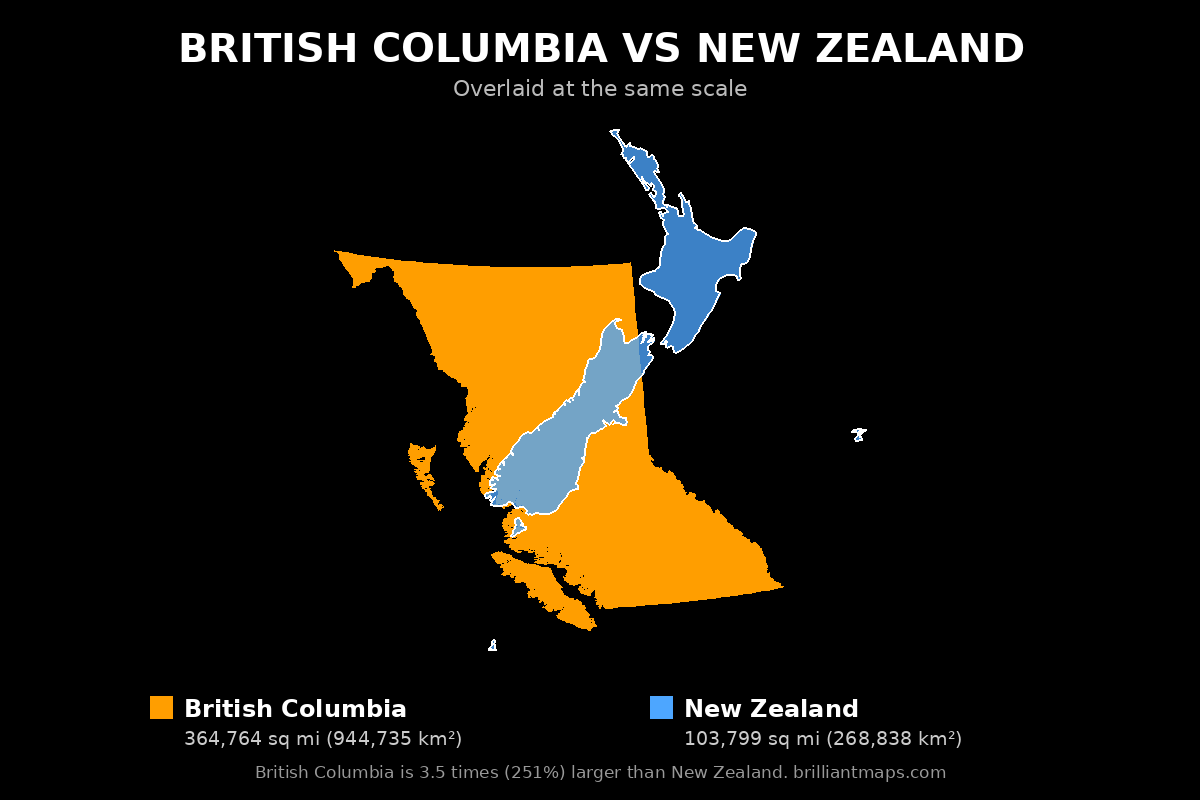
To download the map, right-click the image above (or press and hold on a phone or tablet) and choose Save image as. The map is free to use anywhere, including on your own website or in print, as long as you credit it with a link back to this page or to BrilliantMaps.com.
More Size Comparisons
All British Columbia size comparisons · All New Zealand size comparisons
Area, elevation and boundary figures come from official national statistics and US Census Bureau and Natural Earth boundary data; US state population, economic, county and tax figures come from the US Census Bureau, the Bureau of Economic Analysis and the Tax Foundation. Figures are rounded and for general reference.